56Tons Wood-Based PAC for Edible Oil: South Africa Case Study

56 tons of wood-based powdered activated carbon, shipped in two 40-foot containers to a South African edible oil processor. The carbon was used for decolorization and impurity removal during oil refining — one of the most demanding PAC applications in the food industry.

This case study covers the client's requirements, why wood-based PAC outperforms alternatives for edible oil, and how Huamei Carbon delivered from first inquiry to final shipment in under 8 weeks.

Client Background: Edible Oil Refining in South Africa

Item Details
Industry Edible oil processing
تطبيق Decolorization & impurity removal in oil refining
Key concern Color removal efficiency + product purity after filtration
Order quantity 56 tons (2 × 40ft containers, 28 tons each)
منتج Wood-based powdered activated carbon
Destination South Africa

The client produces refined edible oil and needed a reliable PAC supplier that could deliver consistent decolorization performance across large production batches. Their previous carbon supplier had inconsistent quality — batch-to-batch variation in color removal meant frequent production adjustments and higher product loss.

Why Wood-Based PAC for Edible Oil Decolorization

Edible oil refining is one of the most PAC-intensive food processing applications. During the bleaching stage, powdered activated carbon is mixed directly into the oil to adsorb pigments (carotenoids, chlorophyll), free fatty acids, and trace contaminants like PAHs (polycyclic aromatic hydrocarbons).

Wood-based PAC is the industry standard for edible oil because of its pore structure. Produced through phosphoric acid activation of wood chips, it develops a high proportion of mesopores (2–50 nm) — the exact pore range that captures large organic color molecules in oil.

Property Wood-Based PAC Coal-Based PAC Why it matters for edible oil
Dominant pore type Mesopores Micropores Mesopores capture

large pigment molecules

Methylene blue 150–300 mg/g 80–150 mg/g Higher MB = stronger

decolorization

Ash content ≤6% ≤15% Lower ash = less

contamination in oil

pH Neutral to slightly acidic Alkaline Acidic pH is compatible

with oil refining

Iron content Very low Higher Iron catalyzes oil oxidation

— must be minimal

For this client, we recommended Huamei's wood-based powdered activated carbon with the following specifications:

Parameter Specification
Raw material Wood (sawdust)
Activation method Phosphoric acid
Particle size 200 mesh (95% pass)
Methylene blue ≥17 ml/0.1g
رُطُوبَة ≤10%
Ash content ≤6%

From Inquiry to Order: 5 Days

The entire sales cycle — from first contact to confirmed purchase order — took just two days. Here's the timeline:

August 15: The client sent their initial inquiry, describing their edible oil decolorization requirements. Our technical team reviewed the application details and recommended wood-based PAC with high methylene blue value. We shipped samples the same day via express courier and invited the client to visit our factory.

August 20: The client arrived for a factory visit. We walked them through the full production process — raw material storage, carbonization furnace, activation line, grinding and classification, quality control laboratory, and packaging line. The client inspected our production equipment, testing instruments, and finished product warehouse.

After seeing the production scale and quality control procedures firsthand, the client placed the order on the spot — 56 tons of wood-based PAC, packed in two 40-foot containers.

Loading day: The client personally returned to our factory to supervise the container loading process, verifying product labels, packaging integrity, and container conditions before sealing.

Close-up of wood-based powdered activated carbon texture alongside Carbosorb PAC-1 jumbo bags loaded on pallets inside a shipping container ready for export to South Africa

Shipment Details

Item Details
Total quantity 56tons
Container 2 × 40ft
Loading per container 28 tons
التعبئة والتغليف Jumbo bags (FIBC) on pallets
Documentation COA (Certificate of Analysis) per batch, packing list, commercial invoice

Client Feedback: Less Loss, Better Finished Product

On October 12, the client sent their feedback after running our PAC through full-scale production:

"The product performance is very good. Not only has our processing loss decreased, but the finished oil quality has also improved. We look forward to the next order."

Two specific results the client reported:

In edible oil refining, lower carbon dosage directly translates to less oil loss. Even a small reduction — say from 1.5% to 1.2% of oil volume — saves thousands of dollars per month at industrial production scale.
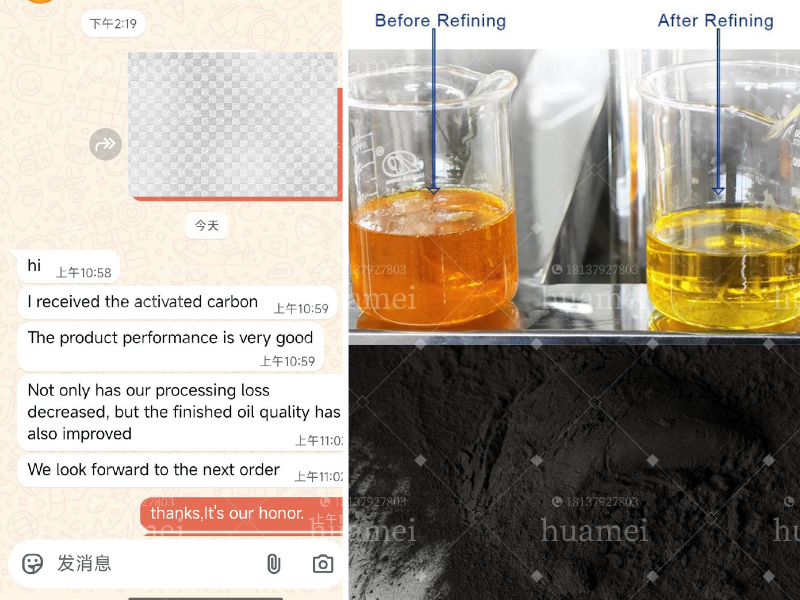
Customer feedback on Huamei powdered activated carbon for edible oil refining, reporting reduced processing loss and improved finished oil quality.

Why Factory Visits Build Trust in Activated Carbon Trade

This case is a good example of how factory visits accelerate procurement decisions. Activated carbon is a product where quality is difficult to verify from a datasheet alone — the same spec sheet can come from a trader reselling unknown product or from a manufacturer with real quality control.

When buyers visit our factory in person, they can verify:

Huamei Carbon welcomes factory visits from all prospective buyers. Our production facilities are located in Fujian and Ningxia, China, approximately 50 km from the nearest export port.

Huamei Wood-Based PAC for Food Processing

Huamei Carbon manufactures wood-based and coal-based powdered activated carbon for edible oil refining, sugar decolorization, beverage purification, glycerin processing, pharmaceutical applications, and water treatment. Our wood-based PAC is produced using phosphoric acid activation of premium wood raw materials, delivering high methylene blue value and low ash content for food-grade applications.

If you need powdered activated carbon for edible oil or other food processing applications, contact us for free samples and a technical consultation:

📱 WhatsApp: +86 181-3792-7803
📧 Email: sale@huameicarbon.com
🌐 Website: www.huameicarbon.com

أسئلة مكررة

What type of activated carbon is best for edible oil refining?

Wood-based powdered activated carbon (PAC) is the industry standard for edible oil decolorization. Its mesoporous structure efficiently adsorbs large pigment molecules like carotenoids and chlorophyll, while its low ash and low iron content prevent contamination of the refined oil.

How much PAC is needed per ton of edible oil?

Typical dosing rates for edible oil decolorization range from 0.5% to 2.0% by weight of oil, depending on the crude oil quality and target color specifications. A bench-scale bleaching test with your actual crude oil is the most reliable way to determine the optimal dose.

What is the minimum order quantity for wood-based PAC?

Huamei Carbon's standard MOQ for wood-based powdered activated carbon is 3 tons. For edible oil processors running continuous production, we typically supply in 20-foot or 40-foot container loads (20–56 tons per container) to ensure uninterrupted supply.

Can I visit the factory before placing an order?

Yes. Huamei Carbon welcomes factory visits from prospective buyers. Our production facilities in Fujian and Ningxia are open for inspection, including the production line, quality control laboratory, and warehouse. We can assist with travel arrangements if needed.

How do you ensure batch-to-batch quality consistency?

Every batch is tested in our in-house laboratory before shipment. A Certificate of Analysis (COA) is provided with every delivery, covering methylene blue value, moisture, ash content, particle size distribution, pH, and iron content. We also support third-party inspection by SGS, Bureau Veritas, or Intertek.

Activated Carbon for Sugar Decolorization: Specs & Guide

Powdered activated carbon (PAC) is the most widely used decolorization agent in sugar refining. It removes color bodies, melanoidins, caramel compounds, and polyphenols from raw sugar liquor — turning dark brown syrup into clear, near-colorless refined sugar below 50 ICUMSA.

The right carbon spec makes the difference between hitting your target color in one pass and burning through double the dosage. This guide covers what specifications matter, how the process works, and what to put in your RFQ.

Why Wood-Based PAC for Sugar

Carbon type Pore structure Decolorization Sugar use
Wood-based PAC Mesopore +

macropore

dominant

✅ Excellent

(large color molecules)

Industry standard
Coconut shell GAC Micropore

dominant

❌ Poor

(pores too small for

color bodies)

Not suitable
Coal-based PAC Mixed (micro

+ meso)

⚠️ Moderate Sometimes used,

inferior to wood

Three forms of activated carbon compared side by side: coal-based granular activated carbon (left), coconut shell granular activated carbon with angular fragments (center), and fine wood-based powder activated carbon (right) — showing particle size differences between GAC and PAC

The chemistry: Sugar color bodies are large organic molecules (MW 500–50,000 daltons). They need mesopores (2–50 nm) and macropores (>50 nm) to physically fit inside the carbon structure. Wood-based carbon has the highest proportion of these larger pores — that's why the sugar industry standardized on it decades ago.

Coconut shell carbon is excellent for water treatment (small molecules like chlorine), but it physically cannot adsorb sugar colorants efficiently. Don't let anyone sell you coconut shell carbon for sugar decolorization — the chemistry doesn't work.

Specifications for Sugar-Grade PAC

Based on actual refinery requirements for producing refined sugar below 50 ICUMSA:

Parameter Specification Test method Why it matters
Raw material Wood (hardwood or softwood) — Determines

pore structure

Form Powder, 90% passing 325 mesh ASTM D2862 Fine particles

= faster kinetics

in batch contact

Iodine number ≥1000 mg/g ASTM D4607 Indicates total adsorption

capacity

Decolorization capacity ≥40% (caramel test) Standard decolorization

test

Direct measure

of color removal ability

Methylene blue ≥200 mg/g — Indicates mesopore volume

(where color bodies adsorb)

Iron content ≤200 ppm — High iron

causes discoloration

Food grade Yes FCC (Food Chemical

Codex)

Required for food-contact

applications

Halal / Kosher Certified (preferred) Third-party auditor Required for export

to Middle East, Southeast Asia

FDA compliance 21 CFR 240.40 — US market

requirement

Critical note on decolorization capacity: The ≥40% spec refers to the standard caramel solution test. Actual performance in real sugar liquor depends on your starting color, temperature, contact time, and dosage. A carbon that scores 40% on the bench test will typically achieve 60–80% color removal in optimized plant conditions.

The Decolorization Process

Standard Batch Contact Process

  1. Liquor preparation — Raw sugar dissolved to 60–65° Brix, heated to 70–85°C
  2. Carbon dosing — PAC added at 0.1–0.5% w/w on dry sugar solids (typical: 0.2–0.3%)
  3. Contact time — 20–45 minutes with agitation
  4. Filtration — Filter press or rotary vacuum filter removes spent carbon
  5. Polish filtration — Secondary filtration catches residual carbon fines
  6. Color check — Measure ICUMSA color; if above spec, adjust dosage for next batch

Key Process Parameters

Parameter Optimal range Effect if too low Effect if too high
Temperature 70–85°C Slow kinetics,

poor color removal

Sugar inversion

(pH-dependent), energy cost

Contact time 20–45 min Incomplete adsorption Minimal improvement

after 30 min, wastes

throughput

Dosage (% on DS) 0.2–0.3% Insufficient

color removal

Wasted carbon, higher

filtration load

Brix 60–65° Dilute = more

volume to process

Viscous = poor

carbon-liquor contact

Dosage economics: At 0.25% dosage on a refinery processing 500 tons/day of raw sugar, carbon consumption is approximately 1.25 tons/day = 37.5 tons/month. At $1,200–1,800/ton for food-grade wood PAC, that's $45,000–67,500/month in carbon cost alone. Getting the spec right (higher decolorization capacity) directly reduces dosage and cost.

ICUMSA Color Targets

Sugar grade ICUMSA color Typical application
Refined white (EU standard) <45 IU European retail, food manufacturing
Refined white (general) <80 IU Most global markets
Plantation white 100–300 IU Direct consumption sugar (less refined)
Raw sugar 600–2000 IU Starting material for refineries

To achieve <50 ICUMSA from typical raw sugar (1000–1500 IU): You need 85–95% total color removal across all refining steps. Activated carbon handles the final polishing — typically taking color from 150–300 IU (after liming/carbonatation) down to below 50 IU.

PAC vs. GAC vs. Bone Char for Sugar

Method Color removal Regenerable? Food grade Cost efficiency
Wood-based PAC Excellent No (single-use) Yes Best for batch

operations

GAC columns Good Yes (thermal) Yes Better for continuous

high-volume

Bone char Excellent Yes (thermal) Certification complex Traditional method, declining use
Ion exchange resin Very good Yes (chemical) Yes Highest capital

cost, best for

very high volume

Why most refineries use PAC: Lower capital cost (no columns or regeneration equipment), flexible dosing per batch, and simpler quality control. GAC columns are gaining ground in large-scale operations (>1000 tons/day) where regeneration economics work, but PAC remains the standard for most sugar mills.

What to Specify in Your RFQ

When sourcing sugar-grade PAC, your specification sheet should include:

Item Requirement
Raw material Wood-based (phosphoric acid activated)
Particle size 90% min passing 325 mesh (45 µm)
Iodine number ≥1000 mg/g
Decolorization ≥40% (caramel standard)
Methylene blue ≥200 mg/g
Iron ≤200 ppm
Heavy metals (Pb) ≤2 ppm
Arsenic ≤1 ppm
Food grade certification FCC compliant
Halal / Kosher Certificate required
التعبئة والتغليف 25kg bags or 500kg jumbo bags
Test report COA per batch with all above parameters

Wood-based powder activated carbon product specifications →

Troubleshooting: Why Color Won't Come Down

Problem Likely cause Solution
Color stuck at

80–100 IU despite

high dosage

Carbon mesopore

volume too low

(wrong spec)

Switch to higher

MB value carbon (≥220 mg/g)

Color fluctuates

batch to batch

Inconsistent raw

sugar quality

Adjust dosage per

batch based on

inlet color

Good color but

high ash in product

Carbon ash too high, minerals dissolving Specify ash ≤3%,

or acid-washed grade

Filter blinding

/ slow filtration

Carbon too fine

or poor quality fines

Check PSD;

specify ≤5% below 10 µm

Color rebound

after storage

Incomplete removal

of precursors

Increase contact

time or add second

carbon stage

FAQ

How much activated carbon is needed per ton of sugar?

Typical dosage is 2–5 kg of PAC per ton of raw sugar (0.2–0.5% on dry solids). The exact amount depends on starting color, target ICUMSA, and carbon quality. Higher-spec carbon (decolorization ≥40%, iodine ≥1000) requires less dosage to achieve the same result. Most refineries producing <50 ICUMSA refined sugar use 2.5–3.5 kg/ton with quality wood-based PAC.

Can coconut shell activated carbon be used for sugar decolorization?

No — not effectively. Sugar color bodies are large molecules (MW 500–50,000) that require mesopores and macropores for adsorption. Coconut shell carbon is micropore-dominant and physically cannot accommodate these large colorants. Wood-based PAC with its open mesopore/macropore structure is the correct choice. This is basic adsorption science, not a marketing preference.

What is the difference between food-grade and industrial-grade activated carbon?

Food-grade activated carbon must comply with Food Chemical Codex (FCC) standards, including strict limits on heavy metals (lead ≤2 ppm, arsenic ≤1 ppm), iron content (≤200 ppm), and must pass extractable matter tests. Industrial-grade carbon has no such limits and may leach contaminants into food products. For sugar refining, only food-grade carbon should be used. Halal and Kosher certifications are additionally required for export to many markets.

Does activated carbon remove minerals or nutrients from sugar?

Activated carbon is selective for organic color compounds and does not significantly remove sucrose, minerals, or basic sugar components at normal operating conditions. The adsorption is driven by the hydrophobic nature of color bodies — sucrose molecules (small, polar) have very low affinity for the carbon surface. You will not lose sugar yield due to carbon treatment.

How do I verify carbon quality before purchasing large quantities?

Request a 25kg sample with COA. Run a bench-scale decolorization test: dissolve raw sugar to 60° Brix, add carbon at 0.3% on DS, hold at 80°C for 30 minutes with stirring, filter through Whatman 42 paper, and measure color with a spectrophotometer at 420nm. Compare results against your current carbon supplier. If the new carbon achieves equal or better decolorization at the same or lower dosage, it qualifies.

Food-grade wood-based PAC for sugar refining — iodine 1000+, decolorization ≥40%, FCC compliant, Halal/Kosher available. WhatsApp: +86 181-3792-7803 | Request specification sheet →

Activated Carbon Mesh Size Guide: How to Choose the Right Particle Size

Mesh size determines everything about how activated carbon performs in your system — flow rate, pressure drop, contact time, and adsorption efficiency. Pick the wrong size and you either get poor removal or can't push enough water/air through the bed.

This guide maps every common mesh size to its application, explains the trade-offs, and gives you a decision framework so you specify correctly the first time.

What Mesh Size Actually Means

Mesh size = the number of openings per linear inch in a sieve screen. Higher numbers = smaller particles.

When you see "8×30 mesh," it means the granules pass through an 8-mesh screen (2.36 mm) but are retained on a 30-mesh screen (0.6 mm). So the particles are between 0.6 mm and 2.36 mm in diameter.

Mesh designation Particle size range Category
4×8 2.36–4.75 mm Coarse granular
6×12 1.70–3.35 mm Coarse granular
8×30 0.60–2.36 mm Standard granular
12×40 0.42–1.70 mm Fine granular
20×50 0.30–0.84 mm Very fine granular
200 mesh (powder) <0.075 mm Powdered (PAC)

The Core Trade-Off: Smaller = Better Adsorption, Worse Flow

Every mesh size decision comes down to this:

Smaller particles:

Larger particles:

Mesh Size by Application: The Complete Map

Water Treatment Applications

تطبيق Recommended mesh Why
Municipal drinking water 12×40 Fine enough for good chlorine removal, flows well in gravity filters
Industrial wastewater 8×30 Handles variable water quality and higher flow velocities
Cooling tower makeup 12×40 Balance of contact time and flow rate for chlorine removal
Swimming pool filtration 12×40 or 20×50 Fine mesh for taste/odor at moderate flow
Aquarium filtration 12×40 Small systems, low flow, prioritize removal efficiency
RO pretreatment 12×40 Fine enough to protect membranes, flows at design rate
Condensate polishing 20×50 Very fine for ultra-low TOC requirements

Air & Gas Treatment Applications

تطبيق Recommended mesh Why
VOC removal (fixed bed) 4 mm pellet or 4×8 Low pressure drop

critical for large air volumes

Solvent recovery 4 mm pellet Needs repeated thermal cycling —

pellets survive better

H₂S removal (biogas) 4 mm pellet or 4×8 Low pressure drop

for continuous gas flow

Indoor air purification 12×40 or 20×50 Small systems,

low velocity, max removal

Automotive cabin filters 20×50 Thin bed, low velocity, needs fast kinetics
Mercury removal (flue gas) 200 mesh (PAC injection) Injected into duct,

needs instant contact

Odor control (WWTP) 4×8 or pellet Large air volumes, pressure drop is the constraint

Gold Mining Applications

the left is coconut shell activated carbon ,the right is package

تطبيق Recommended mesh Why
CIL/CIP gold recovery 6×12 Standard for

gold circuits —

survives screening,

good loading

Heap leach (carbon columns) 6×12 or 6×16 Coarse enough for

gravity flow

through columns

Fine gold recovery 6×16 Slightly finer

for better gold

loading kinetics

Specialty Applications

تطبيق Recommended mesh Why
Pharmaceutical decolorization 200 mesh (PAC) Batch dosing into liquid, filtered out after contact
Sugar/syrup decolorization 200 mesh (PAC) High surface area

for color body removal

Electroplating waste 8×30 Continuous flow,

moderate organics

Dry cleaning solvent 4×8 or pellet Low pressure drop

for vapor phase

Decision Framework: 4 Questions to Pick Your Mesh Size

Question 1: Liquid or gas phase?

Question 2: What's your flow rate relative to vessel size?

Question 3: Is this continuous flow or batch?

Question 4: Any mechanical stress?

Pressure Drop: The Numbers

This is why mesh size matters for system design:

حجم شبكة Typical pressure drop (clean bed) At 5 GPM/ft²
4×8 0.3–0.5 psi/ft of bed Very low
8×30 1.0–2.0 psi/ft of bed Moderate
12×40 2.0–4.0 psi/ft of bed Higher
20×50 4.0–8.0 psi/ft of bed High

Rule of thumb: going from 8×30 to 12×40 roughly doubles your pressure drop at the same flow rate. If your system is already marginal on pump capacity, don't go finer — go coarser and compensate with a deeper bed.

Common Mistakes in Mesh Size Selection

1. Choosing too fine for high-flow systems

We see this with industrial water treatment. Engineer specifies 12×40 for "better performance" but the system runs at 8+ GPM/ft². Result: excessive pressure drop, premature channeling, need for frequent backwash. Solution: use 8×30 and increase bed depth instead.

2. Using granular where powder is needed

Pharmaceutical and food processing clients sometimes try GAC in batch decolorization. Problem: not enough surface area contact in the limited mixing time. PAC (200 mesh) is the correct choice for batch — it disperses completely and maximizes contact.

3. Same mesh for different seasonal conditions

Temperature affects water viscosity. A 12×40 bed that works perfectly in summer may show significantly higher pressure drop in winter (colder water = higher viscosity). If you're in a cold climate, consider sizing for winter conditions or going one step coarser.

4. Ignoring the uniformity coefficient

Two carbons can both be "8×30" but have very different particle size distributions within that range. A high uniformity coefficient (UC > 1.9) means wide distribution — you'll get more fines and more variability. Specify UC < 1.7 for predictable bed behavior.

Our Product Range by Mesh Size

حجم شبكة Carbon type Typical application Iodine number
4×8 Coal-based granular Air/gas treatment, coarse water filtration 800–1000 mg/g
6×12 Coconut shell granular Gold recovery (CIL/CIP) 1050–1300 mg/g
8×30 Coal-based granular Industrial water treatment 900–1100 mg/g
12×40 Coal-based granular Municipal water, drinking water 900–1100 mg/g
12×40 Coconut shell granular Drinking water, high-purity applications 1050–1200 mg/g
4 mm pellet Coal-based extruded VOC, solvent recovery, H₂S 800–1000 mg/g
200 mesh powder Wood-based PAC Decolorization, mercury removal, batch dosing 800–1200 mg/g

All sizes available from stock. MOQ: 10 tons. Monthly capacity: 700+ tons across all grades.

FAQ

What mesh size activated carbon is best for water filtration?

For most water filtration applications, 12×40 mesh is the standard choice. It provides good chlorine removal and organic adsorption at typical municipal flow rates (2–5 GPM/ft²). For industrial systems with higher flow rates, step up to 8×30 to manage pressure drop. For very fine polishing (condensate, ultrapure water), 20×50 may be appropriate.

What's the difference between 8×30 and 12×40 activated carbon?

8×30 has larger particles (0.6–2.36 mm) while 12×40 is finer (0.42–1.70 mm). In practice: 12×40 gives better adsorption performance per unit volume but creates roughly double the pressure drop. Choose 8×30 when flow rate is your constraint; choose 12×40 when removal efficiency is the priority and flow is moderate.

Why is 6×12 mesh used for gold recovery?

Gold CIL/CIP circuits need carbon that's large enough to be screened from ore pulp (separating carbon from slurry), hard enough to survive mechanical abrasion from pumping and mixing, yet still provides adequate gold adsorption kinetics. 6×12 is the industry standard because it hits all three requirements. Finer mesh would be lost through screens; coarser would have slower gold loading.

Can I mix different mesh sizes in one vessel?

Not recommended. Mixed mesh sizes create unpredictable flow patterns, with fines migrating to the bottom and creating zones of high pressure drop. The bed won't backwash uniformly either. Use a single, well-graded mesh size per vessel. If you need different removal capabilities, use two vessels in series with different media.

Does mesh size affect activated carbon price?

Slightly. Finer mesh sizes (12×40, 20×50) cost 5–10% more than coarser sizes (4×8, 8×30) of the same carbon type because production yields are lower (more crushing and sieving, more fines lost). The bigger cost factor is carbon type (coconut shell vs coal vs wood) and specification level (iodine number, hardness).


Need Help Sizing Your Carbon?

Tell us your application, flow rate, and target contaminant — we'll recommend the right mesh size, carbon type, and bed volume for your system.

Huamei Activated Carbon Co., Ltd.
Website: www.huameicarbon.com