Activated Carbon vs Zeolite: Which Filter Media to Choose
Activated carbon removes organics. Zeolite removes ammonia and heavy metals through ion exchange. They solve different problems — and the fastest way to waste money on filter media is to pick the wrong one.
This guide puts both materials side by side with real specs and cost data so you can make a clear decision. If you're designing a treatment system, retrofitting an existing one, or evaluating suppliers, the comparison tables below will save you hours of research.
Quick Comparison: Activated Carbon vs Zeolite at a Glance
| Property | كربون مفعل | Zeolite (Natural Clinoptilolite) |
|---|---|---|
| Primary Mechanism | Physical adsorption (van der Waals forces) | Cation exchange + molecular sieving |
| BET Surface Area | 800–1,500 m²/g | 30–60 m²/g |
| CEC (Cation Exchange
Capacity) |
Negligible | 150–230 meq/100 g |
| Removes Organics
(TOC, VOCs, pesticides) |
✅ Yes — primary
strength |
❌ No — no organic
adsorption capacity |
| Removes Ammonia (NH₃/NH₄⁺) | ❌ Poor | ✅ Yes — primary strength |
| Removes Chlorine/
Chloramine |
✅ Yes (catalytic
reduction) |
❌ No |
| Removes Heavy Metals | Limited (impregnated
grades only) |
✅ Yes (Pb²⁺, Cu²⁺, Zn²⁺,
Cd²⁺ via ion exchange) |
| Removes PFAS | ✅ Yes (GAC + resin
systems) |
❌ No (PFAS are anionic,
zeolite exchanges cations) |
| pH Effect on
Performance |
Minimal (pH 2–12) | Optimal at pH 4–8; loses
capacity outside range |
| Regeneration | Thermal (700–900 °C)
or chemical |
NaCl brine wash or thermal
(350–600 °C) |
| Typical Service Life | 6–24 months (depends
on loading) |
12–36 months for ion
exchange applications |
| Price Range
(FOB China) |
$800–$2,500/ton | $100–$400/ton |
Key Distinction: Activated carbon works by adsorbing molecules into its pore network. Zeolite works by exchanging cations in its crystal lattice. They're solving fundamentally different chemistry problems — one captures organics, the other swaps ions.
What Activated Carbon Does Best
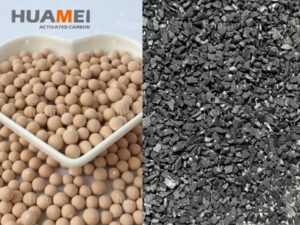
Activated carbon is an adsorption powerhouse. Its internal surface area — 800 to 1,500 m²/g for commercial grades — gives it unmatched capacity for trapping organic molecules, chlorine, taste and odor compounds, VOCs, and emerging contaminants like PFAS.
The pore structure is what makes it work. Micropores (<2 nm) capture small dissolved molecules. Mesopores (2–50 nm) handle larger organics and provide transport channels. The ratio of micropores to mesopores determines which contaminants the carbon targets most effectively.
→ Chlorine and chloramine removal: Activated carbon removes free chlorine through catalytic decomposition, not just adsorption. A properly sized GAC bed with 10+ minutes of empty bed contact time (EBCT) can reduce chlorine from 2–3 ppm to <0.1 ppm — consistently, for months. Zeolite has zero chlorine removal capacity.
→ Organic contaminant removal (TOC, COD, VOCs): This is where activated carbon has no substitute. Dissolved organics — from industrial solvents to pesticide residues to pharmaceutical traces — bind to the carbon surface. Coal-based GAC is the standard choice for industrial wastewater with high COD loading. Zeolite removes essentially zero dissolved organics.
→ Taste and odor control: Geosmin (earthy taste) and 2-MIB (musty odor) in municipal water are organic molecules that activated carbon adsorbs readily. PAC dosing at 5–20 mg/L during seasonal taste/odor events is standard practice at water treatment plants worldwide.
→ PFAS removal: GAC is one of the EPA-recognized best available technologies for PFAS removal. Long-chain PFAS (PFOA, PFOS) adsorb well onto coal-based or coconut shell GAC with EBCTs of 10–20 minutes. Zeolite is ineffective against PFAS because these contaminants are anionic — they carry negative charges, and zeolite only exchanges positively charged cations.
→ Gold recovery: In CIP/CIL mining circuits, coconut shell activated carbon (HMGOLD™ series) adsorbs gold cyanide complexes from pregnant leach solution. Iodine values of 1,050–1,200 mg/g and ball-pan hardness ≥98% are the industry standard. Zeolite has no application in gold extraction.
What Zeolite Does Best
Natural zeolite — primarily clinoptilolite — is a crystalline aluminosilicate mineral with a rigid, cage-like pore structure. Unlike activated carbon's random pore network, zeolite has uniform channels of fixed diameter (approximately 4–7 Å), which gives it molecular sieving capability. But its real value is cation exchange.
Zeolite's CEC of 150–230 meq/100 g means it can swap sodium or calcium ions in its lattice for target contaminant cations in the water. This is a different mechanism entirely from adsorption — and it's extremely effective for specific applications.
→ Ammonia removal (NH₄⁺): This is zeolite's signature application. Clinoptilolite has a strong selectivity for ammonium ions, with removal efficiency of 85–97% at initial concentrations of 1–50 mg/L. In aquaculture, municipal wastewater polishing, and agricultural runoff treatment, zeolite is the go-to media. Activated carbon removes almost no ammonia.
→ Heavy metal ion exchange: Zeolite's selectivity series for heavy metals is typically: Pb²⁺ > Cu²⁺ > Cd²⁺ > Zn²⁺ > Ni²⁺. For lead removal, clinoptilolite can achieve >95% removal from concentrations up to 100 mg/L. Activated carbon has limited heavy metal capacity unless specially impregnated.
→ Cesium and strontium removal (nuclear): Zeolite is used in nuclear wastewater treatment for selective removal of Cs⁺ and Sr²⁺ radionuclides. The Fukushima cleanup operation used thousands of tons of zeolite for this purpose.
→ Aquaculture and fish farming: Zeolite reduces ammonia toxicity in fish tanks and ponds, which is critical because ammonia at just 0.02 mg/L (as un-ionized NH₃) is lethal to many fish species. Zeolite dosing at 10–20 g/L of pond volume provides immediate ammonia control.
→ Soil amendment and slow-release fertilizer: Zeolite retains nutrients (NH₄⁺, K⁺) in the root zone and releases them gradually. Mixing 5–10% zeolite into soil can reduce fertilizer use by 20–30% while preventing nitrate leaching into groundwater.
Performance Comparison by Application
The table below maps common water treatment applications to the recommended media. In some cases, both materials work — but one is clearly superior.
| تطبيق | كربون مفعل | Zeolite | Recommended |
|---|---|---|---|
| Chlorine/chloramine removal | ★★★★★ | ☆☆☆☆☆ | كربون مفعل |
| VOC/solvent removal | ★★★★★ | ☆☆☆☆☆ | كربون مفعل |
| Taste & odor control | ★★★★★ | ☆☆☆☆☆ | كربون مفعل |
| PFAS removal | ★★★★☆ | ☆☆☆☆☆ | كربون مفعل |
| Ammonia (NH₄⁺) removal | ★☆☆☆☆ | ★★★★★ | Zeolite |
| Lead (Pb²⁺) removal | ★★☆☆☆ | ★★★★★ | Zeolite |
| Copper/zinc removal | ★★☆☆☆ | ★★★★☆ | Zeolite |
| COD/TOC reduction | ★★★★★ | ★☆☆☆☆ | كربون مفعل |
| Radioactive Cs/Sr removal | ★☆☆☆☆ | ★★★★★ | Zeolite |
| Municipal drinking water | ★★★★★ | ★★☆☆☆ | Activated carbon (often primary) |
| Aquaculture ammonia control | ★☆☆☆☆ | ★★★★★ | Zeolite |
| Gold recovery (CIP/CIL) | ★★★★★ | ☆☆☆☆☆ | كربون مفعل |
| Industrial wastewater (mixed) | ★★★★☆ | ★★★☆☆ | Both (dual-media system) |
Rule of Thumb: If the contaminant is organic or uncharged, use activated carbon. If it's a positively charged metal ion or ammonia, use zeolite. If it's both, use a dual-media system with zeolite upstream and carbon downstream.
Huamei manufactures coconut shell, coal-based, and wood-based activated carbon. 700+ tons/month capacity across Fujian and Ningxia facilities. MOQ 10 tons.Get a Quote on WhatsApp → | sale@huameicarbon.com
Cost Comparison: Activated Carbon vs Zeolite
Zeolite is dramatically cheaper per ton — but per-ton price is misleading without considering what each ton actually removes.
| Cost Factor | Activated Carbon (GAC) | Zeolite (Clinoptilolite) |
|---|---|---|
| Media price (FOB) | $800–$2,500/ton | $100–$400/ton |
| BET surface area per metric tonne (1,000,000 g) | 800,000,000–1,500,000,000 m² | 30,000,000–60,000,000 m² |
| Organic removal capacity | High (0.1–0.4 g contaminant/g carbon) | Near zero |
| Ammonia exchange capacity | Near zero | 10–25 mg NH₄⁺/g zeolite |
| Regeneration cost | $400–$800/ton (thermal) | $50–$150/ton (brine wash) |
| Regeneration cycles | 3–8 cycles (thermal) | 10–50+ cycles (brine wash) |
| Freight sensitivity | Higher (lighter material, lower bulk density) | Lower (dense mineral, 0.9–1.1 g/cm³) |
→ For organic removal: There is no cost comparison — zeolite simply doesn't work for organics. If you need to remove chlorine, VOCs, pesticides, or PFAS, activated carbon is the only option regardless of price.
→ For ammonia removal: Zeolite wins on cost by a wide margin. At $150–$300/ton with brine regeneration capability, zeolite costs roughly 1/10th as much as activated carbon per unit of ammonia removed. Even if you tried using impregnated carbon for ammonia (which is unconventional), the cost per mg of NH₄⁺ removed would be 5–8× higher than zeolite.
→ For heavy metals: Zeolite is usually more cost-effective for cationic metals (Pb, Cu, Zn, Cd). However, for arsenic (which exists as an oxyanion in water), neither material is ideal — iron-based adsorbents or ion exchange resins are typically more effective.
Regeneration: How Each Media Gets Reused
Both materials can be regenerated, but the methods and economics differ significantly.
→ Activated carbon regeneration: Thermal reactivation at 700–900 °C in a rotary kiln or multiple hearth furnace. This burns off adsorbed contaminants and restores 90–95% of original adsorption capacity. Cost: $400–$800/ton per cycle. Typical carbon loses 5–10% mass per regeneration cycle due to burnoff. After 3–8 cycles, replacement with virgin carbon is needed. For more detail, see our complete regeneration guide.
→ Zeolite regeneration: Much simpler — soak or backwash with 2–10% NaCl (sodium chloride) brine solution. The sodium displaces the adsorbed cations (NH₄⁺, Pb²⁺, etc.) from the zeolite lattice, restoring exchange capacity. Cost: $50–$150/ton per cycle. Zeolite can withstand 10–50+ brine regeneration cycles with minimal capacity loss. Thermal regeneration at 350–600 °C is also possible for heavily fouled zeolite, but rarely necessary.
Pro Tip: The brine waste stream from zeolite regeneration contains concentrated heavy metals or ammonia. Don't discharge it without treatment. In ammonia applications, the brine concentrate can be converted to ammonium sulfate fertilizer through air stripping — turning a waste stream into a revenue stream.
Dual-Media Systems: When You Need Both
Many real-world water streams contain both organic contaminants and ionic pollutants. In these cases, the smartest design uses both materials in sequence:
→ Zeolite first, carbon second: This is the standard configuration. Zeolite removes ammonia and heavy metal cations upstream, which reduces the organic fouling load on the downstream carbon bed. The carbon then handles chlorine, organics, and taste/odor. This sequencing extends activated carbon service life by 20–40% because the carbon isn't wasting capacity on contaminants that zeolite handles more efficiently.
→ Blended media beds: Some smaller systems use a mixed bed of zeolite and GAC in a single vessel. This is simpler but makes regeneration impossible — you can't brine-wash zeolite without the brine contacting the carbon. Blended beds are single-use only, which limits them to small-scale or point-of-use applications.
→ Parallel treatment trains: Industrial plants sometimes run separate zeolite and carbon treatment trains in parallel, then blend the treated streams. This allows independent optimization and regeneration of each media but doubles the equipment footprint.

Common Mistakes When Choosing Between Them
We see these errors regularly from buyers who don't understand the chemistry difference:
→ Mistake #1: Using zeolite for chlorine removal. Zeolite has zero chlorine removal capacity. If your water has residual chlorine (most municipal supplies do), you need activated carbon — period. Installing zeolite for "general water treatment" without checking chlorine levels wastes money and leaves chlorine in the treated water.
→ Mistake #2: Using activated carbon for ammonia. Standard activated carbon adsorbs almost no ammonia. Some buyers assume "carbon removes everything" — it doesn't. If ammonia is your target contaminant (common in aquaculture, landfill leachate, and agricultural runoff), zeolite is the correct media.
→ Mistake #3: Choosing based on price per ton alone. Zeolite at $200/ton looks cheap next to GAC at $1,500/ton. But if your problem is organic contamination, you'll need to replace the zeolite immediately because it removes zero organics — making your actual cost infinite per unit of contaminant removed.
→ Mistake #4: Ignoring pH effects on zeolite. Zeolite's ion exchange capacity drops sharply below pH 4 and above pH 8. If your water is outside the pH 4–8 range, zeolite performance will disappoint. Activated carbon, by contrast, works across pH 2–12 with minimal performance variation.
→ Mistake #5: Overlooking competing ions. Zeolite doesn't just exchange target metals — it exchanges all cations. Hard water with high calcium and magnesium will compete with ammonia or lead for exchange sites, reducing effective capacity by 30–60%. If your water is hard (>200 mg/L CaCO₃), you'll need significantly more zeolite than lab data suggests.
Specifications That Matter for Each Media
When sourcing either material, these are the specs to request from suppliers:
Activated Carbon — Key Specs
| Parameter | Test Method | Typical Range | Why It Matters |
|---|---|---|---|
| رقم اليود | ASTM D4607 | 800–1,200 mg/g | Indicates micropore volume
— higher = more capacity for small molecules |
| BET Surface Area | ASTM D6556 | 800–1,500 m²/g | Total available surface
for adsorption |
| صلابة | ASTM D3802 | ≥95% (ball-pan) | Resistance to breakage
during backwash and handling |
| Ash Content | ASTM D2866 | ≤5% (coal), ≤3% (coconut) | Lower ash = fewer leachable
minerals, better for drinking water |
| رُطُوبَة | ASTM D2867 | ≤5% | You're paying for
carbon, not water |
| Effective Size (D10) | ASTM D2862 | 0.6–1.1 mm (for water treatment GAC) | Affects pressure
drop and contact time |
Zeolite — Key Specs
| Parameter | Typical Range | Why It Matters |
| Clinoptilolite Content | ≥85% | Higher purity = higher
exchange capacity |
| CEC | 150–230 meq/100 g | Directly determines ion
exchange capacity |
| Si/Al Ratio | 4.0–5.5 | Affects selectivity and
acid resistance |
| Grain Size | 0.5–2.0 mm (water treatment) | Smaller = faster kinetics,
higher pressure drop |
| Bulk Density | 0.9–1.1 g/cm³ | Heavier than GAC —
affects vessel sizing |
| Ammonia Capacity | 10–25 mg NH₄⁺/g | The actual performance
metric for ammonia removal |
أسئلة مكررة
Can zeolite remove chlorine from water?
No. Zeolite has no capacity for chlorine removal. Chlorine is removed through catalytic decomposition on the activated carbon surface — a fundamentally different mechanism from ion exchange. If your water contains residual chlorine, you need activated carbon (either قشرة جوز الهند or coal-based GAC).
Is zeolite better than activated carbon for aquarium filters?
It depends on the problem. For ammonia spikes in new tanks (new tank syndrome), zeolite is excellent — it provides immediate ammonia reduction while the biological filter establishes. For removing medications, tannins, or discoloration after treatment, activated carbon is the right choice. Many aquarists use both: zeolite for ammonia, carbon for organics.
Can I mix zeolite and activated carbon in the same filter?
Physically, yes — but it complicates maintenance. You can't regenerate zeolite with brine if it's mixed with activated carbon (the salt will desorb some contaminants from the carbon). For small-scale applications, mixed beds work as single-use media. For larger systems, separate vessels for each media is the standard approach.
Which is cheaper per year of operation?
For ammonia removal: zeolite at $100–$400/ton with brine regeneration is far cheaper annually than any alternative. For organic removal: activated carbon at $800–$2,500/ton is the only option — there is no cheaper alternative that actually works. Annual cost depends on contaminant loading, flow rate, and regeneration frequency. A 100 m³/hour water treatment system typically uses 5–15 tons/year of GAC ($4,000–$37,500) or 3–10 tons/year of zeolite ($300–$4,000) depending on the application.
Does activated carbon remove heavy metals?
Standard activated carbon has limited heavy metal capacity. However, impregnated activated carbon (with sulfur, iron, or other agents) can remove specific metals like mercury (Hg), arsenic (As), and lead (Pb). For general heavy metal removal (Pb, Cu, Zn, Cd, Ni), zeolite is usually more effective and more cost-efficient through ion exchange.
The Bottom Line
Activated carbon and zeolite are not competing products — they solve different problems. Activated carbon is the irreplaceable adsorbent for organics, chlorine, VOCs, and PFAS. Zeolite is the cost-effective ion exchanger for ammonia and heavy metals. If your water has both types of contaminants, use both materials in a dual-media system with zeolite upstream and carbon downstream.
The wrong choice doesn't just underperform — it fails completely. Zeolite will remove zero chlorine. Carbon will remove near-zero ammonia. Match the media to the chemistry, and you'll get reliable results at the lowest lifecycle cost.
Tell us your water analysis, target contaminants, and flow rate. We'll recommend the right activated carbon grade — or tell you honestly if zeolite is the better fit for your application.WhatsApp: +86 181-3792-7803 | sale@huameicarbon.com
Related Articles
- Granular Activated Carbon for Water Treatment: Specs, Types & How to Order →
- Activated Carbon for PFAS Removal: Selection Guide →
- Activated Carbon Regeneration Methods: Complete Guide →
- Activated Carbon Quality Testing Methods →
- Coconut Shell Activated Carbon Products →
- Coal-Based Activated Carbon Products →

