145 Tons of Gold Recovery Carbon to Ethiopia: From Sample Testing to Repeat Orders

An Ethiopian CIL gold mine switched activated carbon suppliers after persistent problems with particle consistency and ash content. After free sample testing and a 96.8-tonne trial shipment, the operation validated Huamei's HMGOLD PLUS™ carbon through multiple reactivation cycles — then placed a 48.4-tonne repeat order. Total supply: 145.2 tonnes across six 40-foot containers.

This case study documents the full process: the quality problems that triggered the supplier search, how the technical evaluation was structured, what the CIL circuit performance data showed, and why the total cost of ownership — not just the per-ton price — drove the repeat order decision.

Project Overview

Parámetro Details
Customer location Ethiopia (gold mining region)
Processing method CIL (Carbon-in-Leach)
Product supplied HMGOLD PLUS™ coconut shell activated carbon
Tamaño de la malla 6×12 (1.70–3.35 mm)
First order 96.8 tonnes — 4 × 40ft containers, 550 kg bulk bag packaging
Repeat order 48.4 tonnes — 2 × 40ft containers
Total supply 145.2 tonnes
Embalaje 550 kg bulk bags (~44 bags per container)

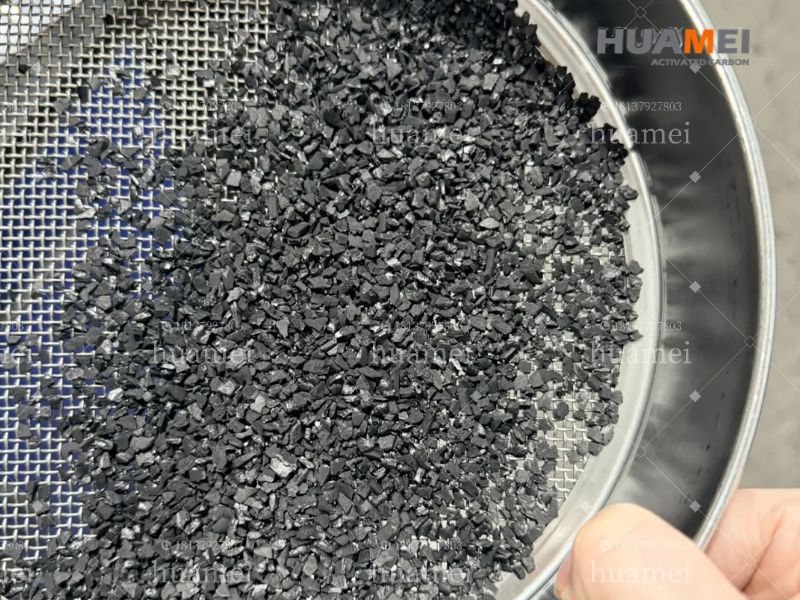
HMGOLD PLUS coconut shell activated carbon 6×12 mesh granules in a sieve tray, showing uniform particle size distribution

The customer's CIL plant had been running activated carbon from another supplier, but two recurring quality issues were affecting production efficiency:

→ Uneven particle size distribution: The carbon arriving on site showed significant variation in granule size within the same batch. In a CIL circuit, inconsistent particle size creates problems at every stage — undersized particles pass through inter-stage screens and report to tailings (direct gold loss), while oversized particles have slower adsorption kinetics due to reduced surface-area-to-volume ratio. The screening team was spending excessive time managing carbon fines and dealing with screen blinding from irregularly shaped fragments.

→ Elevated ash content: The previous supplier's carbon consistently tested above 4% ash, sometimes reaching 5–6%. High ash content in gold recovery carbon is not just a specification issue — it has direct operational consequences. Mineral ash deposits block micropores over successive reactivation cycles, progressively reducing gold loading capacity. At the kiln, high-ash carbon requires more aggressive reactivation temperatures to maintain activity, which accelerates structural degradation and increases carbon losses per cycle.

The combined effect: Higher carbon consumption rates (more tonnes of make-up carbon needed per year), lower gold recovery efficiency, and increased reactivation operating costs. The customer estimated they were losing meaningful production value through carbon-related inefficiencies before initiating the supplier search.

The Search: Jacobi as the Technical Benchmark

When the customer approached Huamei, they referenced Jacobi's GoldSorb® series as the performance standard they wanted to match or exceed. This is common in the gold mining industry — Jacobi GoldSorb® is widely specified in CIL/CIP operations across Africa, and procurement teams often use it as a benchmark when evaluating alternative suppliers.

Important clarification: The customer was not replacing Jacobi products. They were replacing a different supplier whose carbon was underperforming. Jacobi's published specifications served as the technical reference point for evaluating whether Huamei's HMGOLD PLUS™ could meet their CIL circuit requirements.

Specification Comparison: Jacobi GoldSorb® 5500 vs. HMGOLD PLUS™

Parámetro Jacobi GoldSorb® 5500

(Published TDS,

2012 rev.)

HMGOLD PLUS™

(SGS Report MSRCZ2500346-01A)

Test Method
Raw material Coconut shell Coconut shell —
CTC activity ≥55% Contact factory for batch COA ASTM D3467
Total ash ≤4% 2.52% ASTM D2866 / Huamei ASTM testing
Dureza ≥99% (Jacobi proprietary

attrition method, ≤2% loss)

98.2% (GB/T method) Not directly comparable

— see note below

Platelets ≤7% Not tested on this batch Visual / sieve
Humedad ≤5% ≤5% ASTM D2867
Apparent density 450–550 kg/m³ 450–550 kg/m³ ASTM D2854
Tamaño de la malla 6×12 6×12 (1.70–3.35 mm) ASTM D2862
Número de yodo Not published in GoldSorb 5500 TDS 1,208 mg/g ASTM D4607

⚠️ Important note on test methods: Jacobi specifications are from the publicly available GoldSorb® 5500 TDS (2012 revision) and use Jacobi's proprietary test methods for hardness and attrition. HMGOLD PLUS™ results are SGS-tested using GB/T and ASTM standards. Different test methods apply different mechanical stress conditions — direct percentage comparison between columns is not valid. The meaningful comparison is field performance: how the carbon performs in your specific CIL circuit through multiple reactivation cycles. We provide free samples for exactly this purpose.

What the data does show: HMGOLD PLUS™ achieved 2.52% ash (SGS-verified) versus GoldSorb® 5500's ≤4% specification limit. Lower ash content translates directly to better micropore preservation through reactivation cycles — this was the parameter that mattered most to this customer.
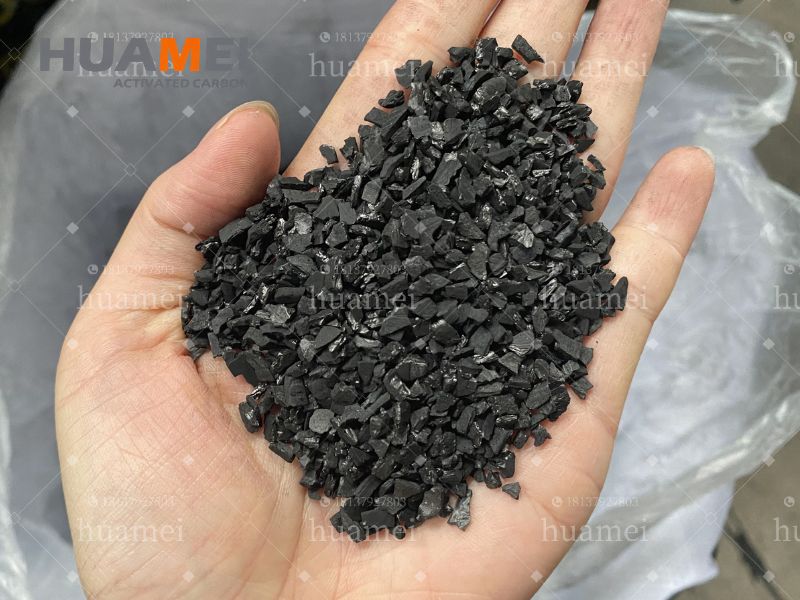
Close-up of Huamei HMGOLD coconut shell activated carbon 6×12 mesh granules held in hand, showing uniform particle size for gold recovery applications

Free Sample Testing: How the Customer Evaluated HMGOLD PLUS™

Before committing to a production order, the customer requested free samples — a standard step that Huamei supports for every gold mining inquiry. Here is how the evaluation process worked:

1. Sample shipment: Huamei shipped representative HMGOLD PLUS™ samples (6×12 mesh) with a batch-specific Certificate of Analysis (COA) showing all tested parameters: iodine number, hardness, ash content, moisture, mesh distribution, and apparent density.

2. Customer-side laboratory testing: The mine's metallurgical team ran their own verification tests, comparing the COA data against their independent results. This step confirms that the supplier's reported data matches reality — a critical trust-building step, especially when switching suppliers.

3. Circuit compatibility assessment: Beyond lab specs, the team evaluated whether the carbon's physical properties (density, mesh distribution, hardness) were compatible with their existing CIL circuit infrastructure — screen apertures, carbon transfer pumps, elution columns, and reactivation kiln settings.

4. Decision to proceed: The sample results confirmed that HMGOLD PLUS™ met the customer's acceptance criteria across all parameters. The particularly low ash content (2.52%) and tight particle size distribution were the deciding factors.

→ Request Free HMGOLD PLUS™ Samples for Your Gold Mine
We provide free activated carbon samples with batch-specific COA for CIL, CIP, and heap leach operations. Test our carbon in your lab or circuit before committing to production volumes. MOQ for production orders: 10 tonnes (one 20ft container).

📱 WhatsApp: +86 181-3792-7803 · 📧 sale@huameicarbon.com

First Shipment: 96.8 Tonnes in Four 40-Foot Containers

After sample approval, the customer placed a 96.8-tonne initial order — four 40-foot containers, all packed in 550 kg bulk bags.

Shipment Details

Item Details
Order quantity 96.8 tonnes
Containers 4 × 40ft FCL
Embalaje 550 kg bulk bags
Loading per container ~24.2 tonnes (~44 bags)
Producto HMGOLD PLUS™ coconut

shell activated carbon, 6×12 mesh

Documentation Batch-specific COA per container,

commercial invoice, packing list,

certificate of origin

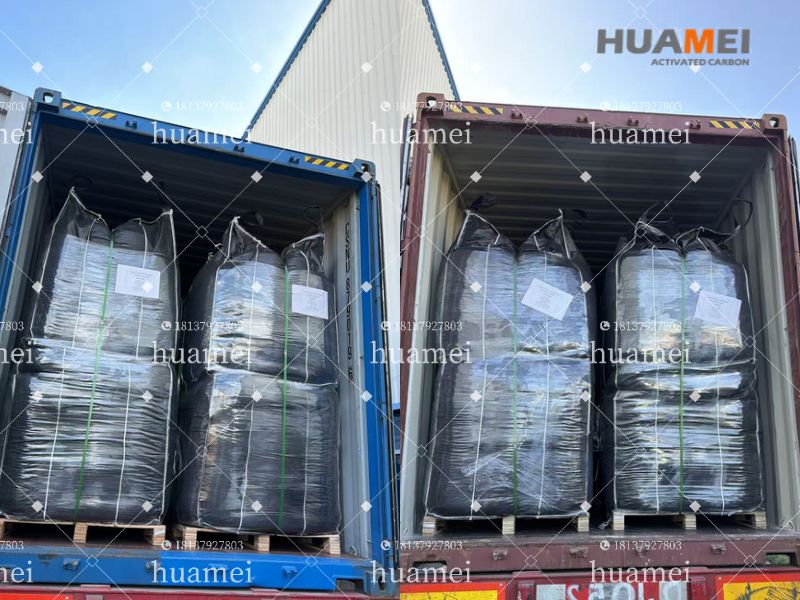
Two 40-foot containers loaded with 550 kg bulk bags of HMGOLD PLUS activated carbon ready for shipment to Ethiopia

Why 550 kg Bulk Bag Packaging for Gold Carbon

The customer specified 550 kg bulk bags rather than 25 kg bags for operational reasons:

CIL Circuit Performance: What the Operation Verified

The real test of any gold recovery carbon is not what the lab report says — it is what happens when the carbon goes into the leach tanks and runs through multiple adsorption-elution-reactivation cycles under actual operating conditions.

After loading HMGOLD PLUS™ into their CIL circuit, the customer's metallurgical team monitored performance across several key indicators over multiple operating cycles:

Performance Indicators Tracked

Indicator What Was Monitored Why It Matters
Gold loading (K value) Gold concentration on loaded

carbon (g Au/t carbon) at

steady state

Directly determines how much gold is

recovered per tonne of carbon in circuit

— the core economic metric

Adsorption kinetics (R value) Rate of gold uptake from leach

solution during the initial

contact period

In CIL, carbon must adsorb gold quickly

because it competes with ongoing leaching

— slow kinetics means gold stays in

solution longer and can be lost to tails

Screening efficiency Carbon retention on

inter-stage screens,

frequency of screen

blinding events

Uniform particle size means fewer fines

passing screens (less gold loss) and less screen

maintenance downtime

Attrition per cycle Carbon mass loss

through each

adsorption-elution

-reactivation cycle

Lower attrition = less make-up carbon needed

per year = lower long-term operating cost

Reactivation response Recovery of adsorption

activity after

thermal reactivation

in kiln

Low-ash carbon reactivates more completely

because fewer mineral deposits block micropores

— the carbon "bounces back" better each cycle

Platelet generation Formation of flat, disc-shaped

carbon

fragments during use

Platelets blind screens, cause carbon carryover

to tails, and reduce effective carbon inventory

The result that drove the repeat order: After running HMGOLD PLUS™ through multiple full cycles, the customer confirmed that the carbon maintained consistent performance — gold loading capacity held up through reactivation, attrition rates were within acceptable limits, and the particle size distribution remained uniform enough that screening operations normalized. The problems they had experienced with the previous supplier — excessive fines, declining activity after reactivation, high make-up carbon consumption — were resolved.

Why Per-Ton Price Is Not the Right Comparison

Gold recovery carbon purchasing decisions that focus exclusively on the per-ton price miss the majority of the actual cost. Carbon in a CIL circuit is not a consumable that gets used once — it cycles through adsorption, elution, and reactivation repeatedly. The total cost of ownership depends on how the carbon performs over its entire service life.

Total Cost of Ownership: What to Calculate

Cost Factor How It Connects to Carbon Quality
Initial purchase price The only number most

procurement teams compare

— but typically represents only 30–

40% of the total carbon-related operating cost

Make-up carbon (annual top-up) CIL circuits typically need 20–50 tonnes

of new carbon per year to replace losses from attrition,

screening, and elution. Higher attrition rate

= more make-up carbon = higher annual spend

Gold lost to carbon fines When carbon breaks into fines that pass through screens,

the gold adsorbed on those fines reports to tailings

— permanently lost. At current gold prices, even small

increases in carbon fines translate to significant revenue loss

Reactivation fuel and kiln wear High-ash carbon may require

higher reactivation temperatures

or longer kiln residence time, increasing

fuel consumption and kiln refractory wear

Screen maintenance Inconsistent particle size and platelet formation cause screen

blinding, requiring more frequent cleaning or replacement

Reactivation efficiency loss Carbon that loses activity faster

through reactivation cycles needs

to be replaced sooner — shortening the

effective service life of each tonne purchased

Rule of Thumb: A carbon that costs 10% more per tonne but lasts 20% more reactivation cycles with 30% lower attrition is significantly cheaper over a 12-month operating period. The customer in this case study understood this — the repeat order confirmed that HMGOLD PLUS™ delivered lower total cost of ownership despite whatever the per-ton price comparison showed.

Repeat Order: 48.4 Tonnes — Validation Through Action

After running the initial 96.8-tonne supply through their CIL circuit and verifying performance across multiple reactivation cycles, the customer placed a second order: 48.4 tonnes in two 40-foot containers.

Order Cantidad Containers Embalaje
First order 96.8 tonnes 4 × 40ft 550 kg bulk bags
Repeat order 48.4 tonnes 2 × 40ft 550 kg bulk bags
Total 145.2 tonnes 6 × 40ft —

A repeat order in gold mining carbon supply is the strongest form of product validation. It means the carbon passed every test that matters — lab verification, circuit performance, reactivation durability, screening behavior, and total cost analysis. No amount of marketing material achieves what a repeat purchase order confirms.

What Batch Consistency Means for Repeat Orders

One risk when scaling from a trial order to ongoing supply is batch-to-batch variation. A supplier might deliver excellent carbon on the first shipment and inconsistent quality on subsequent orders — different raw material sources, varying activation conditions, or production line changes can all introduce variation.

Huamei addresses this through:

Ethiopia's Gold Mining Context

Ethiopia's Ministry of Mines reported total gold production of approximately 44.1 tonnes in the 2025/26 fiscal year (roughly 40.9 tonnes from artisanal miners and 3.2 tonnes from licensed mining companies). The country's industrial gold sector is centered on MIDROC Gold Mine PLC, which operates CIL/CIP processing at the Lega Dembi and Sakaro extraction sites in the Guji Zone, Oromia Region, southern Ethiopia.

Ethiopia's gold mining sector is expanding. New projects backed by $500+ million investment are in development, and the government is actively encouraging foreign investment in mineral extraction. For activated carbon suppliers, this means growing demand for high-quality gold recovery carbon — particularly coconut shell grades suitable for CIL and CIP circuits.

Key factors for supplying activated carbon to Ethiopian gold mines:

Supplying Gold Recovery Carbon to Ethiopia?
Huamei has delivered 145.2 tonnes of HMGOLD PLUS™ coconut shell activated carbon to Ethiopian gold mining operations. HMGOLD PLUS™ grades with iodine 1,050–1,300 mg/g, ball-pan hardness ≥97–99%, ash ≤3%, 6×12 mesh. Factory-direct pricing, batch-specific COA, free samples, SGS verification available. MOQ 10 tonnes.

📱 WhatsApp: +86 181-3792-7803 · 📧 sale@huameicarbon.com · 🌐 huameicarbon.com

Preguntas frecuentes

What activated carbon specs does a CIL gold mine in Ethiopia need?

Ethiopian CIL operations typically require coconut shell activated carbon with 6×12 mesh size, iodine number ≥1,050 mg/g (ASTM D4607), ball-pan hardness ≥97% (ASTM D3802), ash content ≤3% (ASTM D2866), and moisture ≤5%. Beyond these baseline specs, evaluate K value (gold loading capacity), R value (adsorption kinetics), and attrition resistance using your specific ore and leach solution.

Why does ash content matter so much in gold recovery carbon?

Ash content directly affects how well activated carbon maintains its adsorption performance through reactivation cycles. Mineral ash deposits accumulate in micropores during thermal reactivation, progressively blocking the sites where gold adsorption occurs. Carbon with 2.5% ash will maintain gold loading capacity through significantly more reactivation cycles than carbon with 5% ash — reducing make-up carbon consumption and lowering total operating costs.

How do you ship activated carbon to Ethiopia?

Activated carbon is typically shipped in 20ft or 40ft containers from Chinese ports (Xiamen, Shanghai) to Djibouti, Ethiopia's primary import gateway. Ocean freight takes approximately 20–30 days (est.). From Djibouti, overland transport to Ethiopian mine sites follows established logistics corridors. Huamei provides full export documentation including batch-specific COA, commercial invoice, packing list, and certificate of origin.

What is the minimum order quantity?

MOQ is 10 tonnes (one 20ft container). For gold mining operations evaluating a new supplier, we recommend starting with one container alongside free samples for laboratory testing. The customer in this case study started with 96.8 tonnes (4 × 40ft containers) because their sample evaluation was thorough enough to justify a full initial inventory load.

How do you ensure batch-to-batch consistency?

Every HMGOLD PLUS™ shipment includes a batch-specific Certificate of Analysis with independently tested parameters. We maintain consistent coconut shell sourcing, controlled activation conditions, and production capacity of 700+ tonnes per month. Customers can also arrange SGS or other third-party witness testing at the factory before shipment.

Related Articles

56 Tons Coconut Shell Carbon Powder to Turkey for CTO Cartridge Production

A Turkish water filter manufacturer ordered 56 tons of coconut shell activated carbon powder for their CTO (Carbon Block) cartridge production line. The carbon is used as the primary filtration media in household and commercial drinking water filter cartridges — the type you find inside under-sink purifiers, refrigerator filters, and point-of-use water dispensers.

Here's how we handled this order from specification to delivery.

What is a CTO Carbon Block Cartridge?

CTO stands for Chlorine, Taste, and Odor — the three things these cartridges are designed to remove from tap water. Unlike loose GAC (granular activated carbon) filters where carbon granules sit loosely inside a housing, CTO cartridges are solid carbon blocks made by mixing fine carbon powder with a polyethylene (PE) binder and sintering them under heat and pressure.

The result is a dense, uniform block with no channeling, no carbon fines in your water, and significantly better chlorine removal performance than loose GAC at the same contact time.

Why carbon powder is required:

The sintering process needs particles fine enough to create a homogeneous mixture with PE powder. If the carbon is too coarse, the block has voids, weak spots, and inconsistent filtration. Standard CTO production requires 80×325 mesh carbon powder — particles between 0.044mm and 0.177mm.

Client Requirements

This manufacturer produces approximately 3 million CTO cartridges per year for both their own brand and OEM customers across Europe and the Middle East. Their spec:

Parámetro Client specification What we supplied
Raw material Coconut shell Sri Lanka origin coconut shell
Particle size 80×325 mesh (≥90% within range) 93.5% within 80×325 mesh
Número de yodo ≥1100 mg/g 1150 mg/g
Contenido en cenizas ≤3% 2.4%
Humedad ≤5% 3%
pH 6.5–8.0 7.2
Apparent density 0.45–0.55 g/mL 0.48 g/mL
Iron content ≤0.05% 0.02%
Acid-soluble matter ≤1% 0.6%
Water extract conductivity ≤80 μS/cm 52 μS/cm
Chlorine reduction capacity ≥12,000 gallons (per NSF 42 at 0.5 gpm) Verified by client's in-house test

Why these specs matter for CTO production:

Why Coconut Shell Carbon for Drinking Water Cartridges

Not all activated carbon is suitable for CTO cartridge production. Here's why coconut shell dominates the drinking water filter market:

Factor Coconut shell Coal-based Wood-based
Contenido en cenizas 3% 8–12% 3–7%
Taste/odor of carbon itself Neutral Slight smoky note possible Possible woody note
Micropore ratio Very high (>90%) Medium (60–70%) Low (40–50%)
Chlorine removal efficiency Excellent Good Fair
NSF 42/61 certification path Standard Requires more washing Possible but less common
Food safety profile Excellent Acceptable with washing Good
Cost per ton Higher Lower Medium

The micropore advantage: Chlorine molecules are small. They're captured in micropores (<2nm diameter). Coconut shell carbon has the highest micropore ratio of any activated carbon type — meaning more of its internal surface area is actually useful for chlorine removal. This translates directly to longer cartridge life.

Food safety: Drinking water cartridges must pass extractables testing — hot water is passed through the carbon and the extract is analyzed for heavy metals, PAHs, and other contaminants. Low-ash coconut shell carbon passes these tests more easily than coal-based alternatives.

CTO Production Process (How Our Carbon Becomes a Filter Cartridge)

For context on why our specs matter, here's the basic CTO manufacturing process:

  1. Mixing: Our 80×325 mesh coconut carbon powder is blended with UHMWPE (ultra-high molecular weight polyethylene) powder at approximately 60–70% carbon / 30–40% PE ratio
  2. Filling: The mixture is poured into a cylindrical mold with a center core rod
  3. Sintering: Heated to 180–220°C — the PE melts and binds the carbon particles together
  4. Cooling: Controlled cooling to prevent cracking
  5. Demolding: The solid carbon block is removed
  6. Testing: Flow rate, pressure drop, chlorine reduction, and particle shedding tests
  7. Assembly: Wrapped in non-woven fabric, end caps applied, packaged

What happens if carbon quality is wrong:

This is why CTO manufacturers are the most demanding activated carbon buyers — every parameter directly affects whether the final cartridge works or gets scrapped.

Quality Control for This Shipment

Pre-production:

Production:

Testing (every 5-ton lot):

Final inspection:

Huamei Carbon factory warehouse: 1-ton jumbo bags (FIBC) of coconut shell activated carbon stacked on wooden pallets, ready for container loading and export shipment

Huamei Carbon factory warehouse: 1-ton jumbo bags (FIBC) of coconut shell activated carbon stacked on wooden pallets, ready for container loading and export shipment

Packing & Shipping

Item Detail
Packing 1-ton jumbo bags (FIBC), double PE inner liner
Bags per container 28 bags per 40'HQ
Total containers 2 × 40'HQ
Loading Fork-loaded, secured with dunnage bags
Moisture protection Double PE liner + silica gel sachets inside each jumbo bag
Port of loading Xiamen
Port of discharge Mersin, Turkey
Transit time 22 days

Why double PE liner for carbon powder:
Carbon powder is hygroscopic — it absorbs moisture from air. During the 22-day sea transit through the Suez Canal (high humidity), unprotected carbon can gain 3–5% moisture. Double PE liner keeps moisture gain below 0.5% during transit. This matters because excess moisture causes sintering defects in CTO production.

Client Performance Feedback

After running our carbon through their CTO production line (first batch = 5 tons for validation):

They've confirmed a supply agreement for 56 tons per quarter (224 tons/year).

CTO Carbon Powder Specifications Summary

If you're a CTO cartridge manufacturer sourcing activated carbon, here are the key specs to look for:

Parámetro Minimum for CTO Ideal range Why it matters
Raw material Coconut shell Coconut shell Lowest ash, best micropore ratio
Tamaño de la malla 80×200 minimum 80×325 Proper block density and flow rate
Número de yodo ≥1000 mg/g 1100–1200 mg/g Cartridge lifespan
Fresno ≤5% ≤3% Extractables testing
Iron ≤0.1% ≤0.05% Prevents discoloration and metallic taste
pH 6–9 6.5–8.0 Neutral water output
Humedad ≤8% ≤5% Sintering quality
Conductivity (water extract) ≤150 μS/cm ≤80 μS/cm Low ionic leaching
Apparent density 0.40–0.60 g/mL 0.45–0.55 g/mL Consistent block weight and density

PREGUNTAS FRECUENTES

What activated carbon is used in CTO water filter cartridges?

CTO (Carbon Block) cartridges use coconut shell activated carbon powder in 80×325 mesh size. The powder is mixed with polyethylene binder and sintered into a solid block. Coconut shell is preferred because of its high micropore content (best for chlorine removal), low ash (passes food-safety extractables tests), and neutral taste profile. Coal-based carbon is rarely used in drinking water cartridges due to higher ash and potential taste issues.

What mesh size carbon is needed for CTO cartridge production?

80×325 mesh (0.044–0.177mm particle size) is the standard for most 10-inch CTO cartridges. Some manufacturers use 100×325 for tighter blocks with slower flow, or 50×200 for faster flow but slightly lower chlorine removal. The exact size depends on your target flow rate and pressure drop specifications.

How much activated carbon goes into one CTO cartridge?

A standard 10-inch × 2.5-inch CTO cartridge contains approximately 300–450 grams of activated carbon (60–70% of total block weight, remainder is PE binder). A 10-inch × 4.5-inch "big blue" cartridge contains approximately 1,200–1,500 grams. One ton of carbon powder produces approximately 2,200–3,300 standard cartridges.

What certifications does CTO carbon need?

The carbon itself doesn't carry NSF certification — the finished cartridge does. However, the carbon must be produced to a standard that allows the cartridge to pass NSF 42 (aesthetic effects — chlorine, taste, odor) and NSF 61 (health effects — extractables). Key requirements: low heavy metals, low ash, low conductivity of water extract, no PAH contamination. We supply carbon that has been validated by multiple NSF-certified cartridge manufacturers.

How long does a CTO cartridge last?

Typically 6–12 months or 1,000–3,000 gallons depending on inlet water quality and cartridge size. The carbon's iodine number directly determines cartridge life — higher iodine (1100+) gives 20–30% longer life compared to standard 900 iodine carbon. Our 1150 iodine number coconut shell carbon helps manufacturers deliver longer-rated cartridges as a competitive advantage.


Supply Capability for CTO Manufacturers

Huamei Activated Carbon Co., Ltd.
Website: www.huameicarbon.com

52 Tons Pellet Activated Carbon to the Middle East for VOC Treatment

In Q2 2026, we shipped 52 tons of 4mm coal-based pellet activated carbon to a petrochemical client in the Middle East. The carbon is used in fixed-bed adsorbers for VOC removal from process exhaust — specifically toluene, xylene, and mixed C5–C9 hydrocarbons at 40–60°C inlet temperature.

This is how the order went from first inquiry to delivery.

Client Requirements

The client operates a plastics manufacturing complex with three exhaust streams requiring VOC treatment. Their existing carbon (sourced from a European distributor) was underperforming — breakthrough happening at 60% of rated bed life.

Parámetro Client specification What we supplied
Carbon type Coal-based pellet (extruded) 4mm coal-based pellet
Diámetro 4.0 mm 4.0 mm (±0.2 mm tolerance)
Número de yodo ≥900 mg/g 950 mg/g (tested)
Valor CTC ≥60% 65% (tested)
Dureza ≥95% 97%
Humedad ≤5% 3.2%
Contenido en cenizas ≤12% 9.5%
Densidad aparente 450–550 g/L 480 g/L
Cantidad 56 tons (3 adsorbers ×

~18.5 tons each)

56 toneladas

The CTC (carbon tetrachloride activity) value was the critical spec — it measures vapor-phase adsorption capacity, which directly determines how long the bed lasts before breakthrough. Their previous supplier was delivering 55–58% CTC, which explains the early breakthrough.

Why Pellet Carbon for VOC Applications

Pellet (extruded) activated carbon is the standard choice for gas-phase VOC treatment because:

Granular carbon (irregular shape) creates 20–40% higher pressure drop at the same flow rate and generates more dust during handling and operation. For large gas-phase adsorbers, pellet is always the better engineering choice.

Production & Quality Control

The 52-ton order took 12 days to produce. Our QC process for this shipment:

Raw material stage:

In-process checks:

Finished product testing (every 5-ton batch):

Final COA:

We issued 12 batch COAs (one per ~5 tons) plus a composite COA for the full 52 tons. Client also requested third-party SGS inspection before loading — passed without issues.

Forklift loading palletized 25kg bags of Huamei pellet activated carbon into shipping container at factory warehouse

Packing & Loading

Item Detail
Packing 25 kg woven PP bags, palletized
Bags per pallet 40 bags (1 ton/pallet)
Total pallets 52
Container type 2 × 40' HQ containers
Loading per container 26 tons each
Moisture barrier PE liner inside container
Fumigation Methyl bromide free (client requirement)

Pellet carbon is sensitive to moisture absorption during transit — especially to the Middle East where port humidity can be high. We line each container with PE sheeting and include silica gel desiccant packs as standard for Gulf destinations.

Logistics & Delivery

Stage Timeline
Order confirmed Day 0
Production complete Day 12
SGS inspection Day 14
Container loading Day 15
Port departure (Tianjin) Day 18
Arrival at destination port Day 38 (20 days transit)
Client confirmation received Day 42

Total lead time from order to delivery: 42 days. Production was the bottleneck (12 days) — transit time to the Gulf is fixed at ~20 days from North China ports.

For clients who need faster delivery: we maintain 200+ tons of 4mm pellet carbon in stock at any given time. Stock orders can ship within 3–5 days of payment, cutting total delivery to under 30 days.

Performance Feedback

Six weeks after installation, the client reported:

They've since placed a second order (same spec, 52 tons) for their scheduled bed replacement in Q4 2026. Annual consumption: ~112 tons.

Cost Comparison

The client's previous carbon was sourced through a European distributor at approximately $2,800–3,200/ton CIF. Our direct factory price delivered CIF to their port:

The cost saving on 112 tons/year is significant. And the better CTC value means longer bed life — so actual cost-per-operating-hour drops even further.

Specs Summary for VOC Pellet Carbon

If you're running a similar VOC treatment system, here's what to specify:

Parámetro Recommended for VOC Why it matters
Tipo Coal-based pellet (extruded) Low pressure drop, survives regeneration
Diámetro 3 mm or 4 mm 4mm for high-flow; 3mm for higher removal but more ΔP
CTC ≥60% (higher is better) Directly determines bed life for VOC adsorption
Yodo ≥900 mg/g General adsorption capacity indicator
Dureza ≥95% Must survive handling + regeneration cycles
Fresno ≤12% High ash = less active carbon per kg
MOQ 10 tons Our minimum order for custom specs

PREGUNTAS FRECUENTES

What activated carbon is best for VOC removal?

Coal-based pellet (extruded) activated carbon in 3mm or 4mm diameter is the industry standard for fixed-bed VOC adsorption. The key spec is CTC value (carbon tetrachloride activity) — aim for ≥60%. Higher CTC means more vapor-phase adsorption capacity and longer bed life between regeneration or replacement cycles.

How much pellet activated carbon does a VOC treatment system need?

It depends on gas flow rate, VOC concentration, and target outlet concentration. A typical industrial adsorber treating 10,000–30,000 m³/hr of exhaust uses 15–25 tons of carbon per vessel. Most systems have 2–3 vessels (one adsorbing, one regenerating, one on standby). Annual replacement or top-up is typically 15–25% of total bed volume.

What's the difference between 3mm and 4mm pellet carbon?

3mm pellets have more surface area per unit volume (better removal efficiency) but create higher pressure drop. 4mm pellets have lower pressure drop (less fan energy needed) but slightly lower removal kinetics. For high-flow industrial systems (>20,000 m³/hr), 4mm is usually preferred. For smaller systems or when emission limits are very tight, 3mm may be worth the extra pressure drop.

How long does pellet activated carbon last in VOC treatment?

Typically 12–18 months before replacement is needed, depending on inlet VOC concentration and whether the system includes thermal regeneration. With on-site steam or hot nitrogen regeneration, the same carbon can last 3–5 years before adsorption capacity degrades below useful levels. Without regeneration, it's a one-time use with 12–18 month life.

Can you supply pellet carbon with higher CTC for heavy VOC loads?

Yes. Our standard 4mm pellet runs CTC 60–65%. For heavy-duty applications (high VOC concentration or tight emission limits), we produce a high-CTC variant at 70–75% CTC. This requires longer activation time and yields less per batch, so price is approximately 15–20% higher. MOQ 10 tons, lead time 15–18 days.


Ready to Order?

We supply 3mm and 4mm coal-based pellet activated carbon for VOC, solvent recovery, and industrial gas treatment. MOQ 3 tons, monthly capacity 700+ tons across all grades, CIF delivery worldwide.

Huamei Activated Carbon Co., Ltd.
Website: www.huameicarbon.com

600 Tons of Gold Recovery Carbon Shipped in June — How a Burned Buyer Found a Reliable Supplier

Case Study: 600 Tons of Gold Recovery Carbon Shipped in June — How a Burned Buyer Found a Reliable Supplier

When your activated carbon supplier mixes palm shell into your coconut shell carbon, you don't just lose money — you lose gold. Literally.

This is the story of one of our clients in Burkina Faso, how they got burned by a dishonest supplier, and how we earned their trust with 112 tons on the first order.

The Problem: Contaminated Carbon, Lost Gold

WhatsApp chat showing two gold mining customers scammed by other activated carbon suppliers with poor quality product

Our client operates a gold recovery plant in Burkina Faso using CIL circuits. They'd been buying 6×12 mesh carbón activado de cáscara de coco from another Chinese supplier for about a year. Production numbers looked fine at first.

Then recovery rates started dropping.

They sent samples to an independent lab. The results:

The cost of being cheated:

Palm shell carbon looks similar to coconut shell carbon visually. The supplier was betting they'd never test it. They were wrong — just too late.

How They Found Us

WhatsApp testimonials from 3 Huamei customers praising activated carbon quality and choosing to reorder

After the fraud was confirmed, our client asked around. A business contact who'd been buying from us for 3+ years made the introduction.

Their requirements were specific:

They were cautious. Understandably. They requested:

  1. Factory video call showing our coconut shell carbonization and activation lines
  2. Retain samples from our last 3 batches to their gold mining clients
  3. SGS pre-shipment inspection for the first order

We agreed to everything. If your product is real, transparency costs nothing.

The Specs We Delivered

Parámetro Client Requirement Our Delivery
Raw material 100% coconut shell 100% coconut shell (verified)
Tamaño de la malla 6×12 6×12
Número de yodo ≥1100 mg/g 1120–1150 mg/g
Dureza ≥98% 98.5–99%
Contenido en cenizas ≤3% 2.1–2.5%
Humedad ≤10% 6.5%

Every batch tested by our lab + SGS verification on first shipment.

June Shipment: 600 Tons Total, This Client 112 Tons

activated carbon for gold recovery using

June alone, we shipped 600 toneladas of gold-grade coconut shell activated carbon across multiple clients. This Burkina Faso client took 112 tons — 4 × 40HQ containers loaded at Nansha Port (南沙港).

Yesterday's shipment: 4 × 40HQ loaded and on the water, destination Burkina Faso.

The relationship started because:

How to Avoid Getting Burned Like This

If you're buying coconut shell activated carbon for gold recovery, here's how to protect yourself:

  1. Test every batch independently — Don't rely on supplier COAs alone. At minimum, check iodine number and hardness. A density/buoyancy test can quickly flag palm shell contamination (palm shell is lighter).
  2. Check hardness numbers carefully — Pure coconut shell carbon delivers 98%+ hardness. If results come back 85–92%, something else is in there.
  3. Request SGS/BV inspection for first orders — $200–400 for peace of mind on a $50,000+ shipment is obvious math.
  4. Visit the factory if possible — See the raw material storage. Coconut shell and palm shell look different before carbonization. If they won't let you near the raw material area, ask yourself why.

About This Product

Spec Detail
Producto Coconut Shell Activated Carbon for Gold Recovery
Tamaño de la malla 6×12
Dureza 98%+
Número de yodo 1100+ mg/g
Activation Steam activated
Loading port Nansha Port, Guangzhou / Xiamen Port
Production capacity 700+ tons/month
MOQ 10 tons
Embalaje 25kg PP bags or 500kg jumbo bags

PREGUNTAS FRECUENTES

How can I tell coconut shell from palm shell carbon?

Lab testing is most reliable (hardness, ash content, density). Visual inspection: coconut shell carbon is darker, denser, and has a more uniform granule shape. Palm shell tends to be lighter in color with more irregular shapes. A simple water float test also helps — palm shell carbon has lower density and more pieces float.

Why do some suppliers mix palm shell in?

Money. Palm shell is $500–800/ton cheaper than coconut shell as raw material. Mixing 30–40% palm shell into a batch increases profit margin by $200–300/ton. Multiply that by hundreds of tons and the incentive is clear.

Does palm shell carbon work for gold recovery?

Poorly. Lower hardness means more breakage in CIL/CIP circuits (= gold losses to fine carbon). Lower gold adsorption value means less gold loaded per kg of carbon. It's not worthless, but it's not what you're paying for when you order coconut shell grade.

How long does production typically take?

Standard specs: 7–15 days. Custom specifications (special mesh size, impregnation, acid washing): 15–25 days. These timelines assume raw material is in stock — confirm with your supplier before finalizing delivery schedules.


Get a Quote

If your current carbon isn't performing — or you just want to verify what you're actually getting — talk to us. We ship what we promise. 600 tons this month proves it.