Anthracite vs Bituminous Coal for Water Filtration: Which Filter Media Fits Your Plant?
Short answer: anthracite is better for dual-media and multimedia gravity filters where you need a lighter top layer with good flow rates. Bituminous coal works as a standalone media or lower-cost option for smaller systems where budget matters more than layering precision.
The real question isn't "which coal is better" — it's which one matches your filter design, flow rate, and budget. This guide breaks down the differences with actual specs so you can make that call.
Anthracite vs Bituminous Coal: Quick Comparison Table
| Paramètres | Média filtrant anthracite | Bituminous Coal Filter Media |
|---|---|---|
| Carbon Content | 86–98% | 45–86% |
| Specific Gravity | 1.4–1.6 g/cm³ | 1.3–1.5 g/cm³ |
| Hardness (Mohs) | 2.0–2.5 | 2.0–3.0 |
| Acid Solubility | ≤3.5% | ≤5% |
| Porosity | Low (dense structure) | Moderate (more volatile matter) |
| Effective Size (ES) | 0.8–1.2 mm typical | 0.8–1.0 mm typical |
| Uniformity Coefficient (UC) | ≤1.4 | ≤1.5 |
| Color | Metallic black, glossy | Dull black to dark brown |
| Typical Role in Filter | Top layer in dual/multimedia | Single-media or mid-layer |
| Backwash Requirement | Lower (lighter, expands easier) | Higher |
| Relative Cost | Higher | Lower |
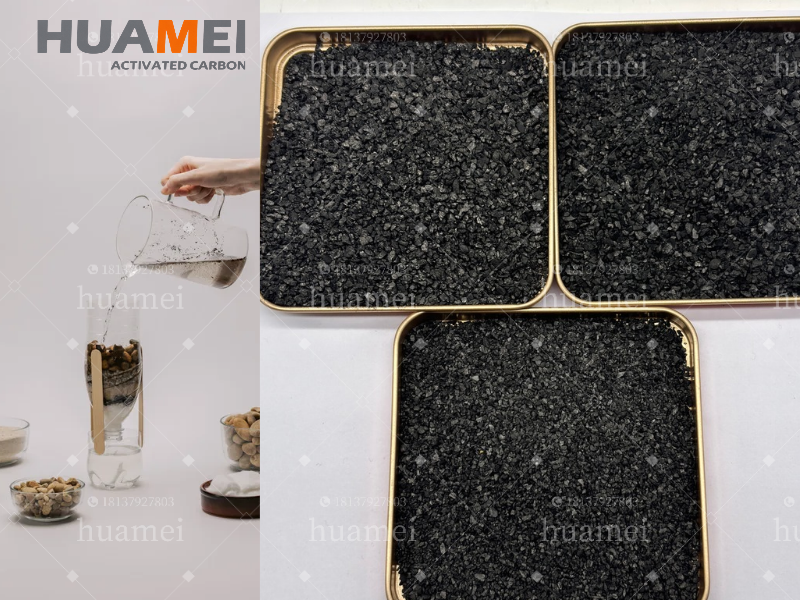
Why Coal Type Matters in Water Filtration
In a gravity filter or pressure filter, coal media does one main job: trap suspended solids while letting treated water flow through at a reasonable rate. The coal's density, grain size, and porosity determine how deep particles penetrate into the bed, how fast water can move through, and how long the filter runs before needing a backwash.
Pick the wrong media, and you get either short filter runs (media too fine or too dense) or poor effluent quality (media too coarse or uneven). In dual-media designs — anthracite on top, sand on the bottom — density difference is critical. If the top layer is too heavy, it mixes with the sand during backwash and the layering breaks down.
Anthracite Coal Filter Media: When to Use It
Anthracite is the standard choice for the top layer in dual-media and multimedia filters. Three reasons:
- Lower density than sand. Specific gravity 1.4–1.6 vs sand's 2.65. After backwash, anthracite naturally settles back on top without mixing. This is the whole point of dual-media design.
- Angular grain shape. Crushed anthracite has irregular, angular particles that create more void space between grains. More void space = deeper solids penetration = longer filter runs before breakthrough.
- Chemical inertness. High carbon content (86–98%) and low volatile matter mean anthracite doesn't leach organics or change water chemistry. Acid solubility typically ≤3.5% per AWWA B100 / ASTM standards.
Anthracite filter media specification for municipal water treatment typically calls for effective size 0.8–1.2 mm, uniformity coefficient ≤1.4, and bed depth of 400–600 mm as the top layer over 200–300 mm of silica sand.
Typical Anthracite Applications
- Municipal drinking water plants (dual-media rapid gravity filters)
- Industrial pre-treatment before GAC adsorption or RO membranes
- Tertiary wastewater treatment
- Power plant cooling water filtration
Bituminous Coal Filter Media: When to Use It
Bituminous coal is softer, more porous, and cheaper than anthracite. It works well when:
- Budget is the priority. Bituminous coal costs 20–40% less than anthracite in most markets.
- Single-media filter. In systems where you're not doing dual-media layering, the density difference doesn't matter.
- Lower turbidity source water. If incoming water is relatively clean (NTU <10), bituminous performs adequately.
- Short-cycle filters. Systems designed for frequent backwash where extended run time isn't critical.
The downside: bituminous coal has higher volatile matter (15–45% vs anthracite's <8%), which means it can leach trace organics, especially during the initial commissioning period. For drinking water, this usually requires a longer flushing period before putting the filter online.
Head-to-Head: Filter Performance Comparison
| Performance Factor | Anthracite | Bituminous | Winner |
|---|---|---|---|
| Filter Run Length (before backwash) | 24–48 hours | 12–24 hours | Anthracite |
| Turbidity Removal | Excellent | Good | Anthracite |
| Backwash Water Savings | Lower water use | Higher water use | Anthracite |
| Media Replacement Cycle | 3–5 years | 2–3 years | Anthracite |
| Upfront Cost per Ton | Higher | 20–40% lower | Bituminous |
| Organic Leaching Risk | Minimal | Moderate (first weeks) | Anthracite |
| Dual-Media Compatibility | Designed for it | Poor (density overlap with sand) | Anthracite |
How to Choose: Decision Flowchart
Ask these four questions in order:
- Is your filter dual-media or multimedia? → Anthracite. No debate. Bituminous coal doesn't maintain proper layering with sand.
- Is this for drinking water? → Anthracite. Lower organic leaching risk, meets stricter regulatory requirements.
- Is your source water turbidity consistently below 10 NTU? → Bituminous is acceptable for single-media filters in this range.
- Is budget the deciding factor and you're running single-media? → Bituminous with more frequent backwash can work.
For most water treatment plants processing surface water or groundwater with moderate turbidity, anthracite in a dual-media configuration delivers the best cost-per-treated-liter over the full lifecycle — even though the upfront media cost is higher.

What About Anthracite vs Bituminous vs Lignite?
Lignite (brown coal) is rarely used as a standalone filter media. Its low hardness (Mohs 1–2) means it breaks down quickly under backwash, creating fines that clog the underdrain. However, lignite-derived coal-based activated carbon is widely used for adsorption — that's a different product with a different function.
For filtration media selection, the practical choice is between anthracite and bituminous. Lignite doesn't compete in this category.
Huamei Anthracite Filter Media: Specs and Supply
Huamei supplies anthracite filter media from Ningxia province, one of China's primary anthracite producing regions. Our filter media has been shipped to water treatment projects in the Philippines (40 tons), Turkey (20 tons)et Saudi Arabia (40 tons).
| Paramètres | Spécifications | Test Method |
|---|---|---|
| Fixed Carbon | ≥85% | ASTM D3172 |
| Acid Solubility | ≤3.5% | AWWA B100 |
| Specific Gravity | 1.4–1.6 g/cm³ | — |
| Effective Size | 0.8–1.2 mm (customizable) | Sieve analysis |
| Uniformity Coefficient | ≤1.4 | Sieve analysis |
| Mud Content | ≤1% | — |
| Emballage | 25 kg bags / 1 ton jumbo bags | — |
| MOQ | 10 tons (1 × 20ft container) | — |
Need anthracite filter media specs or pricing for your water treatment project? Contact us on WhatsApp or send an inquiry with your required size, quantity, and destination port.
FAQ
Is anthracite the same as activated carbon?
No. Anthracite filter media is crushed, sized coal used for physical filtration — it traps particles by straining. Charbon actif is thermally or chemically activated to develop internal pore structure for adsorbing dissolved chemicals. Different products, different functions. Some plants use both: anthracite for filtration, then GAC for adsorption.
Can I use bituminous coal in a dual-media filter?
Not recommended. Bituminous coal's specific gravity (1.3–1.5) overlaps with sand's settling range after backwash, so the layers mix instead of staying separated. This defeats the purpose of dual-media design.
How often should anthracite filter media be replaced?
Typically every 3–5 years, depending on source water quality and backwash frequency. Signs it's time: increased head loss at the same flow rate, shorter filter run times, or visible media loss during backwash. Annual sieve analysis can track grain size degradation.
What is the price difference between anthracite and bituminous filter media?
Bituminous coal is generally 20–40% cheaper per ton than anthracite. But anthracite lasts longer and delivers longer filter runs, so the total cost of ownership is often lower. Factor in media replacement frequency, backwash water costs, and effluent quality requirements before comparing on price alone.
What size anthracite do I need for my filter?
For dual-media filters: effective size 0.8–1.2 mm with uniformity coefficient ≤1.4 is standard. For roughing filters treating high-turbidity water: 1.5–2.5 mm. Consult your filter manufacturer's design manual — the anthracite size must match the sand size and underdrain slot width.