Activated Carbon for Gold Mining in Burkina Faso: Specs & Supply Guide

Burkina Faso is one of West Africa's fastest-growing gold producers. The Ministry of Energy, Mines and Quarries' 2025 statistical yearbook reports national gold production of approximately 90.8 tonnes in 2025, up from approximately 60.8 tonnes in 2024 — a 49% increase. As of 31 December 2025, the ministry recorded 15 industrial mines in production under 22 valid exploitation permits.

The same yearbook separates national output from industrial output: industrial production was 51.496 tonnes in 2025 versus 53.376 tonnes in 2024. The national increase therefore should not be interpreted as a 49% rise in industrial CIL demand or activated-carbon consumption.

Not all 15 mines use carbon-in-leach (CIL) or carbon-in-pulp (CIP) circuits — processing routes differ by operation. But the country's activated carbon imports tell the demand story clearly: Burkina Faso imported 4,173 tonnes of activated carbon worth US$7.28 million in 2025, up from 4,064 tonnes / US$4.13 million in 2024 (World Bank WITS, HS 380210).

Supplying carbon to Burkina Faso requires a different delivery plan from a coastal destination. The country is landlocked. Common options include transit through Lomé, Abidjan, Tema or Cotonou, followed by inland transport to the agreed delivery point. Transit clearance, road conditions and the mine’s location affect the final cost and schedule.

This guide covers the activated carbon specifications Burkina Faso's gold operations require, verified import data, the landlocked logistics landscape, and how to evaluate suppliers for a market where delivery reliability matters as much as product quality.

Item Detail
Ülke Burkina Faso (landlocked, West Africa)
2025 gold production ~90.8 tonnes (Ministry of Energy, Mines and Quarries, 2025 yearbook)
Industrial mines in production (Dec 2025) 15 (not all use activated carbon circuits)
2025 activated carbon imports (HS 380210) 4,173 tonnes / US$7.28 million
2024 activated carbon imports (HS 380210) 4,064 tonnes / US$4.13 million
Top import sources (2025) India, Sri Lanka, China (867t / $1.05M), Philippines, Vietnam
Transit ports Lomé (Togo), Abidjan (Côte d'Ivoire), Tema (Ghana), Cotonou (Benin)
Processing methods CIL, CIP and CIC circuits (varies by operation)
Preferred carbon type Coconut shell GAC, commonly 6×12 mesh, iodine ≥1,050 mg/g

Burkina Faso Gold Mining Market: What the Data Shows

Burkina Faso imported over 4,000 tonnes of activated carbon in both 2024 and 2025. This makes the country a relevant market for gold recovery activated carbon, while the customs totals also include carbon supplied to other applications.

An important distinction: HS 380210 covers all activated carbon forms — coconut shell gold-recovery grades, coal-based water-treatment carbon, powdered activated carbon and other types. The national import total is a useful market indicator, but it should not be read as the exact amount consumed by gold mines. A mine's actual annual requirement depends on its circuit design, carbon inventory, make-up rate, regeneration losses and operating hours.

Known CIL/CIP Gold Mines in Burkina Faso

Several major gold mines in Burkina Faso operate CIL circuits based on information from their parent companies' public filings. The table below lists operations where the processing method has been confirmed in operator annual reports or production disclosures:

Mine Owner Confirmed Process 2024 Production (oz) 2025 Production (oz) Notes
Essakane IAMGOLD (85%) CIL 454,200 427,200 Largest mine; open pit; 12.56 Mt milled in 2025
Houndé Endeavour Mining (85%) CIL 287,726 256,862 5.13 Mt processed in 2025; 86.2% recovery
Sanbrado West African Resources (85%) CIL 206,622 205,228 Open pit + underground; Toega expansion scheduled
Mana Endeavour Mining (85%) CIL 147,806 172,877 Fully underground since 2024; Siou and Wona deposits
Bomboré Orezone Gold CIL 118,746 110,014 Stage 2 expansion targets 220,000–250,000 oz/yr
Kiaka West African Resources CIL — 95,155 Commissioned in 2025; 300,383 oz combined with Sanbrado in the 7 January 2026 production update

Sources: operator FY-2025 disclosures and technical descriptions. Production is shown on a 100% mine basis, not the owner’s attributable share. The Sanbrado and Kiaka figures follow WAF’s 7 January 2026 production update. Ownership percentages are reported interests, which can change. These operators are market examples, not a list of Huamei customers.

Gold production establishes the scale of these operations, but it does not establish their activated-carbon consumption. Estimate procurement from the plant’s standing carbon inventory, measured make-up rate, screening and regeneration losses, and operating hours.

Activated Carbon Import Data: Who Supplies Burkina Faso?

World Bank WITS data (UN Comtrade, HS 380210) provides a breakdown of Burkina Faso's activated carbon imports by source country. The 2024 data includes quantity detail by partner:

Source Country Value (US$ K) Quantity (kg) Share by Volume Avg. Price ($/kg)
India 2,602.68 2,468,080 60.7% 1.05
Çin 860.65 1,173,240 28.9% 0.73
Filipinler 250.08 88,160 2.2% 2.84
Vietnam 186.22 67,056 1.6% 2.78
Sri Lanka 160.54 48,400 1.2% 3.32
Ghana (re-export) 23.50 133,347 3.3% 0.18
Singapore 38.95 84,348 2.1% 0.46
Others 8.10 1,562 <0.1% —
Total (2024) 4,130.70 4,064,190 100% 1.02

For 2025, WITS reports total imports of 4,173.48 tonnes valued at US$7.28 million. China supplied 867 tonnes (US$1.05M) in 2025. The near-doubling of import value with similar tonnage suggests a shift toward higher-value grades or price increases across suppliers.

Source: WITS 2024 and WITS 2025. HS 380210 covers all activated carbon forms — not exclusively gold recovery grades.

Reading the Import Data

Several patterns stand out:

→ India’s 60.7% volume share describes the reported partner-country trade flow in 2024. It does not identify individual manufacturers, final mine customers, raw materials, or re-export routes.

→ China’s $0.73/kg average versus India’s $1.05/kg (2024) is a customs unit value across all activated-carbon imports from each partner. It is not a quotation for gold-recovery carbon or evidence of a particular raw-material mix.

→ Ghana’s $0.18/kg unit value should be interpreted cautiously. These aggregate records do not establish whether the goods were virgin, reactivated or re-exported carbon; shipment-level information would be needed.

→ These are customs-trade statistics for all activated carbon under HS 380210, not a ranking of gold-mine suppliers. The data is useful for understanding trade flows and supplier origins, but each mine's actual consumption should be estimated from its own circuit parameters.
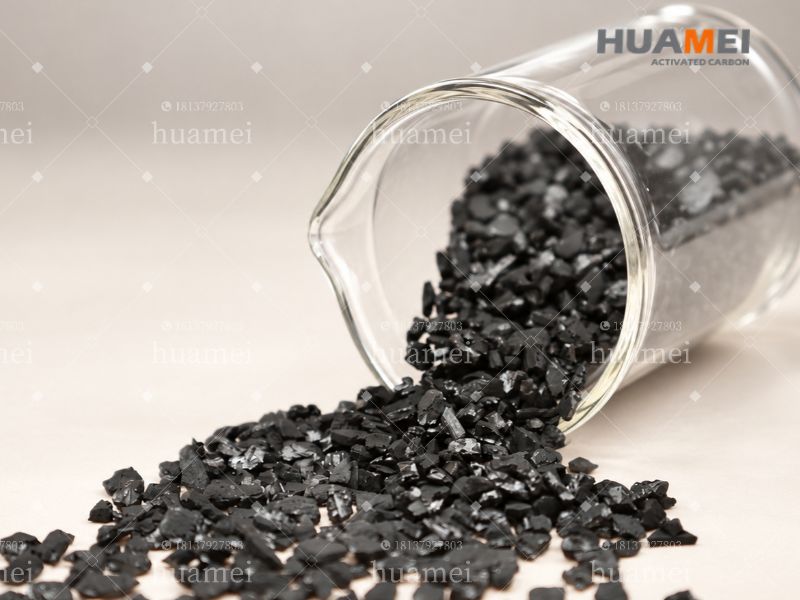
Huamei coconut-shell granular activated carbon poured from a glass jar for gold recovery product review
Evaluate the agreed particle-size distribution and gold-adsorption test results for your circuit.

Activated Carbon Specifications for Gold Recovery Circuits

Granular activated carbon (GAC) is used in CIL, CIP, and CIC gold-recovery circuits to adsorb dissolved gold-cyanide complexes from process solution or slurry. Coconut-shell-based GAC is widely used because of its hard granular structure and microporous pore system — but the right product for a specific plant must be selected against that plant's metallurgical and operating requirements.

There is no single specification that fits every circuit. The end user's technical specification and site test results should take priority. The following parameters are useful when comparing products and reviewing a batch certificate of analysis (COA):

Parametre Typical CIL Specification Test Method What It Tells the Buyer
Raw material Coconut shell — Coconut-shell carbon is widely used for its durable granular structure; verify gold uptake and attrition under the plant’s conditions.
İyot sayısı ≥1,050 mg/g ASTM D4607 General indicator of micropore development — not a direct gold-loading test. Two carbons with similar iodine numbers may perform differently in a specific cyanide solution
ağ boyutu 6×12 (1.70–3.35 mm) ASTM D2862 Common CIL size; balances adsorption rate against screen retention. Confirm against plant's screen openings and carbon transfer system
Ball-pan hardness ≥97% ASTM D3802 Comparative lab measure of granular hardness; does not directly measure in-service carbon loss (per ASTM). Review alongside attrition data and plant operating results
Apparent density 0.48–0.54 g/cm³ ASTM D2854 Affects bed mass-volume calculations and handling. Confirm the method, moisture basis and packing procedure; terminology varies between suppliers.
kül içeriği ≤3% ASTM D2866 Review mineral residue, purity and cleaning requirements alongside the plant’s acceptance limits; ash alone does not predict operating problems.
Nem ≤5% ASTM D2867 Affects net dry-carbon quantity. Moisture above 5% means paying to ship water through two customs borders
CTC activity If required by the buyer ASTM D3467 A vapour-phase activity test; it is not a direct measurement of mesopore volume or gold-cyanide adsorption performance.
Gold adsorption kinetics Per plant specification Kinetic bottle roll test More directly relevant than iodine number. Ask for test solution, Au concentration, pH, cyanide conditions, contact time and calculation method

Beyond Standard Specs: K-Value, R-Value, and Attrition

Iodine number and hardness tell you about the carbon's starting condition. They do not tell you how well it performs under actual CIL operating conditions. Three additional parameters separate adequate carbon from high-performance carbon:

→ K-value (equilibrium gold adsorption capacity) — describes gold loading capacity under the stated test conditions. Confirm the test solution, equilibrium gold concentration, units and calculation method before comparing supplier results.

→ R-value (gold adsorption rate) — describes how quickly carbon adsorbs gold under a specified procedure. Compare results using the same solution chemistry, carbon size, dosage, mixing and contact time. A rate-test value is not a universal guarantee of plant recovery.

→ Attrition rate — measures carbon breakdown under a defined test. Wet abrasion, handling and thermal regeneration can cause different losses; a laboratory result should not be presented as the loss per regeneration cycle unless that is what the method tests. Commercial impact depends on actual inventory, make-up rate, screening efficiency and gold carried with lost fines.

For a meaningful comparison between suppliers, ask for gold adsorption test data where available. The test report should identify the test solution, gold concentration, pH, cyanide conditions, carbon dosage, contact time, and calculation method. Compare results only when the test conditions are sufficiently similar.

Request HMGOLD™ Samples and Available Test Data

Send your current specification and required gold-adsorption or attrition procedure. Ask Huamei which test reports and sample evaluation arrangements are available for your project.

Review HMGOLD™ grades and request samples · WhatsApp +86 181-3792-7803

Import Logistics: The Landlocked Challenge

Every kilogram of activated carbon entering Burkina Faso passes through a neighboring country's port and crosses at least one international border by road. This is the single biggest operational difference between sourcing carbon for Burkina Faso versus coastal gold producers like Ghana or Tanzania.

Four transit corridors serve Burkina Faso. Each has different tradeoffs in cost, speed, and reliability:

Corridor Liman Distance to Ouagadougou Avantajlar Considerations
Togo corridor Lomé ~1,000 km Primary transit gateway for BF freight; dedicated handling; rail link under development Road condition variable on Togo-BF segment; single border crossing
Côte d'Ivoire corridor Abidjan ~1,100 km Largest port capacity in West Africa; Abidjan-Ouagadougou railway connection Longer distance; two clearance points if rail/road mix; rail reliability varies
Ghana corridor Tema ~1,050 km Well-maintained road network; established freight forwarding infrastructure Ghana-BF border congestion at peak periods; subject to ECOWAS transit regulations
Benin corridor Cotonou ~1,100 km Alternative when primary corridors congested; serves eastern BF mines Longest transit time; less established for BF freight; passes through Togo

No port is universally the fastest or cheapest option. The best route must be evaluated against the consignee's exact mine-site location, current freight-forwarder quotations, and corridor conditions at the time of shipment.

What This Means for Carbon Procurement

Inland delivery adds port handling, transit formalities and transport to the mine on top of ocean freight. Compare the complete route and delivery responsibility rather than assuming that the lowest ocean-freight quotation produces the lowest landed cost.

This creates three procurement imperatives that coastal mines do not face:

→ Longer lead time planning — obtain a dated schedule covering production, vessel departure, port clearance and inland delivery. Any indicative 60–90-day planning allowance must be checked against the actual order and current route; it is not a Huamei delivery guarantee.

→ Packaging matters more — carbon travels further by road, over rougher terrain, with more handling points. Bags that survive a 20-day ocean voyage may not survive an additional 1,000 km on West African roads. Jumbo bags (1-tonne FIBCs) reduce handling damage; 25 kg bags offer easier manual loading at remote mine sites but increase handling touchpoints. Packaging should be agreed before quotation and confirmed in packing documents.

→ Supplier reliability over price — a price saving means nothing if a shipment is delayed 30 days at a transit port. Mines in Burkina Faso prioritize suppliers with proven West Africa logistics track records, pre-arranged transit documentation, and the ability to manage port-to-mine delivery — not just FOB or CIF pricing.

What to Include in a Landed-Cost Comparison

When comparing quotations from different suppliers, build a full landed-cost model rather than comparing product price alone:

  • Product price and Incoterm (FOB, CIF, or other with the named port)
  • Ocean freight and insurance
  • Destination-port handling, documentation and storage charges
  • Transit declaration, customs bond and border-related charges
  • Inland trucking or rail costs to the named delivery point
  • Import duties, taxes and product-specific regulatory requirements (confirmed by the importer's customs broker)
  • Expected production time, vessel schedule, port dwell time and inland transit time

Ask the freight forwarder to quote the full route to the named destination. Transit time and cost can change with shipping schedules, port congestion, border formalities, security conditions, season, and the final destination.

Mining Regulations and Import Framework

Before shipment, the importer should obtain written confirmation from its licensed customs broker or the competent authority for the specific product, importer and route. Do not assume that a mining permit automatically creates a customs exemption.

  • Confirm HS classification, applicable customs duty, VAT and any project-specific exemption under the current rules.
  • Check the current transit procedure, bond, declaration and supporting documents for the selected coastal port and border crossing.
  • Confirm consignee details, any mining-project documentation, product labels and safety information required for clearance.
  • Review the current Mining Code and implementing measures where they affect the buyer’s procurement or fiscal status.

This is a procurement checklist. The importer’s broker should confirm the applicable requirements in writing before dispatch.

Evaluating Carbon Suppliers for Burkina Faso Operations

The combination of landlocked logistics, high consumption volumes, and multiple operating CIL plants creates a supplier evaluation framework that differs from coastal markets:

Evaluation Criteria What to Look For Red Flags
West Africa logistics track record Completed deliveries to landlocked destinations (BF, Mali, Niger); named freight forwarding partners; familiarity with TRIE carnet process Supplier quotes FOB/CIF only and cannot discuss inland logistics; no prior landlocked country deliveries
Batch consistency COA per batch (not per product line); iodine, hardness, ash, moisture tested per ASTM standards; K-value and R-value data available on request Single "typical" spec sheet for all shipments; no batch-specific testing; reluctant to share COA before order
Technical documentation Current TDS, batch-specific COA with test methods, SDS, and gold adsorption test data where available No TDS; COA without stated test methods; cannot provide gold adsorption kinetics data
Production capacity Confirmed available capacity, committed production slots and an agreed delivery schedule for your requirement Cannot confirm the production slot or delivery basis for the quotation
Packaging for road transport Reinforced jumbo bags with UV protection; pallet-ready configurations; moisture barrier for rainy season Standard export packaging only; no consideration for 1,000+ km road transport
Technical support Can discuss your specific circuit parameters; offers comparative testing against current carbon; provides reactivation guidance Sales-only contact; cannot answer technical questions about K-value, attrition, or circuit optimization
References Named mine sites in West Africa using the product; willingness to arrange reference calls; published case studies Vague claims of "supplying Africa" without specific site references

Working with Huamei Carbon

Review Huamei’s gold-recovery application guidance for CIP, CIL and CIC alongside your plant’s specification.

Huamei Carbon manufactures the HMGOLD™ range of coconut-shell activated carbon for gold recovery applications, including CIL, CIP, and CIC circuits. The product line covers four grades by iodine number:

HMGOLD™ Grade İyot Sayısı Mesh Size Ball-Pan Hardness Kül İçeriği Nem
HMGOLD™ 6000 ≥1,050 mg/g 6×12 ≥99% ≤3% ≤5%
HMGOLD™ 7000 ≥1,100 mg/g 6×12 ≥99% ≤3% ≤5%
HMGOLD™ 7500 ≥1,150 mg/g 6×12 ≥98.5% ≤3% ≤5%
HMGOLD™ PLUS ≥1,200 mg/g 6×12 ≥98% ≤3% ≤5%

Confirm the test methods and acceptance limits in the agreed specification and batch COA. The cited SGS report (MSRCZ2500346-01A) concerns an HMGOLD™PLUS sample, including an iodine result of 1,208 mg/g; it is not certification of every grade or shipment, and its strength result should not be relabelled as an ASTM ball-pan result without method confirmation.

African supply records: Published Huamei examples include 56 tonnes to a Ghana CIP operation and 112 tonnes to a Tanzania CIL mine. Tanzania is in East Africa. These records do not establish deliveries to Burkina Faso or a guaranteed monthly capacity for this order.

What Huamei provides:

  • Batch-specific COA: agree the reported parameters and applicable test methods before ordering.
  • Gold adsorption and attrition data: request available reports and confirm test methods for a meaningful comparison.
  • Third-party testing: request the available scope, sampling arrangement and quotation before ordering.
  • Free samples with representative batch quality — not hand-picked show samples
  • MOQ: 3 tonnes. Confirm packing, container loading and the shipping plan for the actual order.
  • Packaging: 25 kg bags, jumbo bags (1t FIBC), or custom configurations

For a Burkina Faso project, Huamei can review the end user's specification and process information before recommending a grade. The final selection should be based on the mine's required particle size, adsorption performance, carbon handling system, and acceptance criteria — not iodine number alone.

Get a Quote for Your Burkina Faso Project

Share your specification, quantity, destination and nominated forwarder. Confirm the quoted delivery point, freight responsibilities, transit documents and schedule before placing the order.

WhatsApp +86 181-3792-7803 · Send Your Requirements

Sıkça Sorulan Sorular

What type of activated carbon is used for gold recovery in Burkina Faso?

Granular activated carbon is used in CIL, CIP, and CIC gold-recovery circuits. Coconut-shell-based carbon is widely used because of its granular strength and microporous pore structure. The correct grade must be selected against the plant's process design and technical specification — not chosen by iodine number alone.

What mesh size should a Burkina Faso gold mine choose?

6×12 mesh (1.70–3.35 mm) is the most commonly used size for CIL circuits. However, mesh size depends on the adsorption circuit, inter-stage screen openings, carbon transfer system, and the mine's operating requirements. Confirm the required particle-size distribution with the plant before ordering.

How long does it take to ship activated carbon to Burkina Faso from China?

Delivery depends on the production slot, vessel schedule, entry port, transit clearance and mine-site location. Request a current factory-to-delivery-point schedule. An indicative planning allowance is not a guaranteed lead time.

Which port is best for shipping activated carbon to Burkina Faso?

Lomé (Togo) is the primary transit port for Burkina Faso freight, with established customs procedures and the shortest border crossing route. Abidjan (Côte d'Ivoire) offers the largest port capacity and an existing rail connection. The best choice depends on the mine's location within Burkina Faso, current corridor conditions, and total landed cost. Get route-specific quotations before deciding.

What is the minimum order quantity for gold recovery activated carbon?

Huamei’s minimum order quantity is 3 tonnes. Agree the packing, container-loading plan, delivery point and freight basis for the actual quantity; there is no universal order size for every mine.

Does Burkina Faso charge import duty on activated carbon for mining?

The applicable duty, VAT and any mining-project exemption must be confirmed by the importer’s customs broker under current rules for the product, importer and permit. Do not assume an exemption applies automatically.

What documents should a buyer request before ordering?

At minimum: current technical data sheet (TDS), a recent batch-specific certificate of analysis (COA) with stated test methods, safety data sheet (SDS), quotation, and proposed packing details. For a technically critical application, also request gold adsorption test data and third-party test reports where available.

Related Articles


Activated Carbon for Gold Mining in Ghana: Specs, Supply & Import Guide

Ghana is Africa's largest gold producer. The country mined a record 5.94 million ounces (approximately 184.8 tonnes) in 2025, with gold exports exceeding $9 billion and accounting for over 40% of total national export revenue (Ghana Minerals Commission, 2026). That record didn't come from one or two mega-mines — it came from a combination of large-scale industrial operations like Tarkwa, Obuasi, and Ahafo, plus a massive artisanal and small-scale mining (ASM) sector that contributed 3.1 million ounces, or 52.4% of total output.

Every ounce of that gold — whether produced in a Newmont CIL plant or a licensed community mining site in the Ashanti Region — requires activated carbon at some point in the recovery process. Ghana imported approximately 11,500 tonnes of activated carbon worth $20.1 million in 2024 alone (Eximdatax/OEC, 2025), making it one of Africa's largest activated carbon markets by volume.

This guide is for procurement managers at Ghana's industrial mines, ASM operators transitioning from mercury to cyanide-based processing, and carbon distributors serving the Ghanaian market. It covers what specifications your operation actually needs, how import logistics work through Tema and Takoradi, Ghana's ECOWAS tariff structure and Minerals Commission requirements, and how to evaluate suppliers and calculate your carbon needs.

Ghana's Gold Mining Landscape: Africa's Largest Producer

Ghana's gold sector operates on two parallel tracks: large-scale industrial mining by international operators producing approximately 2.8 million ounces annually, and a formalized-but-fragmented artisanal and small-scale mining (ASM) sector producing 3.1 million ounces — together making Ghana the world's sixth-largest gold producer and Africa's undisputed number one.

Major Industrial Mines

Mine Operator Region Processing Method
Tarkwa Gold Fields Western CIL (open-pit)
Obuasi AngloGold Ashanti Ashanti CIL (underground + open-pit)
Ahafo (North + South) Newmont Ahafo / Bono CIL
Damang Gold Fields Western CIL (open-pit)
Chirano Asante Gold (prev. Kinross) Western North CIL/CIP
Bibiani Asante Gold Western North CIL

→ What makes Ghana different from other African gold markets: Ghana has the most mature mining infrastructure in West Africa. Tarkwa and Obuasi have operated continuously for over a century. The country has established supply chains, experienced technical workforces, and a Minerals Commission that actively regulates — but also actively supports — the industry. For activated carbon suppliers, this means a predictable, repeat-purchase market with standardized procurement processes.

→ The ASM factor: Ghana's 3.1 million ounces from artisanal mining in 2025 is not the informal galamsey narrative that dominates headlines. The Minerals Commission has been formalizing the sector through community mining schemes and designated ASM zones since the Minerals and Mining Act 2006 (Act 703). An estimated 1–1.5 million people work in Ghana's ASM sector. The shift from mercury amalgamation to cyanide leaching with activated carbon — driven by Ghana's ratification of the Minamata Convention on Mercury and the government's crackdown on illegal mercury use — is creating a massive new demand segment for activated carbon that barely existed five years ago.

Close-up comparison of Huamei coconut shell activated carbon granules for gold recovery — two grades of 6×12 mesh showing uniform particle size and angular fracture surfaces

Carbon Specifications for Ghana's Gold Recovery Circuits

Ghana's major mines run CIL circuits with on-site reactivation kilns, which places the highest possible demands on activated carbon quality. The carbon endures continuous agitation in leach tanks, repeated inter-stage screening, and 50–100+ thermal reactivation cycles at 650–750°C over its service life.

CIL/CIP Specification Requirements

Parametre CIL/CIP Requirement Test Method Why It Matters in Ghana's Circuits
Raw material Coconut shell — Highest hardness + micropore density; industry

standard across all Ghana industrial mines

İyot sayısı ≥1,050 mg/g ASTM D4607 Measures micropore volume for Au(CN)₂⁻

adsorption; higher = faster gold loading

Ball-pan hardness ≥98% ASTM D3802 Determines survival rate through reactivation

cycles; ≥98% preferred at Tarkwa/Obuasi

kül içeriği ≤3% ASTM D2866 High ash blocks pores and introduces calcium/

silica contamination into the gold room

Nem ≤5% ASTM D2867 Moisture ≠ adsorption capacity. You're paying per

kilogram — don't pay for water.

ağ boyutu 6×12 (1.70–3.35 mm) ASTM D2862 Universal standard for CIL inter-stage screens in

Ghana; fines report to tailings carrying gold

Apparent density 0.45–0.55 g/cm³ ASTM D2854 Affects carbon flow through inter-stage screens

and elution column loading

Gold loading capacity

(K-value)

≥25 kg Au/t carbon Mintek method Lab-measured gold uptake rate; field performance

depends on your ore mineralogy

Key Distinction — Ghana vs. Tanzania/Sudan: Ghana's industrial mines are among the most technically sophisticated in Africa. Tarkwa, Obuasi, and Ahafo run dedicated metallurgical laboratories that test incoming activated carbon batches against their specific ore profiles before accepting shipments. A COA alone is not enough — you need to be prepared for on-site verification testing. Based on our 15+ years of manufacturing experience and multiple shipments to Ghana's Ashanti and Western Region mines, the sweet spot for Ghana CIL operations is iodine ≥1,100 mg/g with hardness ≥98%. That extra 1% hardness pays for itself in reduced attrition over 60+ reactivation cycles.

Carbon-in-Column (CIC) and Heap Leach Operations

Some Ghanaian operations — particularly heap leach projects processing oxide ores — use carbon-in-column (CIC) systems where carbon sits in fixed columns rather than agitated tanks. Requirements differ slightly:

Parametre CIC / Heap Leach Difference from CIL
ağ boyutu 6×12 or 8×16 8×16 acceptable — no inter-stage screening abrasion
Sertlik ≥95% Lower — no tank agitation or mechanical screening
İyot sayısı ≥1,000 mg/g Slightly lower OK since contact time is longer in columns
Pressure drop Must maintain pregnant solution flow rate Uniform particle size distribution critical to prevent channeling

ASM Operations: The Mercury-to-Carbon Transition

This is where Ghana's activated carbon market is growing fastest. An estimated 30–40% of Ghana's ASM operators have begun transitioning from mercury amalgamation to cyanide leaching with activated carbon, driven by:

→ ASM carbon specifications: Small-scale CIP or vat leach systems typically use 6×12 or 8×30 mesh coconut shell carbon. Iodine ≥1,000 mg/g is sufficient. Hardness matters less when no reactivation kiln is available — most ASM operators use carbon once or twice, then sell loaded carbon to a processor. Order quantities: 1–10 tonnes per batch, typically sourced through Accra/Kumasi distributors rather than direct import.

→ Market size estimate: If even 40% of Ghana's 3.1 million ASM ounces transitions from mercury to carbon-based processing, that represents an additional 2,000–4,000 tonnes of annual activated carbon demand — on top of the ~7,000 tonnes already consumed by industrial mines. This is the single largest growth driver for activated carbon in West Africa.

Sourcing Activated Carbon for Gold Mining in Ghana?

Huamei supplies coconut shell activated carbon for CIL, CIP, CIC, heap leach, and ASM operations across Ghana. HMGOLD™ grades with iodine 1,050–1,300 mg/g and hardness ≥97–99%. We've shipped to Ashanti and Western Region mines. Free samples for on-site circuit testing. MOQ 10 tonnes (one 20ft container). Factory-direct pricing with 700+ tonnes/month production capacity.

WhatsApp: +86 181-3792-7803 · sale@huameicarbon.com

Shipping to Ghana: Dual-Port System and Mine-Site Logistics

Ghana offers two major container ports — Tema and Takoradi — giving activated carbon buyers a logistics advantage that most West African countries lack. Takoradi Port, 280 km west of Accra, is the preferred gateway for shipments destined for the Western Region gold belt (Tarkwa, Damang, Edikan, Bibiani), while Tema Port near Accra handles the majority of containerized imports including those bound for Ashanti Region mines (Obuasi, Chirano) and northern operations (Ahafo).

coconut shell granular activated carbon granules alongside palletized bags loaded in a shipping container at Huamei Carbon warehouse

Shipping Timeline: China to Ghana Mine Site

Stage Timeline Notes
Production + quality testing 15–25 days From order confirmation; includes batch-specific

COA and optional SGS/Intertek witness testing

Inland transport to Chinese port 2–5 days Fujian/Ningxia factory → Xiamen or Shanghai
Ocean freight (FCL) 35–40 days Xiamen/Shanghai → Tema or Takoradi; typical

routing via Colombo, Singapore, or direct West Africa service

Port clearance + customs 5–14 days Ghana Revenue Authority (GRA) + Customs Division;

mining companies with fiscal stability agreements may clear faster

Inland transport to mine site 0.5–2 days Takoradi → Tarkwa (60 km); Tema → Obuasi (~300 km);

Tema → Ahafo (~450 km)

Total lead time: approximately 55–85 days from order confirmation to mine site.

Port Selection: Tema vs. Takoradi

Factor Tema Port Takoradi Port
Location Greater Accra (east coast) Western Region (west coast)
Container volume Ghana's largest — handles ~80% of container traffic Smaller but expanding; prioritized for mining/industrial cargo
Best for Obuasi, Chirano, Ahafo, northern mines, Accra distributors Tarkwa, Damang, Edikan, Bibiani, Prestea
Distance to Tarkwa ~340 km (5–6 hours road) ~60 km (1 hour road)
Distance to Obuasi ~300 km (4–5 hours road) ~200 km (3–4 hours road)
Congestion Higher — more diverse cargo mix Lower — mining-focused traffic
Inland freight cost Higher for Western Region mines Lowest for Western Region mines

→ Practical recommendation: For shipments to Tarkwa, Damang, Edikan, or Bibiani, route through Takoradi. The 60 km truck ride from Takoradi to Tarkwa costs a fraction of the 340 km haul from Tema — and the port's mining-cargo focus means faster clearance and less congestion. For Obuasi, Chirano, and Ahafo, Tema is closer or comparable, and the wider shipping line coverage means more competitive freight rates.

Packaging Options

Option Weight Per 40ft HC Best For
Jumbo bags (FIBC) 500–1,000 kg 24–28 bags Industrial mines (Tarkwa, Obuasi, Ahafo)

with forklift/crane access

25 kg PP woven bags 25 kg each ~1,080–1,120 bags ASM operators, Accra/Kumasi carbon

distributors, sites without heavy equipment

500 kg bags on pallets 500 kg ~52–56 bags Mid-tier mines, community mining schemes

with basic handling equipment

→ Ghana-specific note: The 25 kg bag format is disproportionately important in Ghana compared to Tanzania or Sudan. Ghana's massive ASM sector creates a strong domestic retail and distribution market for activated carbon. Distributors in Accra, Kumasi, and Tarkwa buy in 40ft containers (25 kg bags), then resell in smaller quantities to hundreds of small-scale operators. If you're a distributor serving Ghana's ASM market, 25 kg bags maximize your per-unit margins and simplify last-mile delivery to remote mining sites.

Import Duties, Taxes & Regulatory Requirements

Ghana is a member of the Economic Community of West African States (ECOWAS), which applies a Common External Tariff (CET) to imports from non-ECOWAS countries. Activated carbon falls under HS Code 3802.10.

Cost Structure for Imported Activated Carbon

Cost Component Rate Notes
ECOWAS CET import duty 5–10% Activated carbon (HS 3802.10); exact rate depends

on tariff line and CPC classification. Verify via Ghana

Revenue Authority ICUMS portal.

VAT (NHIL + GETFund + VAT) 21.9% combined 12.5% VAT + 2.5% NHIL + 2.5% GETFund + 1% COVID levy

+ 2.5% IDIF + 0.9% AU import levy. Mining companies with

stability agreements may qualify for exemptions.

ECOWAS levy 0.5% Applied to CIF value
Import inspection (DVLA/SOE) ~1% Destination inspection by appointed agent (currently

Ghana Standards Authority)

IDF (Import Declaration Fee) 0.5–1% Paid at point of customs declaration

Rule of Thumb: Budget 30–35% on top of CIF (Tema or Takoradi) price for total duties, taxes, and fees. This is higher than Tanzania's ~20–25% due to Ghana's broader tax base. However, mining companies operating under the Minerals and Mining Act with fiscal stability agreements may negotiate reduced rates — particularly on capital and production inputs. Consult your customs broker or the Ghana Chamber of Mines for current rates applicable to your mining license type.

Minerals Commission Local Content Requirements

The Minerals and Mining (Local Content and Local Participation) Regulations, 2020 (L.I. 2431) require mining companies to:

Since activated carbon is not manufactured in Ghana, direct import from overseas manufacturers is permitted. However, routing procurement through a Ghanaian-registered trading company or agent is common practice — it satisfies local content reporting requirements and provides a local entity for customs clearance, warehousing, and logistics coordination.

Mercury Regulations and the ASM Transition

Ghana's regulatory push away from mercury is directly increasing activated carbon demand:

Coconut shell activated carbon granules held in hand showing 6×12 mesh particle size (left), gold bars representing CIL/CIP gold recovery application (top right), and Huamei Premium Activated Carbon 25 kg bag in orange and black packaging (bottom right)

How to Calculate Carbon Requirements for Ghana Operations

Industrial CIL/CIP Mines

Two calculations drive procurement planning:

1. Carbon inventory (total carbon in circuit):

Carbon inventory (tonnes) = Daily ore throughput (tonnes) × Carbon concentration (kg/t ore) ÷ 1,000

Standard CIL carbon concentration: 15–25 g/L slurry, which translates to roughly 10–20 kg carbon per tonne of daily ore capacity.

2. Annual makeup carbon (replacement rate):

Annual makeup (tonnes) = Carbon inventory × Annual attrition rate (15–25%)

Mine Capacity (tpd) Carbon Inventory (tonnes) Annual Makeup at 20% Attrition Containers/Year (40ft HC)
2,000 20–40 4–8 1 × 40ft
5,000 50–100 10–20 1–3 × 40ft
8,000 80–160 16–32 2–4 × 40ft
15,000 150–300 30–60 4–8 × 40ft
28,000 280–560 56–112 8–16 × 40ft

→ Ghana's total industrial carbon consumption: Adding up the major mines' throughputs (~67,000 tpd combined), Ghana's industrial gold mines maintain an estimated 670–1,340 tonnes of carbon in circuits, requiring approximately 130–270 tonnes of makeup carbon annually — plus periodic full inventory replacements. Total industrial consumption is estimated at 6,000–8,000 tonnes per year when including initial fills, emergency replacements, and inventory expansions.

→ Why attrition varies in Ghana: Ghana's ores — particularly in the Ashanti gold belt — contain higher levels of organic carbon (preg-robbing carbonaceous material) than typical free-milling ores. This can increase activated carbon fouling and accelerate effective capacity loss, sometimes requiring more aggressive reactivation schedules. Mines processing carbonaceous ores like Obuasi may see effective attrition rates of 20–30% versus 15–20% at Tarkwa's oxide ores.

ASM and Small-Scale Operations

Operation Type Batch Size (ore) Carbon Needed per Batch Annual Consumption (est.)
Vat leach (basic) 5–20 tonnes 100–800 kg 1–5 tonnes
Small CIP 50–200 tonnes 500 kg–4 tonnes 3–15 tonnes
Community mining scheme 200–500 tonnes 2–10 tonnes 10–40 tonnes

Without reactivation kilns — which most ASM operations lack — carbon is used once or twice and then sold to gold buyers who strip the loaded carbon for its gold content. This single-use model means ASM operators consume more tonnes of carbon per ounce of gold recovered than industrial mines.

Evaluating Activated Carbon Suppliers for the Ghana Market

Ghana imported activated carbon from Côte d'Ivoire ($6.1M), India ($3.7M), Philippines ($1.4M), Sri Lanka, and China in 2024 (WITS/Eximdatax, 2025). Here's how to evaluate suppliers for the Ghanaian market specifically:

1. Batch-Specific COA with ASTM References

Every shipment needs a Certificate of Analysis showing iodine number, ball-pan hardness, ash content, moisture, mesh distribution, and apparent density — tested per ASTM methods. Ghana's major mines will reject shipments that arrive with only a generic product datasheet. For contracts above 50 tonnes/year, request third-party verification through SGS Ghana, Intertek, or Bureau Veritas — all have offices in Accra and Tarkwa.

2. On-Site Circuit Testing

Ghana's industrial mines routinely test incoming carbon against their ore profile before approving suppliers. Request 2–5 kg free samples and ask the mine's metallurgical lab to run a 72-hour comparative adsorption test against their current carbon brand. This is standard practice in Ghana — no reputable mine will approve a new supplier without this step.

3. Production Capacity and Supply Chain Control

The Ghanaian market rewards consistency. Key verification points:

4. Pricing: What to Expect

Cost Component Typical Range Key Driver
FOB price (gold-grade coconut shell) $2,900–4,500/tonne Iodine number, hardness, acid washing
Ocean freight (FCL to Tema/Takoradi) $2,000–3,500/container Container size, carrier, routing, fuel surcharge
Duties + taxes (landed) 30–35% of CIF ECOWAS CET, VAT, levies, stability agreement status
Inland freight $30–150/tonne Port choice, mine location, road vs. rail

→ Total landed cost: For gold-grade coconut shell activated carbon (iodine ≥1,100 mg/g, hardness ≥97%), expect $3,200–5,500/tonne delivered to a Western Region mine site via Takoradi. Ashanti Region mines receiving via Tema pay slightly more for inland freight. Annual contracts with quarterly shipments typically yield 5–15% savings versus spot purchasing.

→ Côte d'Ivoire vs. India vs. China in Ghana: Côte d'Ivoire is Ghana's largest activated carbon supplier by import value — largely coconut shell carbon transshipped through Abidjan. India ranks second. Chinese manufacturers typically compete on a combination of higher hardness grades (≥98%) and faster lead times from Xiamen port. The choice often comes down to specific grade availability and mine-site test results rather than price alone.

Why Ghana Is Africa's Most Important Activated Carbon Market for Gold

Several structural factors make Ghana the highest-value activated carbon market in Africa:

For activated carbon manufacturers and distributors, Ghana is not a "try once" market — it's a long-term partnership market where technical quality, supply reliability, and on-the-ground support determine who earns repeat orders.

SSS

How much activated carbon does Ghana import each year?

Ghana imported approximately 11,500 tonnes of activated carbon worth $20.1 million in 2024, primarily from Côte d'Ivoire, India, Philippines, Sri Lanka, and China (Eximdatax/OEC, 2025). This makes Ghana one of the largest activated carbon import markets in sub-Saharan Africa, driven by both industrial gold mining and the growing ASM sector.

What specifications do Ghana's gold mines require for activated carbon?

CIL operations at major mines (Tarkwa, Obuasi, Ahafo) require coconut shell activated carbon with 6×12 mesh, iodine number ≥1,050 mg/g (preferably ≥1,100), ball-pan hardness ≥98% (preferably ≥98%), ash ≤3%, and moisture ≤5%. All parameters must be tested per ASTM methods and documented in a batch-specific Certificate of Analysis.

Should I ship activated carbon to Tema or Takoradi port?

It depends on the mine location. For Western Region mines (Tarkwa, Damang, Edikan, Bibiani), route through Takoradi — it's only 60 km from Tarkwa versus 340 km from Tema. For Ashanti Region mines (Obuasi, Chirano) and Ahafo/Bono operations, Tema is closer or comparable, with more shipping line options and competitive freight rates.

What import duties apply to activated carbon in Ghana?

Activated carbon (HS 3802.10) is subject to ECOWAS Common External Tariff of 5–10%, plus approximately 21.9% in combined VAT, NHIL, GETFund, and other statutory levies on CIF value. Total landed duties and taxes typically add 30–35% to the CIF price. Mining companies with fiscal stability agreements under the Minerals and Mining Act may negotiate reduced rates.

How is Ghana's mercury ban affecting activated carbon demand?

Ghana's Mercury Regulations (L.I. 2477, 2022) and Minamata Convention compliance are driving ASM operators from mercury amalgamation to cyanide leaching with activated carbon. An estimated 30–40% of ASM operators have begun transitioning, creating potential additional demand of 2,000–4,000 tonnes per year by 2030 — representing the fastest-growing segment of Ghana's activated carbon market.


Get Gold Recovery Carbon for Your Ghana Operation — Factory Direct

Tell us your processing method (CIL/CIP/CIC/heap leach/ASM vat leach), daily ore throughput, and current carbon specs. We'll recommend the right HMGOLD™ grade, provide pricing to Tema or Takoradi, and send free samples for your metallurgical lab testing. MOQ 10 tonnes. Production capacity 700+ tonnes/month. Multiple shipments to Ghana's Ashanti and Western Region mines.

WhatsApp: +86 181-3792-7803

E-posta: sale@huameicarbon.com

Website: www.huameicarbon.com

Related Articles

Activated Carbon for Gold Mining in Tanzania: Specs, Supply & Logistics Guide

Tanzania produced 67.8 tonnes of gold in the 2025/26 financial year — worth TZS 18.4 trillion — making it one of Africa's top three gold producers alongside South Africa and Ghana (Tanzania Ministry of Minerals, 2026). Gold exports reached $5.67 billion for the year ending July 2026, a 47% year-on-year increase that reflects both rising gold prices and expanding production capacity.

Every tonne of that gold passed through activated carbon at some stage of processing. Tanzania's major gold mines — Geita, North Mara, Bulyanhulu, and the growing mid-tier operations around the Lake Victoria Goldfields — all run CIL or CIP circuits that depend on coconut shell activated carbon to adsorb dissolved gold from cyanide leach solutions.

This guide covers what Tanzania-based gold operations and procurement teams need to know about sourcing activated carbon: the right specifications for different mine types, how shipping and logistics work through Dar es Salaam, Tanzania's local content and regulatory requirements, and how to calculate your carbon needs and evaluate suppliers.

Tanzania's Gold Mining Landscape: Industrial Scale Meets Growing Mid-Tier

Tanzania's gold mining sector is dominated by large-scale industrial operations concentrated in the Lake Victoria Goldfields of northwestern Tanzania, supplemented by a growing mid-tier segment and a significant artisanal mining community estimated at over 1.5 million participants.

Unlike some African gold markets where artisanal mining dominates output, Tanzania's gold production is primarily industrial. The country's five domestic gold refineries processed 28,701 kilograms of gold in 2025/26, with the Bank of Tanzania purchasing 21,710 kg (75.64%) under its Domestic Gold Purchase Programme (Bank of Tanzania, 2026).

Mine Operator Region Processing Method Ore Throughput
North Mara Barrick Gold (Twiga Minerals) Mara CIL (open-pit + underground) ~8,000 tpd
Geita AngloGold Ashanti Geita CIL ~14,000 tpd
Bulyanhulu Barrick Gold (Twiga Minerals) Shinyanga CIL (underground) ~3,500 tpd
Buzwagi Barrick Gold (Twiga Minerals) Shinyanga CIL (open-pit) Transitioning to

stockpile processing

New Luika Shanta Gold Songwe CIL ~1,200 tpd

→ What this means for carbon demand: A CIL plant processing 8,000 tonnes of ore per day typically maintains a carbon inventory of 80–160 tonnes (10–20 kg carbon per tonne of daily ore capacity) and replaces 15–25% annually through normal attrition. Across Tanzania's major mines, total national activated carbon consumption likely exceeds 500 tonnes per year — and that figure is growing as mid-tier operations come online and existing mines expand.

→ The Barrick–Tanzania partnership: Barrick's North Mara mine received a 15-year Special Mining License renewal in October 2026, signaling long-term commitment. Barrick operates in Tanzania through Twiga Minerals, a joint venture giving the Tanzanian government a 16% free-carried interest in the mines. This structure means procurement decisions — including activated carbon supply — involve both corporate and government stakeholders.

Carbon Specifications for Tanzania's Gold Circuits

Tanzania's major mines run CIL circuits — the most demanding application for activated carbon. The carbon sits in leach tanks alongside cyanide solution and ore slurry, enduring continuous agitation, inter-stage screening, and repeated thermal reactivation at 650–750°C.

CIL/CIP Specification Requirements

Parametre CIL/CIP Requirement Test Method Why It Matters
Raw material Coconut shell — Highest hardness and micropore

volume among all AC raw materials

İyot sayısı ≥1,050 mg/g ASTM D4607 Indicates micropore volume

available for Au(CN)₂⁻ adsorption

Ball-pan hardness ≥98% ASTM D3802 Determines carbon survival

rate through 50–100+ reactivation cycles

kül içeriği ≤3% ASTM D2866 High ash blocks pores and introduces

contaminants to the gold circuit

Nem ≤5% ASTM D2867 Excess moisture = you're paying for

water, not carbon

ağ boyutu 6×12 (1.70–3.35 mm) ASTM D2862 Industry standard for CIL inter-stage screens;

fines pass through and carry gold to tailings

Apparent density 0.45–0.55 g/cm³ ASTM D2854 Affects carbon flow in tanks and settling

behavior during screening

Key Distinction: Tanzania's large-scale mines operate reactivation kilns on-site, which means carbon hardness is the single most important parameter after iodine number. Every percentage point below 97% hardness means measurably more carbon breakdown per reactivation cycle — and each kilogram of carbon lost to fines carries adsorbed gold into the tailings stream. Based on our 15+ years of manufacturing experience, the economic sweet spot for CIL operations running 50+ reactivation cycles annually is hardness ≥98% with iodine ≥1,100 mg/g.

Underground gold mine tunnel with gold ore (left) and Huamei 6×12 mesh coconut shell activated carbon granules for gold CIL recovery (right)

Heap Leach with Carbon Columns

Some Tanzania operations — particularly newer mid-tier mines processing lower-grade ores — use heap leach with carbon adsorption columns. Requirements differ from CIL:

Parametre Heap Leach Requirement Difference from CIL
ağ boyutu 6×12 or 8×16 8×16 acceptable since no inter-stage screening
Sertlik ≥98% Lower — no agitation or screening abrasion
İyot sayısı ≥1,000 mg/g Slightly lower acceptable since contact time is longer
Pressure drop Must maintain flow rate Uniform mesh distribution critical to avoid channeling

Artisanal and Small-Scale Mining (ASM)

Tanzania's ASM sector is substantial — an estimated 1.5 million people are directly involved in artisanal mining, with the government actively formalizing the sector through designated mining areas and simplified licensing. Many ASM operators are transitioning from mercury amalgamation to cyanide-based leaching with activated carbon, creating a growing demand segment.

→ ASM carbon requirements: Small-scale CIP or vat leach systems typically use 6×12 or 8×30 mesh carbon. Iodine ≥1,000 mg/g is sufficient. Hardness is less critical if no reactivation kiln is available — single-use economics favor balancing price against gold loading capacity. Order quantities are typically 1–10 tonnes per batch.

Sourcing Activated Carbon for Gold Mining in Tanzania?

Huamei supplies coconut shell activated carbon for CIL, CIP, heap leach, and artisanal gold operations. HMGOLD™ grades with iodine 1,050–1,300 mg/g and hardness ≥97–99%. Free samples for mine-site testing. MOQ 10 tonnes (one 20ft container). Factory-direct pricing with 700+ tonnes/month production capacity.

WhatsApp: +86 181-3792-7803 · sale@huameicarbon.com

Shipping Activated Carbon to Tanzania: Routes, Ports & Timeline

Dar es Salaam Port is Tanzania's primary maritime gateway, handling approximately 95% of the country's imports — including all containerized activated carbon shipments destined for the mining sector.

The logistics chain from a Chinese activated carbon factory to a Tanzanian mine site follows a well-established route:

Stage Timeline Notes
Production + quality testing 15–25 days From order confirmation; includes COA

and optional third-party testing

Inland transport to Chinese port 2–5 days Fujian/Ningxia factory → Xiamen/Shanghai port
Ocean freight (FCL) 15–20 days Xiamen/Shanghai → Dar es Salaam; direct or

via transshipment (Colombo, Port Klang, or Salalah)

Port clearance + customs 3–10 days Tanzania Revenue Authority (TRA)

customs processing

Inland transport to mine site 1–3 days Dar es Salaam → Lake Victoria

Goldfields region

Total lead time: approximately 15–25 days from order to mine site.

→ Dar es Salaam vs. Port Sudan comparison: Tanzania's port infrastructure is significantly more developed than many other East African options. Dar es Salaam port handles over 16 million tonnes of cargo annually and has undergone capacity expansion, reducing average container dwell times. That said, peak season congestion (typically Q4) can add 3–7 days to clearance timelines — build this buffer into procurement planning.

Huamei coconut shell activated carbon granules for gold recovery (left) and refined gold bars pyramid representing high gold prices driving carbon demand (right)

Inland Transport: Port to Mine

Mining Region Distance from Dar es Salaam Road Condition Transport Time
Geita (Lake Victoria) ~1,100 km Paved (A7/B6 highway) 1.5–2 days
Mara (North Mara) ~1,200 km Paved 2 days
Shinyanga (Bulyanhulu/Buzwagi) ~900 km Paved (A7 corridor) 1–1.5 days
Songwe (New Luika) ~850 km Partially paved 1.5–2 days
Singida ~600 km Paved (A7) 1 day
Dodoma region ~450 km Paved (A7) 0.5–1 day

→ Logistics advantage: Unlike some African gold markets where mine sites require days of off-road transport, most of Tanzania's major gold mines sit along the paved A7/B6 corridor connecting Dar es Salaam to the Lake Victoria region. This makes road freight relatively predictable and reduces the risk of packaging damage during transit — a relevant factor when choosing between jumbo bags and 25 kg bags.

Packaging for Tanzania

Option Weight Per 40ft HC Best For
Jumbo bags (FIBC) 500–1,000 kg 24–28 bags Industrial mines with forklift access — standard

for Geita, North Mara, Bulyanhulu

25 kg PP woven bags 25 kg each ~1,080–1,120 bags ASM operators, distributors, remote sites

without heavy equipment

500 kg bags 500 kg ~52–56 bags Mid-tier mines, sites with basic

handling equipment

For Tanzania's major industrial mines, jumbo bags are the standard — these operations have warehouse infrastructure, forklifts, and established receiving procedures. The 25 kg bag option remains relevant for the ASM segment and for carbon distributors in Dar es Salaam and Mwanza who supply smaller operations.

Tanzania's Regulatory Environment: What Carbon Buyers Need to Know

Tanzania's mining regulatory framework has undergone significant changes since the 2017 amendments to the Mining Act (2010), with direct implications for how mining operations source activated carbon and other inputs.

Local Content Requirements

The Mining (Local Content) Regulations require mining companies to give preference to Tanzanian suppliers and service providers where available. For activated carbon — which is not manufactured in Tanzania — this means:

→ Practical impact: Most large mines in Tanzania import activated carbon directly from manufacturers (China, India, Sri Lanka) or through Tanzanian-registered trading intermediaries. The local content requirement does not restrict the origin of the carbon, but it does influence the procurement channel — working with a Tanzanian-registered import agent can simplify compliance.

Import Duties and Taxes

Cost Component Rate Notes
Import duty 0–10% Activated carbon (HS 3802) typically classified at

0–5% for mining inputs under EAC tariff schedule

VAT 18% Standard rate; mining companies may apply for

VAT deferral or exemption on capital/production inputs

Railway Development Levy 1.5% Applied to CIF value of imports
Inspection fees ~1% Tanzania Bureau of Standards (TBS) or

appointed inspection agent

Rule of Thumb: Budget an additional 20–25% on top of CIF Dar es Salaam price for duties, taxes, and fees. Mining companies with Special Mining Licenses (SMLs) may negotiate preferential duty treatment as part of their Mining Development Agreements with the government.

Bank of Tanzania Gold Purchase Programme

Since 2023, the Bank of Tanzania has been actively purchasing domestically refined gold to build foreign reserves. In 2025/26, the central bank bought 21,710 kg — 75.64% of all gold sold through Tanzania's five refineries (Bank of Tanzania, 2026). This programme incentivizes domestic processing and refining, which in turn supports consistent demand for activated carbon in Tanzania's gold processing circuits.

How to Calculate Activated Carbon Requirements for Tanzania Operations

Industrial CIL/CIP Mines

Two calculations drive your carbon procurement planning:

1. Initial carbon inventory:

Carbon inventory (tonnes) = Daily ore throughput (tonnes) × Carbon concentration (kg/t) ÷ 1,000

Standard carbon concentration in CIL circuits: 10–20 kg per tonne of daily ore capacity. For a mine processing 8,000 tpd (like North Mara), that's 80–160 tonnes of carbon in the circuit at any time.

2. Annual makeup carbon (with reactivation):

Annual makeup (tonnes) = Carbon inventory × Attrition rate (15–25%/year)

Mine Capacity (tpd) Carbon Inventory (tonnes) Annual Makeup at 20% Attrition Containers per Year (approx.)
1,000 10–20 2–4 1 × 20ft
3,500 35–70 7–14 1–2 × 40ft
8,000 80–160 16–32 2–4 × 40ft
14,000 140–280 28–56 4–8 × 40ft

→ Why attrition rate varies: A well-maintained reactivation kiln operating at the correct temperature (650–750°C) with proper residence time achieves 15–18% annual attrition. Kilns running too hot (>800°C) or with inconsistent feed can push attrition above 25%. Carbon quality matters too — hardness ≥98% delivers measurably lower attrition than 95–97% grades over 50+ cycles.

Huamei activated carbon manufacturing facility

Huamei activated carbon manufacturing facility

ASM and Small-Scale Operations

For batch CIP or vat leach systems processing 5–50 tonnes of ore or tailings per batch:

Evaluating Activated Carbon Suppliers for Tanzania

Tanzania's gold mines import activated carbon primarily from China, India, Sri Lanka, and Southeast Asia. Here's how to evaluate suppliers systematically:

1. Batch-Specific Certificate of Analysis (COA)

Every shipment should include a COA listing iodine number, ball-pan hardness, ash content, moisture, mesh distribution, and apparent density — all with specific ASTM test method references. If a supplier provides a generic datasheet instead of a batch-specific COA, that's a reliability concern.

For large procurement contracts (100+ tonnes/year), request third-party verification through SGS Tanzania, Intertek, or Bureau Veritas. Cost is $200–500 per sample — negligible against the value of gold in your circuit.

2. Sample Testing in Your Circuit

COA data shows laboratory performance. Performance in your specific leach circuit — with your ore mineralogy, cyanide concentration, pH, and temperature profile — can only be confirmed through on-site testing. Reputable suppliers provide 1–5 kg free samples for this purpose. Run a minimum 72-hour adsorption test comparing the sample against your current carbon to verify gold loading rate and capacity.

3. Supply Consistency and Capacity

A supplier who delivers one container doesn't necessarily have capacity for quarterly supply. For ongoing procurement, verify:

4. Pricing Structure

Cost Factor Typical Range What Drives It
FOB price (gold grade) $2,900–4,900/tonne Iodine number, hardness, acid washing
Ocean freight (FCL to DSM) $1,500–3,000/container Container size, carrier, routing, fuel surcharge
Duties + taxes (landed) 20–25% of CIF value HS classification, SML exemptions
Inland freight (DSM to mine) $50–120/tonne Distance, road conditions, season

→ Total landed cost at mine site: For standard gold-grade coconut shell carbon (iodine ≥1,100 mg/g, hardness ≥98%), expect $2,800–5,000 per tonne landed at a Lake Victoria Goldfields mine site, depending on volume, specifications, and duty treatment. Multi-container annual contracts typically achieve 5–10% better pricing than spot orders.

Why Tanzania Is a Growing Market for Gold-Grade Activated Carbon

Several factors are driving increased carbon demand in Tanzania:

→ What this means for carbon suppliers: Tanzania is not a one-shipment market. It's a long-cycle, repeat-order market where industrial mines procure annually and mid-tier operations grow into regular buyers. Suppliers who invest in understanding Tanzania's regulatory environment and logistics earn multi-year procurement relationships.

SSS

What mesh size of activated carbon do Tanzania gold mines use?

The standard for CIL and CIP circuits in Tanzania is 6×12 mesh (1.70–3.35 mm particle size). This is the universal mesh size used at Geita, North Mara, Bulyanhulu, and other major mines. Heap leach operations may also accept 8×16 mesh. For artisanal vat leach systems, 6×12 or 8×30 mesh are both common.

How much activated carbon does a Tanzania gold mine use per year?

It depends on ore throughput and reactivation efficiency. A 3,500 tpd CIL mine typically needs 7–14 tonnes of makeup carbon annually. A larger operation like Geita (14,000 tpd) may require 28–56 tonnes per year. Without reactivation, annual consumption equals 100% of the carbon inventory — a 3,500 tpd operation would need 35–70 tonnes per year.

Can I import activated carbon directly to Tanzania, or do I need a local agent?

Direct import is permitted — there are no restrictions on mining companies importing activated carbon from overseas manufacturers. However, Tanzania's local content regulations encourage the use of Tanzanian-registered trading companies as import intermediaries. Working with a Dar es Salaam–based agent can also simplify customs clearance and reduce port dwell time. Huamei ships direct to mining companies and works with established local agents in Tanzania.

What import duties apply to activated carbon in Tanzania?

Activated carbon (HS code 3802) typically attracts 0–5% import duty under the East African Community tariff schedule, plus 18% VAT and 1.5% Railway Development Levy on CIF value. Mining companies with Special Mining Licenses may negotiate duty exemptions as part of their Mining Development Agreements. Budget approximately 20–25% of CIF value for total duties, taxes, and import fees.

How long does it take to ship activated carbon from China to a Tanzania gold mine?

Total lead time is approximately 45–80 days: 15–25 days for production and testing, 2–5 days inland transport to Chinese port, 25–35 days ocean freight to Dar es Salaam, 3–10 days port clearance, and 1–3 days inland freight to the Lake Victoria Goldfields region. Plan procurement at least 3 months before carbon is needed at the mine site.


56 Tons Gold Recovery Carbon Shipped to Sudan: Full Process

Huamei just completed a two-container shipment of coconut shell activated carbon for altın kurtarma to Sudan — roughly 56 tonnes of HMGOLD™ carbon, produced, tested, packed, and loaded in 18 days from order confirmation to vessel departure.

This article walks through the entire fulfillment process step by step: what the client needed, how we produced and tested the carbon, how it was packaged for Sudan's inland logistics reality, and how two 40ft high-cube containers were loaded and dispatched. Every detail here reflects an actual shipment — not a capabilities brochure.

Close-up of Huamei HMGOLD coconut shell activated carbon 6×12 mesh granules held in hand, showing uniform particle size for gold recovery applications

Order Profile: What the Client Needed

A gold recovery activated carbon order profile defines the product specification, packaging format, shipping terms, and delivery timeline agreed between supplier and buyer before production begins — it is the single document that drives every downstream decision from raw material selection to container loading.

Order Detail Şartname
Ürün HMGOLD™ coconut shell akti̇f karbon

for gold recovery

Başvuru CIL/CIP gold processing circuit
Miktar ~56 tonnes (two 40ft high-cube containers)
ağ boyutu 6×12 (1.70–3.35 mm)
İyot sayısı ≥1,100 mg/g (ASTM D4607)
Ball-pan hardness ≥97% (ASTM D3802)
kül içeriği ≤3% (ASTM D2866)
Nem ≤5% (ASTM D2867)
Ambalajlama 25 kg PP woven bags on pallets
Shipping terms FOB Xiamen
Destination port Port Sudan

The client operates a gold processing plant in Sudan's River Nile State, running a CIL circuit with a daily ore throughput that requires regular activated carbon replenishment. This was not a first order — the operation had previously tested Huamei samples and confirmed gold loading performance before committing to a full two-container shipment.

→ Why two 40ft containers instead of 20ft? A 40ft high-cube container holds approximately 26–28 tonnes of activated carbon in 25 kg bags on pallets. Two containers deliver ~56 tonnes — enough carbon inventory for several months of continuous CIL operation at a medium-scale plant. Shipping two 40ft containers in one booking also reduces per-tonne ocean freight cost by 8–12% compared to four separate 20ft containers carrying the same volume.

Step 1: Raw Material Selection and Pre-Production QC

Gold recovery activated carbon starts with raw material — and not all coconut shell charcoal is equal. For this Sudan order, we selected coconut shell charcoal sourced from Southeast Asia with fixed carbon content ≥75% and ash ≤2%, which are the baseline requirements for producing carbon that meets the iodine and hardness specs demanded by CIL circuits.

Raw Material Parameter Requirement Why It Matters for Gold Recovery
Fixed carbon ≥75% Higher fixed carbon → more micropores

after activation → better gold-cyanide

complex adsorption

kül içeriği ≤2% Low-ash charcoal produces cleaner

carbon with fewer mineral

impurities that block pores

Particle size (pre-crush) 5–30 mm Uniform feed size ensures consistent

activation and mesh distribution

after crushing

Nem ≤8% Excess moisture reduces kiln

efficiency and activation uniformity

Before production begins, our QC team tests every incoming batch of coconut shell charcoal against these parameters. Batches that don't meet the threshold are rejected or diverted to lower-grade product lines. Based on our production records, roughly 10–15% of incoming charcoal batches are rejected at this stage.

Rule of Thumb: The quality ceiling of your finished activated carbon is set by the raw material. No amount of activation time or temperature can turn low-grade charcoal into high-performance gold recovery carbon.

Step 2: Activation — Where Carbon Gets Its Pore Structure

The crushed coconut shell charcoal enters our rotary activation kilns at 850–950°C under a controlled steam atmosphere. This is the step that transforms dense charcoal into the highly porous structure that adsorbs gold-cyanide complexes.

For this shipment, the activation parameters were tuned specifically for gold recovery grade:

→ Why activation matters for gold recovery specifically: Gold-cyanide complexes (Au(CN)₂⁻) are relatively small molecules that adsorb preferentially in micropores (pore diameter <2 nm). The activation step develops these micropores. Under-activated carbon has too few micropores — the gold loading capacity drops. Over-activated carbon develops mesopores (2–50 nm) at the expense of micropores, which actually reduces gold adsorption efficiency. The sweet spot for gold recovery carbon is an iodine number of 1,050–1,300 mg/g.

Step 3: Screening and Mesh Grading

After activation, the carbon is cooled and passed through multi-deck vibrating screens to separate it into the target mesh size — in this case, 6×12 mesh (1.70–3.35 mm), the industry standard for CIL and CIP gold circuits.

Mesh Fraction Parçacık boyutu Disposition
Oversize (>6 mesh) >3.35 mm Returned for re-crushing
On-spec (6×12 mesh) 1.70–3.35 mm Proceeds to QC testing → packaging
Undersize (<12 mesh) <1.70 mm Diverted to water treatment or other applications

→ Why mesh size precision matters in CIL/CIP: Oversized particles reduce the total surface area available for gold adsorption per kilogram of carbon. Undersized particles — fines — pass through inter-stage screens in the CIL circuit and carry adsorbed gold into the tailings stream. Either way, you lose gold. For this shipment, we targeted <5% material outside the 6×12 specification, verified by sieve analysis on every production batch.

Step 4: Quality Testing — Every Batch, Every Parameter

This is where we prove the carbon meets spec — not with a generic data sheet, but with batch-specific testing on every production run that goes into the shipment.

For the Sudan two-container order, testing covered:

Parametre Test Method Target Actual Result (Batch Average)
İyot sayısı ASTM D4607 ≥1,100 mg/g 1,165 mg/g
Ball-pan hardness ASTM D3802 ≥97% 98.5%
kül içeriği ASTM D2866 ≤3% 2.3%
Nem ASTM D2867 ≤5% 3.8%
Apparent density ASTM D2854 0.45–0.55 g/cm³ 0.49 g/cm³
Mesh distribution (6×12) Sieve analysis ≥95% on-spec 96.7%

Each production batch gets its own Certificate of Analysis (COA) before being cleared for packaging. If any parameter falls outside the agreed specification, that batch is held and re-tested or diverted — it does not go into the shipment.

Key Distinction: A COA from the manufacturer tells you what the carbon tested at in our lab. For critical gold recovery applications, some clients also request third-party verification through SGS, Intertek, or Bureau Veritas. We facilitate this on request — the client in this case had already validated our carbon through sample testing and accepted our in-house COA for the production order.

→ What the numbers mean in practice: Iodine 1,165 mg/g means this carbon has approximately 15% more adsorption capacity than the minimum 1,000 mg/g often sold as "gold grade" by competitors. Hardness 98.5% means less than 1.5% of the carbon will break down into fines per reactivation cycle — critical for a CIL circuit where fines equal gold loss. Ash 2.3% is well below the 3% ceiling, indicating clean raw material and minimal mineral contamination.

Need Gold Recovery Carbon with Batch-Specific COA?

Every Huamei shipment comes with ASTM-method test reports for iodine, hardness, ash, moisture, and mesh distribution. Third-party SGS testing available on request. MOQ 10 tonnes. Free samples for plant trials.

WhatsApp: +86 181-3792-7803 · sale@huameicarbon.com

Step 5: Packaging — Designed for Sudan's Last-Mile Reality

Packaging is not an afterthought — it's a logistics decision that affects product integrity, handling efficiency, and cost all the way to the mine site.

For this shipment, the client specified 25 kg polypropylene (PP) woven bags, palletized and stretch-wrapped. Here's why:

Packaging Option Weight Bags per 40ft HC Best For
25 kg PP woven

bags (palletized)

25 kg each ~1,080–1,120 bags Sites with manual handling,

remote mine access,

redistribution to smaller operations

Jumbo bags (FIBC) 500–1,000 kg each 24–28 bags Industrial sites with forklift/

crane access, bulk storage

500 kg bags 500 kg each ~52–56 bags Compromise — manageable

without heavy equipment

→ Why 25 kg bags for Sudan: Most gold mining operations in Sudan — particularly in River Nile State and Red Sea Hills — are reached by roads that range from paved highways to unpaved tracks. The last 50–200 km from the main road to the mine site often requires smaller trucks or even donkey carts. 25 kg bags can be manually loaded and unloaded by two workers, don't require a forklift at the mine site, and are easy to store in simple warehouses without specialized racking.

The trade-off is more labor at the port for container destuffing, but the client's logistics team confirmed this was the right format for their operation.

Each bag is double-stitched, with an inner moisture barrier liner to protect the carbon during the 30–45 day ocean transit and potential delays at Port Sudan. Moisture pickup during shipping is one of the most common quality complaints in the activated carbon trade — our packaging is designed to keep moisture below the 5% specification even after extended storage.

Step 6: Container Loading — How 56 Tonnes Fit into Two 40ft HCs

Loading two 40ft high-cube containers with ~56 tonnes of 25 kg bags is a precision operation that takes approximately 6–8 hours per container.

The loading sequence:

    1. Container inspection: Before loading, each container is inspected for structural damage, moisture, odors, and contamination. A contaminated container (previously carrying chemicals, for example) can compromise the entire shipment. Both containers passed inspection with no issues.
    2. Pallet loading: 25 kg bags are stacked on wooden pallets in an interlocking pattern — typically 40 bags per pallet (1,000 kg). Pallets are stretch-wrapped for stability during transit.
    3. Container stacking: Pallets are loaded by forklift into the container. A 40ft HC container accommodates approximately 26–28 pallets, depending on pallet dimensions. Total weight per container: ~26–28 tonnes of carbon plus pallet weight.
    4. Securing: After loading, cargo is secured with dunnage bags (airbags) and bracing to prevent shifting during ocean transit. This is not optional — a shifted load can damage bags, cause container imbalance, and create safety hazards during port handling.
    5. Sealing and documentation: Container is sealed with a numbered security seal. Seal numbers are recorded on the bill of lading and packing list. Photos of the sealed container are sent to the client for verification.
Loading Detail Container 1 Container 2
Container type 40ft high-cube 40ft high-cube
Net weight (carbon) ~28 tonnes ~28 tonnes
Bags ~1,120 × 25 kg ~1,120 × 25 kg
Pallets 28 28
Loading time ~7 hours ~7 hours
Seal number Recorded on B/L Recorded on B/L

Step 7: Export and Shipping — Xiamen to Port Sudan

Once loaded and sealed, the containers were trucked from our factory in Fujian Province to Xiamen Port for vessel loading. The shipping route:

Stage Timeline Detail
Factory → Xiamen Port 1–2 days Inland trucking, ~60 km

from factory to port

Port processing 2–3 days Customs declaration,

inspection, vessel booking

Ocean transit 30–40 days Xiamen → (transshipment)

→ Port Sudan

Port Sudan arrival — Client arranges customs

clearance and inland transport

Export documentation provided with this shipment:

→ Why documentation completeness matters for Sudan: Sudan customs has specific requirements for imported industrial chemicals, including activated carbon. Missing or incomplete documentation can cause clearance delays of 1–3 weeks at Port Sudan — a costly hold when your gold plant is waiting for carbon. We provide a complete document package before vessel departure so the client's customs broker can pre-clear as much as possible.

The Full Timeline: 18 Days from Order to Vessel

Here's how the entire production-to-shipment cycle looked for this two-container order:

Day Activity
Day 1 Order confirmed, raw material allocated, production scheduled
Day 2–8 Production: activation,

screening, and mesh grading

for ~56 tonnes

Day 9–10 Quality testing: full ASTM parameter suite on every batch
Day 11–13 Packaging: 25 kg bags,

palletizing, stretch-wrapping

Day 14–15 Container loading:

two 40ft HCs loaded and sealed

Day 16 Inland transport:

factory → Xiamen Port

Day 17–18 Port processing: customs

declaration, vessel loading

Total: 18 days from order confirmation to vessel departure. This timeline reflects our current production capacity of 700+ tonnes/month across two factory sites in Fujian and Ningxia — enough capacity to handle multiple large orders simultaneously without queue delays.

→ What this means for buyers planning procurement: If you need carbon at your Sudan mine site in 60 days, work backward: 30–40 days ocean transit + 18 days production-to-vessel = order must be placed at least 48–58 days before needed. Add 5–14 days for Port Sudan clearance and inland transport, and the real planning horizon is 65–75 days minimum. This is why we always tell Sudan-based clients: order before you're running low, not after.

SSS

How much gold recovery carbon fits in a 40ft high-cube container?

Approximately 26–28 tonnes, depending on packaging format. In 25 kg bags on pallets, a 40ft HC holds about 1,080–1,120 bags (27–28 pallets). In jumbo bags (1,000 kg each), it holds 24–26 bags. The high-cube variant offers ~13% more volume than a standard 40ft container, which matters for lightweight-but-bulky cargo like activated carbon.

What quality documentation comes with a Huamei gold carbon shipment?

Every shipment includes a batch-specific Certificate of Analysis (COA) covering iodine number (ASTM D4607), ball-pan hardness (ASTM D3802), ash content (ASTM D2866), moisture (ASTM D2867), apparent density (ASTM D2854), and mesh distribution. We also provide commercial invoice, packing list, bill of lading, certificate of origin, MSDS, and fumigation certificate. Third-party SGS/Intertek testing is available on request at the buyer's cost.

Can Huamei ship activated carbon directly to Port Sudan?

Yes. We ship from Xiamen Port to Port Sudan regularly, with transit time of 10–25 days depending on carrier and routing (direct or transshipment). We've completed multiple shipments to Sudan and are familiar with the documentation requirements for Sudanese customs clearance. FOB, CFR, and CIF terms are all available.

How long does production take for a two-container order?

For a ~56-tonne order, production-to-vessel typically takes 15–20 days: 7–8 days production, 2 days testing, 3 days packaging, 2 days loading, and 2–3 days port processing. Larger orders (100+ tonnes) may require 25–30 days. We confirm exact timelines at order placement based on current production schedule.

Get Gold Recovery Carbon — Factory Direct, Full Documentation

Tell us your gold processing method, annual carbon consumption, and preferred packaging. We'll provide specs, pricing, and a production timeline. Free samples available for plant trials.

WhatsApp: +86 181-3792-7803

E-posta: sale@huameicarbon.com

Website: www.huameicarbon.com

Related Articles

140 Tons Coconut Shell Activated Carbon Shipped to Egypt for Gold Recovery

140 Tons of Coconut Shell Activated Carbon Delivered to Egypt

In June 2026, Huamei Carbon successfully completed a large-scale shipment of 140 tons of coconut shell activated carbon to a gold mining operation in Egypt. This order highlights the growing demand for high-performance adsorption materials in Africa's expanding gold recovery sector.

Order Specifications

Parametre Şartname
Ürün Coconut Shell Activated Carbon for Gold Recovery
Miktar 140 tons
Mesh Size 6x12 ağ
Iodine Value ≥1100 mg/g
Ambalajlama 25 kg woven bags
Destination Egypt
Başvuru Gold recovery (CIL/CIP process)

Why 6x12 Mesh with 1100 Iodine Value?

The client's gold processing plant uses a Carbon-in-Leach (CIL) circuit — one of the most common gold extraction methods in North Africa. For CIL operations, the carbon must meet three critical requirements:

Packaging & Shipping

All 140 tons were packed in 25 kg polypropylene woven bags, palletized and stretch-wrapped for container loading. This packaging format is preferred by mining operations because:

The shipment was loaded into multiple 20ft containers and shipped via sea freight to Alexandria port, Egypt.

6x12 mesh coconut shell activated carbon granules 1100 iodine value for gold recovery

Huamei's Gold Recovery Carbon Advantage

As a direct manufacturer with over 20 years of experience, Huamei Carbon supplies coconut shell activated carbon specifically optimized for gold recovery applications. Our gold-grade carbon features:

Get a Quote for Your Gold Recovery Project

Whether you need 1 ton for testing or 500+ tons for full production, we provide:

Contact us today:

Related reading: How to Select Activated Carbon for Gold Recovery