52 Tons HMGOLD™7000 to Peru: CIP Recovery from 93.5% to 97.3%

A gold mine in La Libertad, Peru — processing 3,000 tons of ore per day through a CIP circuit — was losing 8–10% of its carbon inventory every elution cycle. The old carbon had a ball-pan hardness of just 94%. Recovery had dropped from 96% to 93.5%, and the operation was bleeding gold into tailings. After switching to HMGOLD™7000 (iodine ≥1,100 mg/g, hardness ≥99%, 6×12 mesh), carbon loss dropped to 2.5–3% per cycle, recovery climbed to 97.3%, and the mine recovered an extra ~320 grams of gold per day — approximately $24,000 in additional daily revenue at the time of reporting. This is how that project came together.

The Problem: 94% Hardness Carbon Was Destroying Recovery

The mine's CIP circuit ran six adsorption tanks in series. The carbon they were using — a generic coconut shell product from a Southeast Asian supplier — was specified at 94% ball-pan hardness. On paper, 94% sounds fine. In a 3,000 tpd CIP circuit, it's not.

Here's what was happening:

Metric Before (Old Carbon) Target
Ball-pan hardness 94% ≥98%
Carbon loss per elution 8–10% <3%
Gold recovery rate 93.5% (declining) ≥96%
Fine carbon in tailings Visible on screens Minimal
Elution cycles before replacement 30–40 cycles 50+ cycles

The mechanism is straightforward: every time carbon goes through the elution kiln and gets pumped back into the adsorption circuit, the granules collide with each other, the ore slurry, and the inter-stage screens. Low-hardness carbon breaks down into fines. Those fines are too small to be retained by the screens — they pass through and end up in tailings, carrying adsorbed gold with them.

At 8–10% loss per cycle, the mine was replacing its entire carbon inventory roughly every 10–12 cycles. That's not just a carbon cost problem — it's a gold loss problem. Every kilogram of carbon fines leaving the circuit carries gold that will never be recovered.

Coconut shell activated carbon granules held in hand showing 6×12 mesh particle size (left), gold bars representing CIL/CIP gold recovery application (top right), and Huamei Premium Activated Carbon 25 kg bag in orange and black packaging (bottom right)

Why Hardness Matters More Than Iodine Number in High-Throughput CIP

Most buyers ask about iodine number first. It makes sense — iodine number indicates adsorption capacity, and higher numbers mean faster gold loading. But in a high-tonnage CIP circuit like this one, hardness is the controlling parameter.

Here's the math that convinced this buyer:

Scenario 94% Hardness 99% Hardness
Starting carbon inventory 52 ton 52 ton
Loss per elution cycle 9% (midpoint) 2.75% (midpoint)
Carbon lost per cycle 4.68 tons 1.43 tons
Cycles to lose 50% inventory ~7 cycles ~24 cycles

*Based on 26 elution cycles/year (biweekly), FOB carbon price ~$1,800/ton for gold-grade coconut shell GAC.

The carbon replacement cost difference alone is ~$145,000/year. Add the gold recovery improvement (from 93.5% to 97.3% on 3,000 tpd of ore), and the economics become overwhelming.

Huamei's Recommendation: HMGOLD™7000

After reviewing the mine's circuit design, ore characteristics, and operating conditions, we recommended HMGOLD™7000 — not the higher-grade HMGOLD™7500 or PLUS. Here's why:

Parametre HMGOLD™7000 Old Carbon Why It Matters
İyot Sayısı ≥1,100 mg/g ~1,000 mg/g Faster gold loading in the first 2–3 tanks
Ball-Pan Hardness ≥99% 94% Dramatically reduces carbon fines and gold loss
Kül İçeriği ≤3% ~5% Less inert material, more active carbon surface
Nem ≤5% ~6% Less water weight per bag
Mesh Size 6×12 6×12 Standard CIP sizing — no screen modifications needed

Why not HMGOLD™7500 or PLUS? The mine's ore grade and circuit throughput didn't justify the premium. HMGOLD™7000's ≥1,100 mg/g iodine number was more than sufficient for this operation, and the ≥99% hardness — actually higher than both HMGOLD™7500 (≥98.5%) and PLUS (≥98%) — was the priority for solving their carbon loss problem. We recommended the grade that solved the specific problem, not the most expensive option.

Shipment: 52 Tons in 4 × 20ft Containers to Callao

Item Details
Ürün HMGOLD™7000 Coconut Shell Activated Carbon
Miktar 52 tons (4 × 13 tons per 20ft container)
Ambalajlama 25 kg woven bags on pallets
Destination Port Callao, Peru
Origin Port Xiamen, China
Transit Time ~15 days (sea freight)
Documentation COA per container, MSDS, phytosanitary certificate

Each 20ft container was loaded with 13 tons — the standard loading capacity for 25 kg bags on pallets in a 20ft dry container. The mine requested COA testing for each container lot, including iodine number, hardness, ash, moisture, and particle size distribution. All four lots tested above spec.

Results After 6 Months

The mine ran HMGOLD™7000 through their full CIP circuit for six months before reporting back. The numbers:

Metric Before (Old Carbon) After 6 Months (HMGOLD™7000) Change
Gold recovery rate 93.5% 97.3% +3.8 percentage

points

Carbon loss per elution 8–10% 2.5–3% Reduced by ~70%
Additional gold

recovered/day

Baseline +~320 grams ~$24,000/day

additional revenue

Carbon inventory stability Full replacement

every 10–12 cycles

Stable with top-up only Replacement cost

down ~70%

Fine carbon in tailings Visible on inter-

stage screens

Minimal Significant reduction

The 3.8-point recovery improvement came from two sources: (1) less gold leaving the circuit on carbon fines, and (2) higher iodine number providing better adsorption kinetics in the lead tanks. The mine estimated the combined impact at roughly 320 grams of additional gold recovered per day across their 3,000 tpd throughput — approximately $24,000 per day in additional revenue based on the gold price at the time of reporting. That's from a carbon change that cost under $100,000.
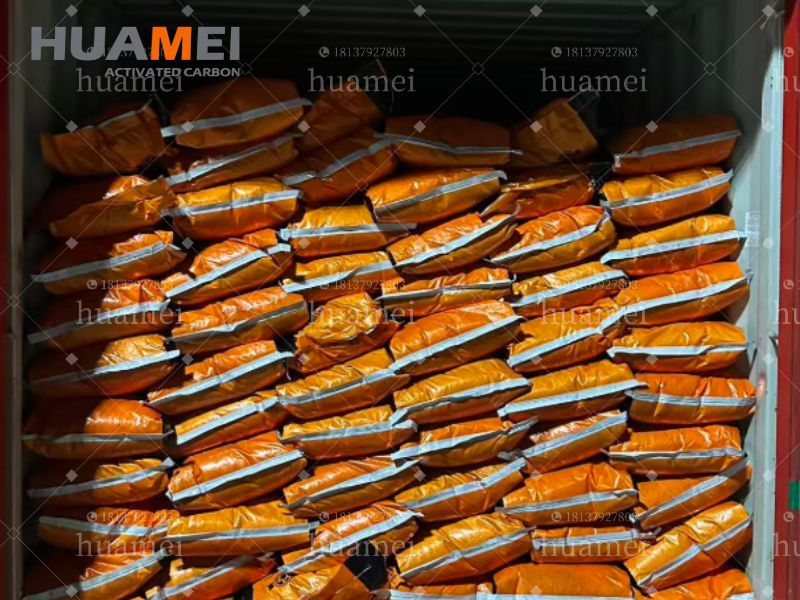
huamei gold recovery carbon 25kg bags

Reorder: 56 Tons in 2 × 40ft Containers

Based on the six-month results, the mine placed a reorder for 56 tons — this time in two 40ft high-cube containers (28 tons each) instead of four 20ft containers. The switch to 40ft containers reduced per-ton shipping cost by approximately 15%.

The reorder also included a request to pre-screen the carbon to tighten the 6×12 mesh distribution — minimizing the fraction of particles near the upper and lower size limits. This is a detail that experienced gold mine operators pay attention to: tighter particle size distribution means more uniform flow through the carbon bed and more consistent gold loading across all tanks.

What This Case Tells You About Choosing CIP Carbon

If you're running a CIP or CIL gold circuit and evaluating carbon suppliers, this project highlights three things:

  1. Hardness is not optional. In circuits processing more than 1,000 tpd, anything below 97% ball-pan hardness will cost you in carbon loss and gold recovery. The 5-point difference between 94% and 99% hardness translated to a 70% reduction in carbon loss per cycle.
  2. The cheapest carbon is rarely the cheapest option. The old carbon was priced lower per ton, but the mine was replacing inventory 3× faster and losing gold to tailings. Total cost of ownership — including carbon replacement and gold loss — favored the higher-spec product by a wide margin.
  3. Match the grade to the circuit, not the brochure. We recommended HMGOLD™7000, not the top-tier PLUS, because this mine's specific problem was hardness, not adsorption capacity. Over-specifying wastes money; under-specifying loses gold.

Sıkça Sorulan Sorular

What causes high carbon loss in CIP gold circuits?

The primary cause is low ball-pan hardness — carbon with hardness below 97% breaks down rapidly during elution, screening, and inter-stage pumping in CIP circuits. Secondary causes include oversized or undersized particles (poor mesh distribution), excessive pumping velocity, and thermal shock during kiln regeneration. In this Peru case, upgrading from 94% to 99% hardness reduced carbon loss from 8–10% to 2.5–3% per elution cycle.

How much activated carbon does a CIP gold mine need?

A typical CIP circuit carries 10–20 kg of carbon per ton of ore processed per day. For a 3,000 tpd operation, that's 30–60 tons of carbon in the circuit at any time. Initial loading for this Peru mine was 52 tons. The exact quantity depends on the number of adsorption stages, tank volume, carbon concentration, and residence time.

What is the difference between HMGOLD™7000 and HMGOLD™7500?

HMGOLD™7000 has an iodine number ≥1,100 mg/g with ≥99% ball-pan hardness. HMGOLD™7500 has a higher iodine number (≥1,150 mg/g) but slightly lower hardness specification (≥98.5%). For circuits where carbon durability is the priority (high-throughput CIP), HMGOLD™7000 is often the better choice. For CIL circuits where faster adsorption kinetics matter more, HMGOLD™7500 may be preferred. See the full HMGOLD™ product comparison.

Can I test HMGOLD™ carbon before ordering a full container?

Yes. We provide sample quantities (25–50 kg) for lab-scale gold adsorption testing (R-value and K-value tests). Many buyers run a 1–2 ton trial lot in a single adsorption tank before committing to a full circuit change. Minimum production order is 10 tons (one 20ft container).

How long does it take to ship activated carbon from China to Peru?

Sea freight from Xiamen or Ningde port to Callao typically takes 30–40 days. Production lead time is 15–25 days for standard grades, so total door-to-door is approximately 45–65 days from order confirmation. We can also arrange CIF Callao pricing if needed.

Evaluating carbon options for your CIP or CIL circuit? Send us your current carbon specs and circuit conditions — we'll recommend the right HMGOLD™ grade and provide a quote:

Activated Carbon for Gold Recovery: A Practical Buyer's Guide (2026)

This guide covers what you need to know when sourcing activated carbon for gold recovery — specifications, grades, pricing and purchase checks.

How Activated Carbon Works in Gold Recovery

Activated carbon adsorbs gold-cyanide complexes [Au(CN)₂]⁻ from solution. The contact arrangement differs between carbon-in-leach (CIL), carbon-in-pulp (CIP) and carbon-in-column (CIC) circuits:

Process Brief description Information for selection
CIL (Carbon-in-Leach) Carbon contacts slurry during leaching. Current carbon, slurry conditions, screens and operating concerns.
CIP (Carbon-in-Pulp) Carbon contacts pulp after leaching. Current carbon, adsorption conditions and performance concerns.
CIC (Carbon-in-Column) Dissolved gold is recovered using carbon columns. Solution conditions, flow, column or bed arrangement and current media.

Loaded carbon undergoes elution to remove adsorbed gold. Thermal reactivation is a separate step used to restore carbon for reuse. Contact conditions and recovery depend on the circuit; the process name alone does not specify a contact time or recovery percentage.

Key Specifications for Gold Recovery Carbon

Review gold recovery carbon specifications for the actual grade under evaluation. A generic gold-grade or water-treatment label does not define a universal specification.

Parametre What it helps evaluate What to verify
Gold adsorption Loading capacity and adsorption kinetics. Method, units, solution and test conditions.
Mechanical performance Resistance to particle degradation. Method, fines and relevant plant evaluation.
Particle size Screen and equipment compatibility. Sieve system and particle-size distribution.
İyot sayısı Supporting product characterization. Method and grade; not a gold-performance guarantee.
Ash and moisture Consistency and specification compliance. Method, basis and batch result.
Apparent density Loading calculations and consistency. Method, reporting basis and agreed grade specification.

A water-treatment label alone neither qualifies nor disqualifies a carbon for a gold circuit. Assess the actual grade and relevant test results.

Evaluate gold adsorption and mechanical performance together

Gold loading capacity and adsorption kinetics describe different aspects of performance. Compare results only when the test method, units and conditions are aligned. Iodine number is supporting information and does not replace a gold adsorption assessment.

For results reported as gold activity or a K value, request the definition, method, units and test conditions. Hardness and attrition are separate measurements; neither alone establishes plant carbon loss, gold loss or service life. Particle size also needs evaluation: for example, a 6×12 mesh label should be checked against the sieve system, full size distribution and retention screens.

Compare samples under aligned test conditions

Compare identified samples under aligned preparation and test conditions. Use the current operating carbon as a reference where available, and agree on acceptance criteria before testing. Laboratory results support selection but do not guarantee plant recovery or consumption.

Record sample identity, particle size, preparation, dry or wet basis, test solution, method, temperature, contact time and reference material.

Coconut Shell vs Coal-Based: Which One for Gold?

Coconut shell-based carbons are widely used in gold recovery, but raw material alone does not establish suitability. Compare the specific grades on gold adsorption performance, mechanical behaviour and particle size under relevant test conditions. A coal-based carbon alternative requires the same evaluation; do not select it solely on ore grade or a lower purchase price.

Compare the proposed grades using relevant adsorption and mechanical tests. An unqualified comparison of raw materials, prices or regeneration counts is not a substitute for evaluating the actual carbon.

Huamei activated carbon granules and bagged carbon loaded in a shipping container

How to Choose the Right Carbon for Your Operation

1. Your circuit type

For CIL and CIP, share the current carbon, slurry characteristics, screen openings, contact conditions and operating concerns. For CIC, provide solution conditions, flow, column or bed arrangement and the current media. Do not assign a universal hardness threshold from the process abbreviation.

2. Your ore and solution characteristics

Describe changes in feed and solution chemistry, potential fouling and the observed adsorption problem. If preg-robbing is suspected, review the circuit evidence with the responsible process team. Do not assume that a higher iodine number or an acid-washed label resolves the cause.

3. Your reactivation setup

Describe the existing elution and reactivation arrangements and how regenerated carbon is evaluated. Where reactivation is outsourced, include transport and handling in the assessment. Higher initial activity alone does not establish a longer operating life.

4. Price and total cost of ownership

Compare quotations on the same grade, specification, quantity, packaging and delivery terms. Check the quotation date and which transport and handling costs are included. For operating-cost comparisons, use plant-specific carbon consumption, reactivation and disposal data, together with any measured gold losses attributable to carbon. Avoid counting the same loss twice.

When requesting a price for gold recovery activated carbon, identify the grade, required tests, order quantity, packaging, delivery terms and destination. A current, clearly scoped quotation is more useful than a general price range without a date or specification.

Specifications We Supply for Gold Recovery

Huamei’s HMGOLD range includes HMGOLD6000, 7000, 7500 and PLUS. Request the TDS and batch documents for the grade under evaluation, and confirm the required particle size and acceptance tests before purchasing.

Confirm which documents and test results are available for the proposed grade and delivered batch. A sample report does not establish that every batch or every grade has been tested for the same properties.

For a supplier comparison, see the gold recovery carbon brands and suppliers guide. Compare the exact proposed grade and its evidence rather than brand names alone.

Common Problems and How to Avoid Them

Problem: Gold recovery dropping over time

Possible factors include changes in feed or solution conditions, carbon fouling, adsorption conditions and the condition of regenerated carbon. Review plant trends and compare relevant carbon samples with a defined reference using an agreed test method. Confirm the cause before changing the carbon or operating procedure.

Problem: High carbon attrition

Review the carbon grade and particle-size distribution together with screening, transfer and other handling conditions. Compare mechanical test results using the same method. Investigate where fines are generated rather than assuming that one hardness threshold will solve the problem.

Problem: Gold not stripping completely

Review the loaded-carbon condition, solution chemistry and elution operating records with the responsible process team. Evaluate the findings against the plant’s approved procedure and relevant supplier information. Do not apply a universal temperature or time adjustment from a purchasing guide.

Problem: Inconsistent quality between shipments

Compare batch identity, agreed specifications, sampling procedures and test methods before attributing the difference to the raw material. Review the batch documents and retained samples, and follow the agreed retesting and dispute-resolution procedure.

SSS

What iodine number is best for gold recovery?

There is no single iodine number that establishes suitability for every gold circuit. Iodine number provides supporting information about the carbon, while gold adsorption capacity, adsorption kinetics, mechanical performance and particle size need separate evaluation. Review the specific grade, the test method and your operating requirements rather than treating an iodine value as a recovery guarantee.

How long does activated carbon last in a gold plant?

There is no universal service life or regeneration count. Carbon condition depends on the circuit, handling, fouling, elution and reactivation practices. Track particle degradation, relevant adsorption tests and plant performance over time. Elution and thermal reactivation are different steps, so their cycle counts should not be used interchangeably.

What's the difference between CIL and CIP carbon requirements?

CIL combines leaching and carbon adsorption, while CIP introduces carbon to pulp after leaching. Both require a grade suited to the actual adsorption and mechanical demands of the circuit. Assess the slurry, screening, contact conditions and operating concerns. Do not assign a universal hardness threshold or contact time solely from the process abbreviation.

Can I use the same carbon for gold and water treatment?

Application labels alone are not enough to decide. A carbon sold for water treatment should not be substituted without evaluating the specific grade against gold adsorption, mechanical and particle-size requirements. Compare relevant test data and agree on a trial or acceptance plan where needed. Suitability cannot be determined from iodine number or purchase price alone.

How do I test carbon quality when it arrives?

Check packaging, batch identification and supplied documents against the purchase agreement. Visual inspection is only an initial check. Use an agreed sampling and testing procedure for acceptance, retain samples where required and compare results using the specified methods. Confirm laboratory availability and turnaround rather than assuming a fixed testing time.

What to include in your quotation request

For an RFQ, include the current grade or specification, particle size, required tests and methods, quantity, packaging, delivery terms and destination. State the circuit type and operating concern. If replacing an existing product, provide its technical information for comparison.

Discuss your gold recovery carbon requirements

Send your current specification, circuit type, required tests, quantity and destination.

Request a Gold Recovery Carbon Quote →

Related reading: Mısır'a 84 Ton Altın Geri Kazanımı için Aktif Karbon · Choosing Activated Carbon for Water Treatment