Jacobi AquaSorb 2000: Specs, Comparison & Alternatives
Jacobi AquaSorb® 2000: Specs, Comparison & Alternatives
Jacobi AquaSorb® 2000 is a coal-based granular activated carbon widely specified in municipal and industrial water treatment projects. If you're currently using AquaSorb® 2000 and evaluating alternative coal-based GAC suppliers — whether for supply chain diversification, procurement flexibility, or project specifications that accept equivalent products — this guide provides a detailed spec comparison and a practical framework for validating alternatives.
Activated carbon equivalence means a replacement product that matches the original on all critical performance parameters — iodine number, particle size distribution, apparent density, hardness, and ash content — verified through identical ASTM test methods and confirmed by parallel pilot testing under your specific operating conditions.
AquaSorb® 2000 Technical Specifications
The core specifications of AquaSorb® 2000 define what any alternative must match. The following data is compiled from Jacobi's published technical datasheet (TDS).
| Parametre | AquaSorb® 2000 (TDS) | Test Method |
|---|---|---|
| Base material | Bituminous coal, steam activated | — |
| İyot sayısı | min. 950 mg/g | ASTM D4607 |
| Ball-pan hardness | 95–96% | ASTM D3802 |
| Apparent density | min. 480 kg/m³ (typical 490–520 kg/m³) | ASTM D2854 |
| kül içeriği | max. 15% | ASTM D2866 |
| Moisture content | max. 5% | ASTM D2867 |
| Particle size | 12×40 US Mesh (0.425–1.70 mm) | ASTM D2862 |
Note: Jacobi may issue updated TDS versions with revised specifications. Always request the latest datasheet directly from Jacobi Carbons for project-critical decisions. AquaSorb® is a registered trademark of Jacobi Carbons.
AquaSorb® 2000 is primarily designed for:
- Municipal drinking water treatment — taste, odor, and organic compound removal
- Industrial process water purification
- Dechlorination — free chlorine and chloramine reduction in pre-treatment systems
- Organic contaminant adsorption — THMs, pesticides, phenols
What Defines a True Equivalent?
A true equivalent must match the original product across all performance-critical parameters simultaneously — not just iodine number alone. Here's what each parameter controls in your system:
| Parametre | Role in System Performance | Matching Criteria |
|---|---|---|
| İyot sayısı | Micropore volume indicator;
correlates with small-molecule adsorption capacity |
Must meet min. 950 mg/g per ASTM D4607 |
| Ball-pan hardness | Resistance to mechanical breakdown
during backwash — low hardness generates fines that increase pressure drop |
Must be tested by ASTM D3802 (ball-pan method);
do not compare directly with abrasion number from different test methods |
| Particle size distribution | Determines flow rate, pressure drop,
bed expansion, and backwash hydraulics |
Must match the specified mesh range (e.g., 12×40)
with similar distribution curve |
| Apparent density | Determines carbon mass per unit volume
in your existing vessel |
Should fall within ±10% of the reference value |
| kül içeriği | Mineral residue that reduces effective pore
volume; can leach into treated water |
Must not exceed the project specification limit |
Important: A carbon that meets iodine number requirements but has a significantly different particle size distribution will alter your system's hydraulic profile — pressure drop, flow distribution, and backwash performance will all change.
Huamei Coal-Based GAC: Available Specifications
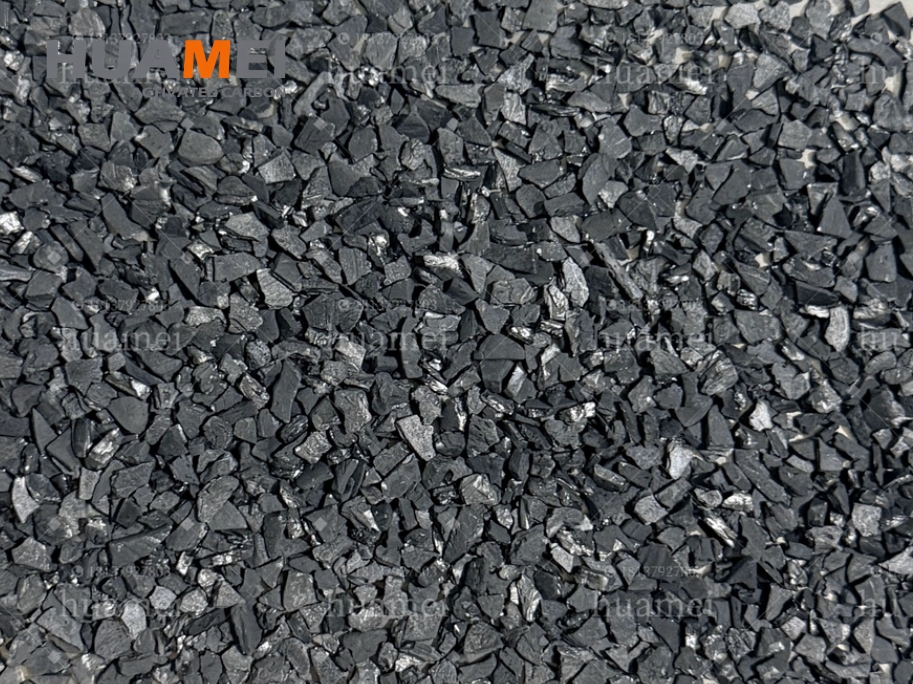
Huamei's coal-based granular activated carbon is manufactured from bituminous coal using steam activation — the same raw material category and activation process as AquaSorb® 2000. Below are the published specifications from Huamei's product page:
| Parametre | AquaSorb® 2000 (TDS) | Huamei Coal-Based GAC | Notes |
|---|---|---|---|
| Base material | Bituminous coal,
steam activated |
Bituminous coal,
steam activated |
Same material and process category |
| İyot sayısı | min. 950 mg/g | 500–1,000 mg/g
(range across grades) |
Customer must specify grade
with iodine ≥950 and confirm with batch COA |
| Ball-pan hardness | 95–96% | ≥95% | Both use ball-pan hardness;
comparable range |
| Apparent density | min. 480 kg/m³
(typical 490–520) |
450–520 kg/m³ | Overlapping range;
verify specific batch data |
| kül içeriği | max. 15% | max. 12% | Huamei's published
spec is tighter |
| Moisture content | max. 5% | max. 3% | Huamei's published
spec is lower |
| Available mesh sizes | 12×40 | 4×8, 6×12, 8×30,
12×40, 20×50, 30×60 |
12×40 available to match |
Key points for buyers evaluating this comparison:
- Huamei's iodine range spans 500–1,000 mg/g across all coal-based grades. For AquaSorb® 2000 equivalence, you need to specify a grade with iodine ≥950 mg/g and verify this with a batch-specific Certificate of Analysis (COA).
- Hardness values are comparable, and both manufacturers use ball-pan hardness (ASTM D3802), making the comparison valid.
- Apparent density ranges overlap. The specific batch value matters — request COA data and confirm the density falls within your system's design parameters.
- Whether the specs on paper translate to equivalent field performance depends on your water chemistry, flow conditions, and target contaminants. Pilot testing is the only reliable way to confirm.
Huamei does not sell Jacobi AquaSorb® products. We manufacture our own coal-based GAC as an independent alternative.
Certifications and Quality Documentation
Certifications, management systems, and third-party testing serve different purposes. They are not interchangeable:
| Category | AquaSorb® 2000 | Huamei Coal-Based GAC |
|---|---|---|
| Product certification | NSF/ANSI 61 available
(varies by grade and production facility) |
Contact Huamei to confirm current NSF/ANSI 61
certification status for the specific grade you need |
| Quality management system | ISO 9001 | ISO 9001 certified |
| Third-party testing | Batch COA available | Batch COA with ASTM-referenced methods;
SGS third-party inspection available on request |
If your project requires NSF/ANSI 61 certification (common in U.S. and international municipal drinking water projects), you must confirm whether the specific product grade and production facility hold current NSF listing. ISO 9001 and SGS inspection reports demonstrate quality management and testing capability, but they do not replace product-specific certifications required by regulation.
How to Validate an Alternative Before Switching
Switching activated carbon in an operating water treatment system carries performance risk. Follow this validation process to minimize that risk:
Step 1 — Request samples and batch COA. A reliable manufacturer provides free samples with a Certificate of Analysis showing results for all key parameters tested per ASTM standard methods. The COA should reference the specific batch, not generic product specifications.
Step 2 — Run independent laboratory tests. Do not rely solely on the supplier's COA. Test iodine number (ASTM D4607), ball-pan hardness (ASTM D3802), apparent density (ASTM D2854), particle size distribution (ASTM D2862), ash (ASTM D2866), and moisture (ASTM D2867) in your own lab or through an accredited third party.
Step 3 — Conduct a pilot column test. For drinking water applications, run a parallel pilot column alongside your existing AquaSorb® 2000 bed. Compare breakthrough curves for chlorine, TOC, and your specific target contaminants under identical flow conditions. This is the only way to confirm real-world equivalence.
Step 4 — Verify certifications. Confirm that the alternative carbon holds any product-specific certifications required by your project (NSF/ANSI 61, AWWA B604, EN 12915). Request documentary evidence — not verbal assurances.
Step 5 — Trial in a single vessel. Load the alternative carbon into one filter vessel while maintaining your existing carbon in others. Monitor performance over a full service cycle before committing to a system-wide change.

Coal-Based vs. Coconut Shell GAC: Choosing the Right Raw Material
Coal-based GAC and coconut shell GAC have different pore structures, and each is better suited to certain applications. However, actual performance varies significantly depending on the specific raw material source, activation conditions, and product grade — these are typical characteristics, not universal rules:
| Characteristic | Coal-Based GAC (typical) | Coconut Shell GAC (typical) |
|---|---|---|
| Pore structure | Broader pore size distribution
(micro + mesopores) |
Predominantly microporous |
| Typical applications | Municipal water treatment,
industrial wastewater, dechlorination |
Altın kurtarma, high-purity water,
small-molecule adsorption |
| Hardness range | Varies by grade; typically
85–96% (ball-pan) |
Typically 95–99% (ball-pan) |
| Ash content range | Typically 8–15% | Typically 2–5% |
| Reactivation | Structure retention varies
by grade and reactivation conditions |
Generally retains structure well
through multiple thermal cycles |
For water treatment applications matching AquaSorb® 2000's design intent — broad-spectrum organic removal, dechlorination, taste and odor control — coal-based GAC with its balanced micro/mesopore structure is typically the appropriate choice. The mesopore content allows removal of larger organic molecules that micropore-dominant carbons may not capture efficiently.
For applications requiring very low ash content or very high hardness (such as high-purity pharmaceutical water), coconut shell GAC may be more suitable despite higher cost.
Working with Huamei: What to Expect
Huamei is a coal-based and coconut shell activated carbon manufacturer based in China (Fujian and Ningxia provinces). Key facts relevant to procurement:
- Products: Coal-based GAC, coconut shell GAC, wood-based PAC, and pelletized activated carbon
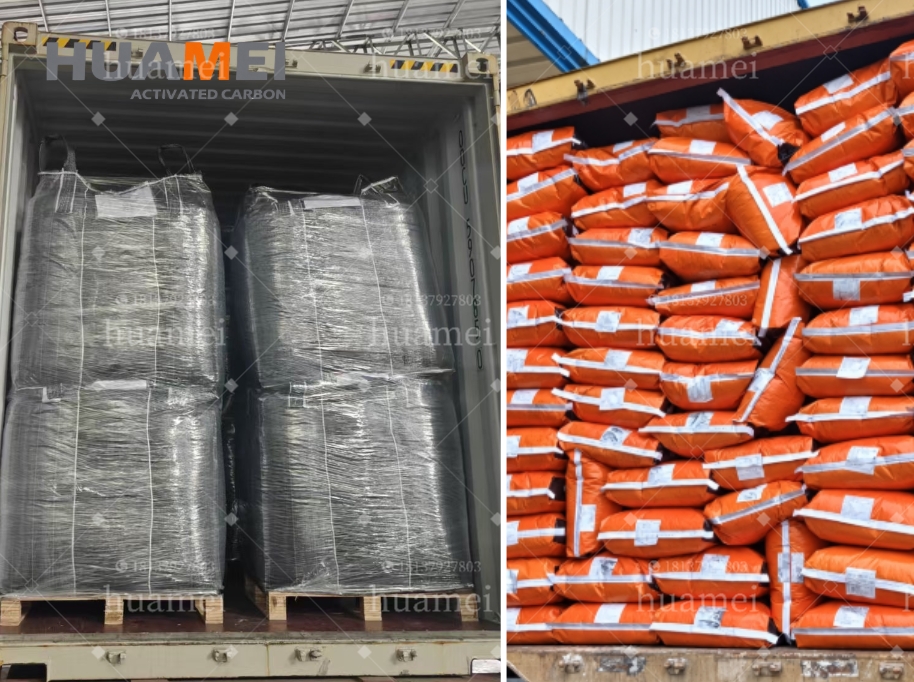
- Minimum order: One 20-foot container (approximately 10–12 tonnes depending on product form and packaging)
- Paketleme: 25 kg PP woven bags on pallets, 500 kg or 1,000 kg jumbo bags (FIBC), or custom packaging
- Samples: Free samples provided with batch-specific COA
- Quality assurance: ISO 9001 certified; batch COA issued before shipment; SGS or other third-party inspection available on request
- Export experience: Shipped to 40+ countries including municipal water treatment projects in the Middle East, Africa, and Southeast Asia
Coal-based GAC is not a one-size-fits-all product. Huamei's coal-based GAC range covers iodine values from 500 to 1,000 mg/g. When requesting a quote or sample, specify your required iodine number, mesh size, and application so the correct grade can be matched to your needs.
Huamei does not sell or distribute Jacobi AquaSorb® products. We manufacture our own activated carbon product lines. Whether our coal-based GAC is a suitable alternative for your specific application depends on your water quality, system design, operating conditions, and testing results.
Sıkça Sorulan Sorular
What is the difference between AquaSorb® 2000 and AquaSorb® 2000 Plus?
AquaSorb® 2000 Plus is an enhanced-activity version with a higher minimum iodine number (typically 1,000 mg/g vs. 950 mg/g for the standard 2000). If your project specification references AquaSorb® 2000 Plus, any alternative must match the Plus-grade specifications, not the standard 2000.
Can I compare ball-pan hardness with abrasion number directly?
No. Ball-pan hardness (ASTM D3802) and abrasion number (ASTM D3802 variant or other methods) use different test procedures and produce results on different scales. A ball-pan hardness of 95% and an abrasion number of 70 are not directly comparable. Always confirm which test method was used and compare like with like.
What ASTM standards should I reference when comparing GAC products?
For water treatment GAC comparison, the essential tests are: D4607 (iodine number), D3802 (ball-pan hardness), D2854 (apparent density), D2862 (particle size distribution), D2866 (total ash), and D2867 (moisture). Request COA data that references these specific method numbers.
How do I confirm whether an alternative carbon will perform the same in my system?
Matching datasheet specifications is necessary but not sufficient. The only reliable way to confirm equivalent field performance is running a parallel pilot column test with your actual water, at your operating flow rate, measuring breakthrough for your target contaminants. Datasheet specs predict potential; pilot data confirms performance.
Does Huamei sell Jacobi AquaSorb® 2000?
No. AquaSorb® is a Jacobi Carbons product line. Huamei manufactures its own coal-based GAC using bituminous coal and steam activation. The products share the same raw material category and activation process, but they are independent product lines from different manufacturers.
Related Articles
- Granular Activated Carbon for Water Treatment: Complete Guide
- Activated Carbon for Drinking Water: Specs, Standards & How to Order
- Activated Carbon for Chlorine Removal: Specs, Design & Selection
- Activated Carbon for Industrial Water Treatment: Selection by Application
- Activated Carbon Quality Testing Methods
- Activated Carbon ASTM Standards Guide
Huamei provides free samples with batch-specific COA. Tell us your required iodine number, mesh size, and application — we'll match the right grade.
📱 WhatsApp: +86 181-3792-7803 · 📧 sale@huameicarbon.com · 🌐 huameicarbon.com