52 Tons HMGOLD™7000 to Peru: CIP Recovery from 93.5% to 97.3%

A gold mine in La Libertad, Peru — processing 3,000 tons of ore per day through a CIP circuit — was losing 8–10% of its carbon inventory every elution cycle. The old carbon had a ball-pan hardness of just 94%. Recovery had dropped from 96% to 93.5%, and the operation was bleeding gold into tailings. After switching to HMGOLD™7000 (iodine ≥1,100 mg/g, hardness ≥99%, 6×12 mesh), carbon loss dropped to 2.5–3% per cycle, recovery climbed to 97.3%, and the mine recovered an extra ~320 grams of gold per day — approximately $24,000 in additional daily revenue at the time of reporting. This is how that project came together.

The Problem: 94% Hardness Carbon Was Destroying Recovery

The mine's CIP circuit ran six adsorption tanks in series. The carbon they were using — a generic coconut shell product from a Southeast Asian supplier — was specified at 94% ball-pan hardness. On paper, 94% sounds fine. In a 3,000 tpd CIP circuit, it's not.

Here's what was happening:

Metric Before (Old Carbon) Target
Ball-pan hardness 94% ≥98%
Carbon loss per elution 8–10% <3%
Gold recovery rate 93.5% (declining) ≥96%
Fine carbon in tailings Visible on screens Minimal
Elution cycles before replacement 30–40 cycles 50+ cycles

The mechanism is straightforward: every time carbon goes through the elution kiln and gets pumped back into the adsorption circuit, the granules collide with each other, the ore slurry, and the inter-stage screens. Low-hardness carbon breaks down into fines. Those fines are too small to be retained by the screens — they pass through and end up in tailings, carrying adsorbed gold with them.

At 8–10% loss per cycle, the mine was replacing its entire carbon inventory roughly every 10–12 cycles. That's not just a carbon cost problem — it's a gold loss problem. Every kilogram of carbon fines leaving the circuit carries gold that will never be recovered.

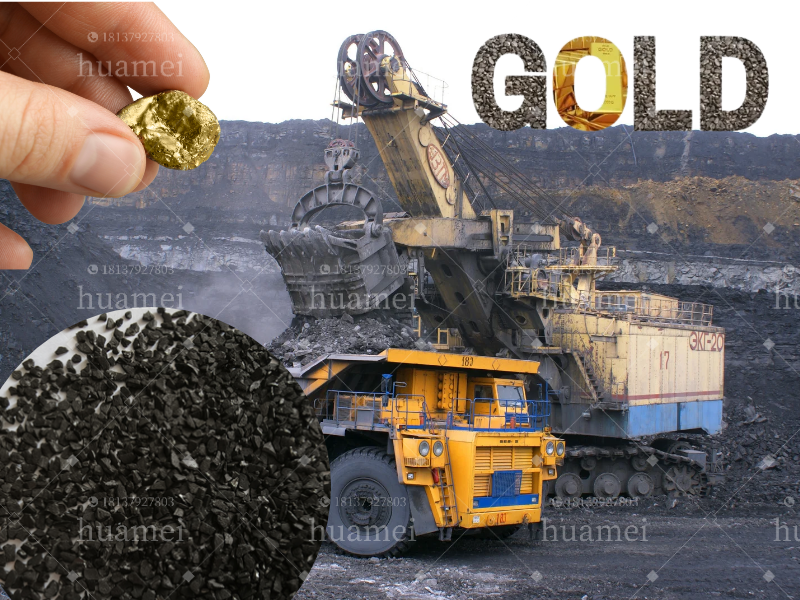
Coconut shell activated carbon granules held in hand showing 6×12 mesh particle size (left), gold bars representing CIL/CIP gold recovery application (top right), and Huamei Premium Activated Carbon 25 kg bag in orange and black packaging (bottom right)

Why Hardness Matters More Than Iodine Number in High-Throughput CIP

Most buyers ask about iodine number first. It makes sense — iodine number indicates adsorption capacity, and higher numbers mean faster gold loading. But in a high-tonnage CIP circuit like this one, hardness is the controlling parameter.

Here's the math that convinced this buyer:

Scenario 94% Hardness 99% Hardness
Starting carbon inventory 52 ton 52 ton
Loss per elution cycle 9% (midpoint) 2.75% (midpoint)
Carbon lost per cycle 4.68 tons 1.43 tons
Cycles to lose 50% inventory ~7 cycles ~24 cycles

*Based on 26 elution cycles/year (biweekly), FOB carbon price ~$1,800/ton for gold-grade coconut shell GAC.

The carbon replacement cost difference alone is ~$145,000/year. Add the gold recovery improvement (from 93.5% to 97.3% on 3,000 tpd of ore), and the economics become overwhelming.

Huamei's Recommendation: HMGOLD™7000

After reviewing the mine's circuit design, ore characteristics, and operating conditions, we recommended HMGOLD™7000 — not the higher-grade HMGOLD™7500 or PLUS. Here's why:

Parametre HMGOLD™7000 Old Carbon Why It Matters
İyot Sayısı ≥1,100 mg/g ~1,000 mg/g Faster gold loading in the first 2–3 tanks
Ball-Pan Hardness ≥99% 94% Dramatically reduces carbon fines and gold loss
Kül İçeriği ≤3% ~5% Less inert material, more active carbon surface
Nem ≤5% ~6% Less water weight per bag
Mesh Size 6×12 6×12 Standard CIP sizing — no screen modifications needed

Why not HMGOLD™7500 or PLUS? The mine's ore grade and circuit throughput didn't justify the premium. HMGOLD™7000's ≥1,100 mg/g iodine number was more than sufficient for this operation, and the ≥99% hardness — actually higher than both HMGOLD™7500 (≥98.5%) and PLUS (≥98%) — was the priority for solving their carbon loss problem. We recommended the grade that solved the specific problem, not the most expensive option.

Shipment: 52 Tons in 4 × 20ft Containers to Callao

Item Details
Ürün HMGOLD™7000 Coconut Shell Activated Carbon
Miktar 52 tons (4 × 13 tons per 20ft container)
Ambalajlama 25 kg woven bags on pallets
Destination Port Callao, Peru
Origin Port Xiamen, China
Transit Time ~15 days (sea freight)
Documentation COA per container, MSDS, phytosanitary certificate

Each 20ft container was loaded with 13 tons — the standard loading capacity for 25 kg bags on pallets in a 20ft dry container. The mine requested COA testing for each container lot, including iodine number, hardness, ash, moisture, and particle size distribution. All four lots tested above spec.

Results After 6 Months

The mine ran HMGOLD™7000 through their full CIP circuit for six months before reporting back. The numbers:

Metric Before (Old Carbon) After 6 Months (HMGOLD™7000) Change
Gold recovery rate 93.5% 97.3% +3.8 percentage

points

Carbon loss per elution 8–10% 2.5–3% Reduced by ~70%
Additional gold

recovered/day

Baseline +~320 grams ~$24,000/day

additional revenue

Carbon inventory stability Full replacement

every 10–12 cycles

Stable with top-up only Replacement cost

down ~70%

Fine carbon in tailings Visible on inter-

stage screens

Minimal Significant reduction

The 3.8-point recovery improvement came from two sources: (1) less gold leaving the circuit on carbon fines, and (2) higher iodine number providing better adsorption kinetics in the lead tanks. The mine estimated the combined impact at roughly 320 grams of additional gold recovered per day across their 3,000 tpd throughput — approximately $24,000 per day in additional revenue based on the gold price at the time of reporting. That's from a carbon change that cost under $100,000.
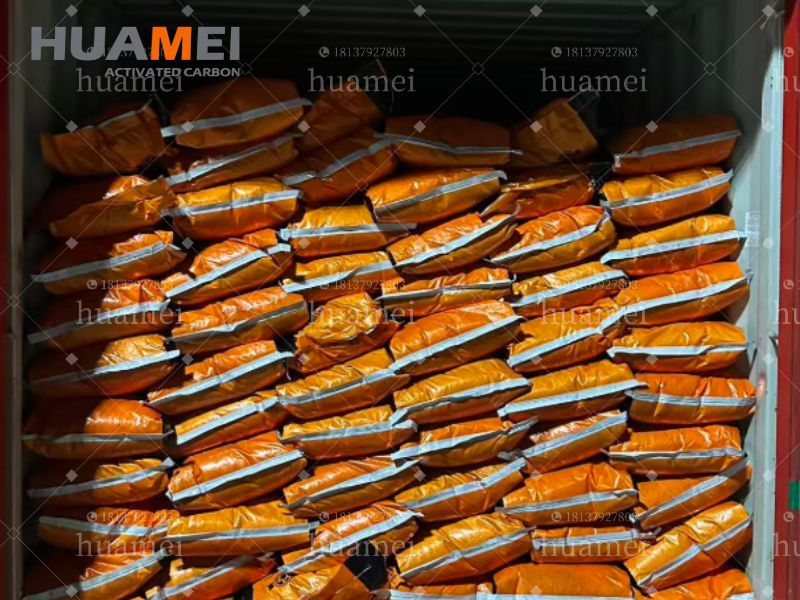
huamei gold recovery carbon 25kg bags

Reorder: 56 Tons in 2 × 40ft Containers

Based on the six-month results, the mine placed a reorder for 56 tons — this time in two 40ft high-cube containers (28 tons each) instead of four 20ft containers. The switch to 40ft containers reduced per-ton shipping cost by approximately 15%.

The reorder also included a request to pre-screen the carbon to tighten the 6×12 mesh distribution — minimizing the fraction of particles near the upper and lower size limits. This is a detail that experienced gold mine operators pay attention to: tighter particle size distribution means more uniform flow through the carbon bed and more consistent gold loading across all tanks.

What This Case Tells You About Choosing CIP Carbon

If you're running a CIP or CIL gold circuit and evaluating carbon suppliers, this project highlights three things:

  1. Hardness is not optional. In circuits processing more than 1,000 tpd, anything below 97% ball-pan hardness will cost you in carbon loss and gold recovery. The 5-point difference between 94% and 99% hardness translated to a 70% reduction in carbon loss per cycle.
  2. The cheapest carbon is rarely the cheapest option. The old carbon was priced lower per ton, but the mine was replacing inventory 3× faster and losing gold to tailings. Total cost of ownership — including carbon replacement and gold loss — favored the higher-spec product by a wide margin.
  3. Match the grade to the circuit, not the brochure. We recommended HMGOLD™7000, not the top-tier PLUS, because this mine's specific problem was hardness, not adsorption capacity. Over-specifying wastes money; under-specifying loses gold.

Sıkça Sorulan Sorular

What causes high carbon loss in CIP gold circuits?

The primary cause is low ball-pan hardness — carbon with hardness below 97% breaks down rapidly during elution, screening, and inter-stage pumping in CIP circuits. Secondary causes include oversized or undersized particles (poor mesh distribution), excessive pumping velocity, and thermal shock during kiln regeneration. In this Peru case, upgrading from 94% to 99% hardness reduced carbon loss from 8–10% to 2.5–3% per elution cycle.

How much activated carbon does a CIP gold mine need?

A typical CIP circuit carries 10–20 kg of carbon per ton of ore processed per day. For a 3,000 tpd operation, that's 30–60 tons of carbon in the circuit at any time. Initial loading for this Peru mine was 52 tons. The exact quantity depends on the number of adsorption stages, tank volume, carbon concentration, and residence time.

What is the difference between HMGOLD™7000 and HMGOLD™7500?

HMGOLD™7000 has an iodine number ≥1,100 mg/g with ≥99% ball-pan hardness. HMGOLD™7500 has a higher iodine number (≥1,150 mg/g) but slightly lower hardness specification (≥98.5%). For circuits where carbon durability is the priority (high-throughput CIP), HMGOLD™7000 is often the better choice. For CIL circuits where faster adsorption kinetics matter more, HMGOLD™7500 may be preferred. See the full HMGOLD™ product comparison.

Can I test HMGOLD™ carbon before ordering a full container?

Yes. We provide sample quantities (25–50 kg) for lab-scale gold adsorption testing (R-value and K-value tests). Many buyers run a 1–2 ton trial lot in a single adsorption tank before committing to a full circuit change. Minimum production order is 10 tons (one 20ft container).

How long does it take to ship activated carbon from China to Peru?

Sea freight from Xiamen or Ningde port to Callao typically takes 30–40 days. Production lead time is 15–25 days for standard grades, so total door-to-door is approximately 45–65 days from order confirmation. We can also arrange CIF Callao pricing if needed.

Evaluating carbon options for your CIP or CIL circuit? Send us your current carbon specs and circuit conditions — we'll recommend the right HMGOLD™ grade and provide a quote:

56 Tons Gold Recovery Carbon: Repeat Order from Tanzania

In gold recovery, activated carbon is not a commodity you buy on price alone.

For mines running CIL (carbon-in-leach) and CIP (carbon-in-pulp) circuits, the carbon's particle size, adsorption capacity, mechanical strength, and attrition behavior all affect daily production and operating costs. A single batch with inconsistent specs can clog screens, reduce gold loading, or shorten reactivation cycles — problems that cost far more than whatever you saved on the purchase price.

That's why long-term carbon buyers care about two things above all else: specification consistency between shipments, and a supplier who can reliably meet their procurement schedule.

This Tanzania gold mine just placed their second order with Huamei Carbon — 56 tons of HMGOLD™ coconut shell activated carbon for their CIL circuit. Here's how this partnership developed from first contact to repeat purchase.

From First Order to Repeat Purchase

The relationship started when the mine was looking for a more consistent carbon supply. Their previous supplier's product had issues — uneven particle size and high ash content that made the carbon difficult to reactivate in the kiln.

That first order was 112 tons shipped in four 40-foot containers — a significant commitment for a new supplier relationship. The mine ran the carbon through their CIL circuit, confirmed the particle size uniformity, tested the reactivation performance, and tracked gold loading across multiple cycles.

The results held up. And when it was time to restock, they came back.

Why 56 Tons This Time?

The first order (112 tons) was an initial inventory fill — replacing the old carbon stock entirely. This 56-ton repeat order reflects the mine's ongoing consumption rate. For a CIL plant, annual fresh carbon consumption typically runs 50–200 tons depending on ore throughput, carbon attrition, and reactivation efficiency. A 56-ton order covers roughly 6–12 months of makeup carbon for a mid-size operation.

The shift from a large trial order to a regular resupply order is a normal pattern — and a good sign. It means the carbon is performing as expected in the circuit, and the mine has incorporated Huamei into their ongoing procurement plan rather than treating us as a one-time alternative.

Huamei HMGOLD coconut shell granular activated carbon for gold recovery, showing black carbon granules

Order Specifications

Item Details
Ürün HMGOLD™ Coconut Shell Activated Carbon
Başvuru Gold recovery — CIL circuit
Destination Tanzania
Total volume 56 tons (2 × 40ft containers)
ağ boyutu 6×12
İyot sayısı ≥1100 mg/g
Ball-pan hardness ≥98%
kül içeriği <3%
Nem ≤5%

Same specs as the first order — no changes. In gold carbon procurement, that's exactly what you want. When a mine finds a carbon grade that works in their circuit, they lock in the specification and expect every future shipment to match. Changing specs means re-tuning elution parameters, adjusting screen apertures, and potentially re-qualifying the carbon through plant trials.

What Consistency Actually Means in Practice

When we say "specification consistency," we're not talking about matching a datasheet. We mean batch-to-batch uniformity across the parameters that directly affect gold recovery operations:

Parametre Why Consistency Matters What Happens When It Varies
Particle size

distribution (6×12 mesh)

Screens are calibrated for

a specific size range

Undersized particles pass through screens

→ carbon loss. Oversized particles reduce

surface area → lower gold loading

İyot sayısı

(≥1,100 mg/g)

Directly correlates with

gold adsorption capacity

Low iodine → lower gold loading

per kg of carbon

→ more carbon

needed per ounce

of gold recovered

Ball-pan hardness

(≥98%)

Determines carbon

survival rate in the circuit

Soft carbon breaks down faster

→ higher attrition losses

→ more frequent carbon replacement

Ash content (<3%) Affects reactivation

quality and carbon longevity

High ash carbon → poor kiln reactivation

→ reduced cycle life

→ more fresh carbon purchases

Moisture (≤5%) Affects weight accuracy

and handling

Excess moisture →

you're paying for water, not carbon.

Also causes clumping

during storage in tropical climates

For this 56-ton order, we pulled test samples from the production batch and compared results against the first 112-ton shipment's Certificate of Analysis. The numbers matched within normal production variance — not because we got lucky, but because the raw coconut shell source, activation process, and screening protocols haven't changed.

Supply Chain: From Order to Port

For repeat orders, the process is faster because specifications and logistics are already established:

  1. Order confirmation — Client confirms quantity (56 tons), same spec as previous PO. No re-negotiation needed.
  2. Production scheduling — Batch allocated from our monthly output (700+ tons/month capacity across Fujian and Ningxia facilities). Repeat orders get priority scheduling.
  3. Quality testing — Full in-house COA on the production batch: iodine, hardness, ash, moisture, particle size distribution. Results sent to client for approval before loading.
  4. Container loading — 56 tons loaded into 2 × 40ft containers. Loading photos and seal numbers sent to client.
  5. Shipping — Export documentation (commercial invoice, packing list, COA, MSDS, certificate of origin) prepared. Typical transit to Dar es Salaam: 25–35 days.

From order confirmation to cargo departure, the turnaround for a repeat order is typically 15–20 days — shorter than a first order because there's no sample stage, no spec negotiation, and no new logistics setup.

The Economics of Carbon Supplier Switching vs. Staying

Mining operations sometimes consider switching carbon suppliers to chase a lower price quote. Here's what that decision actually costs:

Factor Staying with Proven Supplier Switching to New Supplier
Sample testing Not needed 4–8 weeks for sample

+ lab testing

Plant trial Not needed 1–3 months of circuit

monitoring with new carbon

Risk of quality variance Low (track record established) Unknown until proven

in your circuit

Procurement lead time 15–20 days (repeat order) 8–16 weeks (sample

→ trial → first bulk order)

Operational disruption None Possible — if new carbon

behaves differently in

elution or reactivation

Price difference Known and stable May be 5–10% lower initially,

but hidden costs from above

factors can exceed savings

This is why experienced procurement managers at gold mines tend to maintain their carbon supplier — unless there's a genuine quality or supply failure. The cost of switching is real, even if it doesn't show up on the purchase order.

Gold mining and recovery using Huamei coconut shell granular activated carbon, featuring mining equipment, gold and carbon granules.

Tanzania: A Growing Gold Mining Market

Tanzania is Africa's fourth-largest gold producer, with major mining operations in the Lake Victoria Goldfields, Lupa Goldfield, and Mpanda Mineral Field. The country's gold mining sector has grown steadily, driven by both large-scale international operations and expanding medium-scale mines.

For activated carbon suppliers, Tanzania represents a consistent demand market:

Huamei Carbon currently supplies multiple clients in Tanzania. This 56-ton repeat order is one of several ongoing partnerships we maintain in the country.

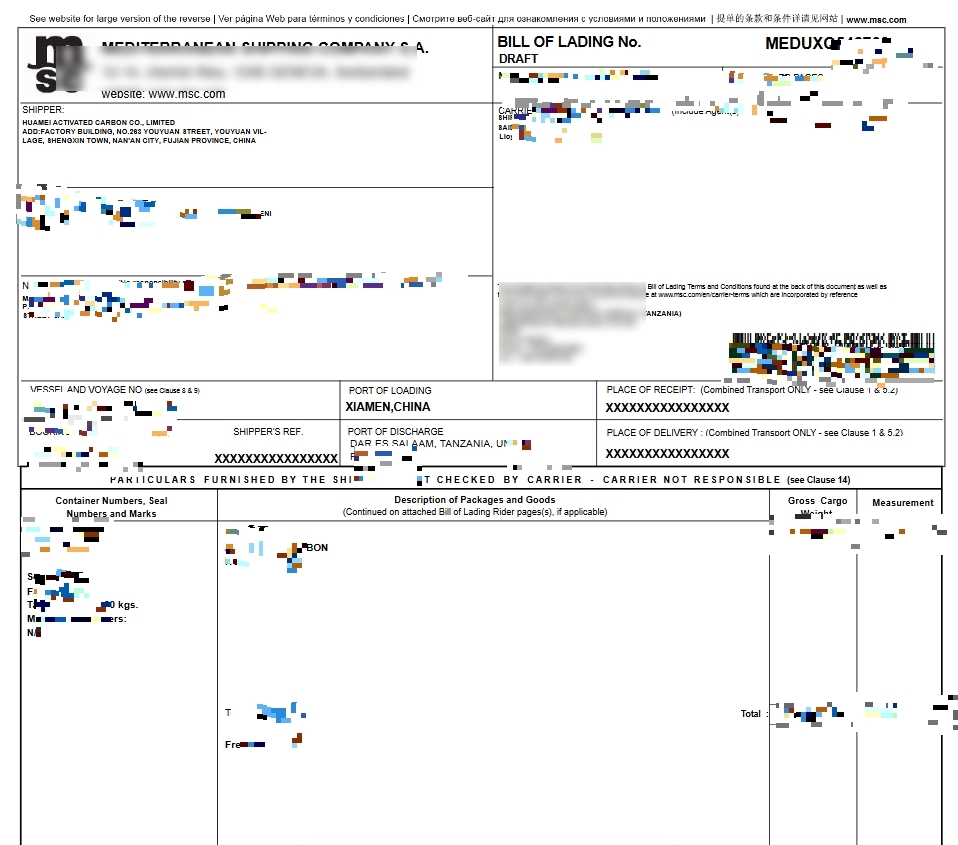
Bill of lading for Huamei's 56-ton gold recovery activated carbon shipment to Tanzania, documenting the export shipment.

What This Order Means to Us

For us, the real measure of success is not completing a shipment — it's whether the customer comes back for the next one.

From order confirmation to cargo departure, we focus on three things: that the product specifications match what was agreed, that communication is clear and timely, and that the supply arrangement runs smoothly enough that the buyer doesn't need to think about it.

This 56-ton repeat order from Tanzania confirms that those three things are working. And it's a partnership we intend to maintain.

Working with Huamei Carbon

We produce Hindistan cevizi kabuğu, kömür bazlıve wood-based activated carbon at our facilities in Fujian and Ningxia provinces, China. Monthly production capacity exceeds 700 tons.

For gold recovery, our HMGOLD™ series covers four grades — HMGOLD™6000, 7000, 7500, and PLUS — with iodine values from 1,050 to 1,200 mg/g, designed for CIP, CIL, and CIC circuits.

Whether you're sourcing gold recovery carbon for the first time or looking for a more consistent supply, the process starts the same way: tell us your specs and volume, and we'll send a quote with full technical data within 24 hours.

📱 WhatsApp: +86 181-3792-7803
📧 Email: sale@huameicarbon.com
🌐 Website: www.huameicarbon.com

Sıkça Sorulan Sorular

Why do gold mines place repeat orders with the same activated carbon supplier?

Specification consistency. Gold recovery circuits are calibrated for a specific carbon grade — particle size, iodine number, hardness, and ash content. Switching suppliers introduces risk: the new carbon may behave differently during elution, reactivation, or screening. The cost of testing, trialing, and potentially disrupting production usually outweighs any savings from a lower per-ton price.

How often do CIL gold plants reorder activated carbon?

Most CIL plants place fresh carbon orders every 3–12 months, depending on plant size and carbon attrition rate. A mid-size CIL operation processing 2,000–5,000 tons of ore per day typically consumes 50–200 tons of fresh carbon per year. Regular reorders — like this 56-ton shipment — indicate the mine's normal consumption cycle.

What is the minimum order quantity for gold recovery activated carbon from China?

10 tons (one 20-foot container). For better freight economics, most buyers order in 26–28 ton increments (one 40-foot container). This 56-ton order shipped in two 40-foot containers — a common configuration for repeat orders.

How do you ensure activated carbon quality stays consistent between shipments?

Three controls: standardized raw material sourcing (same coconut shell grade from the same supply chain), consistent activation process parameters (temperature, steam ratio, residence time), and multi-stage quality testing on every production batch. We compare each batch's COA against previous shipments to the same client, flagging any drift before the carbon ships.

Can I get a sample before placing a bulk order?

Yes. We send 1–5 kg samples from the production line — not hand-picked samples. The sample comes from the same process that produces the bulk order, so test results are representative of what you'll receive. Sample testing typically takes 2–4 weeks including shipping and lab analysis.

44 Tons Gold Recovery Carbon Shipped to UK

We just shipped 44 tons of gold recovery activated carbon to a trading company in the United Kingdom — their fourth repeat order in under two years.

This shipment went out in two 40-foot containers, loaded with HMGOLD series coconut shell activated carbon sized at 6×12 mesh. The carbon is heading to CIL and CIP gold processing plants through our UK partner's distribution network.

Here's the story behind this order and why a UK-based trader keeps coming back to the same Chinese factory.

Client Background: A UK Activated Carbon Trader

Our client is a trading company based in the United Kingdom that supplies activated carbon to gold mining operations across multiple regions. They source carbon from manufacturers worldwide and distribute to end users — mining companies running CIL (carbon-in-leach) and CIP (carbon-in-pulp) circuits.

Trading companies like this one serve an important role in the supply chain: they hold inventory closer to the end user, offer faster delivery than ordering direct from China, and provide local-language support and documentation. For mining operations that need carbon on short notice — say, when a kiln run is delayed or consumption exceeds forecast — having a regional trader with stock on hand can prevent costly production gaps.

The tradeoff is margin. Traders need competitive factory pricing to remain profitable while offering fair prices to their mining clients. That's where the factory-direct relationship matters.

How the Partnership Started

The first conversation happened about two years ago. The client had been sourcing gold recovery carbon from suppliers in Southeast Asia and was looking for an alternative — not because of quality issues, but because their end users were expanding and they needed a second reliable source with consistent output and competitive pricing.

We went through the standard process:

  1. Technical discussion — they shared the specs their mining clients required: iodine number above 1050 mg/g, hardness above 97%, 6×12 mesh, moisture under 5%
  2. Sample shipment — we sent 50 kg of HMGOLD for their client's lab testing. The sample came from the same production line that would fulfill the bulk order — not a hand-picked "golden sample"
  3. Lab results came back positive — iodine, hardness, and activity matched the datasheet. The carbon performed well in their client's screening tests
  4. Trial order — one 20-foot container, approximately 13 tons. We arranged SGS pre-shipment inspection at their request
  5. First repeat order within 4 months — same specs, but this time a full 40-foot container (26 tons)

Since then, they've ordered consistently — scaling from single containers to this latest 44-ton, two-container shipment.

Close-up of coconut shell granular activated carbon granules alongside jumbo bags loaded on pallets inside a shipping container at Huamei Carbon factory

What We Shipped: 44 Tons of HMGOLD Coconut Shell Carbon

This order was straightforward because the specs were already proven through previous shipments:

Parametre Şartname
Ürün HMGOLD series coconut shell activated carbon
Başvuru Altın kurtarma (CIL/CIP)
Mesh Size 6×12
İyot Sayısı ≥1050 mg/g
Sertlik ≥98%
Kül İçeriği ≤3%
Nem ≤5%
Miktar 44 tons

Nothing exotic here — and that's the point. For gold recovery carbon, consistency between batches matters more than pushing for the highest possible numbers on any single parameter. A mine running 24/7 needs to know that the carbon arriving this quarter will perform the same as last quarter's shipment.

Quality Control and Loading

Every shipment follows the same QC protocol, whether it's the first order or the tenth:

The fact that a client who started with mandatory SGS inspection now orders on in-house COA alone tells you something about how trust builds over time.

34 tons HMPAC-W22 activated carbon shipment to Italy

Why Trading Companies Choose Factory-Direct from China

For activated carbon traders, the economics are simple: the closer you buy to the production source, the more margin you have to work with downstream. But price alone doesn't sustain a trading relationship. What keeps traders coming back is:

Working with Huamei Carbon

We produce coconut shell, coal-based, and wood-based activated carbon at our facilities in Fujian and Ningxia provinces, China. For gold recovery applications, our HMGOLD series is specifically designed for CIL/CIP circuits — high iodine, high hardness, and tight particle size control to minimize gold loss from carbon attrition.

Whether you're a trading company looking for a reliable manufacturing partner, or a mining operation sourcing carbon directly, the process starts the same way: tell us your specs, and we'll send you a quote with full technical data within 24 hours.

Sıkça Sorulan Sorular

What activated carbon is used for gold recovery?

Coconut shell granular activated carbon in 6×12 mesh is the industry standard for CIL and CIP gold processing. Key specs: iodine number above 1050 mg/g for adequate gold loading capacity, hardness above 97% to survive the abrasive circuit, and ash below 3% to minimize interference with gold elution.

How much activated carbon does a gold mine use per year?

It varies with ore throughput and circuit design, but typical consumption ranges from 20–80 grams of carbon per ton of ore processed. A mid-size CIL plant processing 500,000 tons of ore annually might consume 30–100 tons of fresh carbon per year, depending on carbon attrition rates and reactivation efficiency.

Can I buy gold recovery carbon from China?

Yes. China is one of the largest producers of coconut shell activated carbon for gold recovery. Buying factory-direct from a Chinese manufacturer typically offers 20–40% cost savings compared to purchasing through regional distributors, with the same quality when you verify specs through third-party testing (SGS, Bureau Veritas, Intertek).

What is the minimum order for gold recovery activated carbon?

Most Chinese manufacturers have a minimum order of 10 tons (one 20-foot container). For optimal freight economics, ordering 26–28 tons (one 40-foot container) is recommended. Multi-container orders like this 44-ton shipment further reduce per-ton logistics costs.

How do you ensure quality consistency between batches?

Through standardized production protocols, in-house testing of every batch against the agreed specification, and optional third-party pre-shipment inspection. We also document every loading with photos and video. Clients can request test reports from previous shipments to verify batch-to-batch consistency before placing their first order.

13 Tons Gold Recovery Carbon Shipped to Djibouti

We recently shipped 13 tons of HMGOLD7000 coconut shell activated carbon for gold recovery to a mining client in Djibouti. One 20-foot container, packed with 25 kg bags, departed from our factory and headed to the Port of Djibouti.

This article covers the order background, why a 20GP container was the right fit for this volume, and how we ensure quality from factory floor to container seal.

Order Overview

Item Details
Ürün HMGOLD7000 coconut shell activated carbon

için altın kurtarma

Miktar 13 tons
Container 1 × 20GP
Ambalajlama 25 kg PP woven bags
Destination Port of Djibouti, Djibouti
End use Gold recovery (CIL/CIP process)

Why Djibouti

Djibouti sits at the Horn of Africa, where the Red Sea meets the Gulf of Aden. While the country's own gold mining sector is still developing, Djibouti's port and free trade zone make it a logistics gateway for the broader East African gold belt — including Ethiopia, Somalia, and parts of Sudan and Eritrea, all of which have active gold operations.

This particular order went directly to a mining operation in Djibouti. The client needed a reliable supply of gold recovery carbon with consistent adsorption performance for their CIL circuit. After evaluating samples, they placed an initial order of 13 tons — a practical volume for a 20GP container and a good starting point to validate the carbon in their plant before scaling up.

25 kg bags of HMGOLD7000 gold recovery activated carbon loaded inside 20GP shipping container to Djibouti

Why 25 kg Bags in a 20GP Container

A standard 20-foot container (20GP) handles up to 21–22 tons of payload. For 13 tons of activated carbon, it's the right choice:

huamei activated carbon woker

Loading and Quality Control

Every shipment from our factory follows the same process, whether it's 13 tons to Djibouti or 140 tons to Egypt:

  1. Pre-shipment testing — iodine number, hardness, ash content, moisture, and particle size distribution are tested against the order specification before any bags are packed
  2. Container inspection — we check the container for cleanliness, structural damage, odor, and moisture before loading. Activated carbon is hygroscopic — it must go into a clean, dry container
  3. Supervised loading — our team documents the entire loading process with photos and video. The client receives these in real time via WhatsApp so they can verify bag condition, stacking pattern, and quantity
  4. Seal and ship — the container seal number is photographed and shared immediately after sealing. Bill of lading, packing list, and test certificate follow within 24 hours

For clients who can't visit the factory — which is most of our African customers — these loading photos and videos are their eyes on the ground. It's not a sales gimmick. It's how we've built repeat orders across 40+ countries.

About HMGOLD7000

HMGOLD7000 is our mid-range gold recovery carbon, designed for CIL and CIP circuits that need solid adsorption kinetics without the premium price tag of our top-tier HMGOLD7500. It's made from coconut shell, steam-activated in our kilns in Fujian and Ningxia provinces, China.

HMGOLD7000 is a proven workhorse in gold plants across East Africa, West Africa, and Central Asia. For full specifications, visit our HMGOLD product page.

Sıkça Sorulan Sorular

Can you ship activated carbon to Djibouti?

Yes. We ship regularly to ports across East Africa, including Djibouti, Dar es Salaam, Mombasa, and Port Sudan. Djibouti's port handles container cargo efficiently, and we can arrange CIF or FOB terms depending on your preference.

What is the minimum order for gold recovery carbon?

Our minimum order quantity is 10 tons — enough to fill a 20GP container. For first-time buyers, we recommend starting with one container to test the carbon in your plant, then scaling up based on results.

How do I verify quality before shipment?

We provide pre-shipment samples and test reports for every batch. You can also arrange third-party inspection (SGS, Bureau Veritas, Intertek) at our factory. During loading, we share real-time photos and videos via WhatsApp so you can monitor the process remotely.

Need gold recovery carbon delivered to East Africa? We've shipped to Djibouti, Tanzania, Egypt, Niger, Benin, Sudan, Ghana, and more. Tell us your volume and specs — we'll quote within 24 hours.