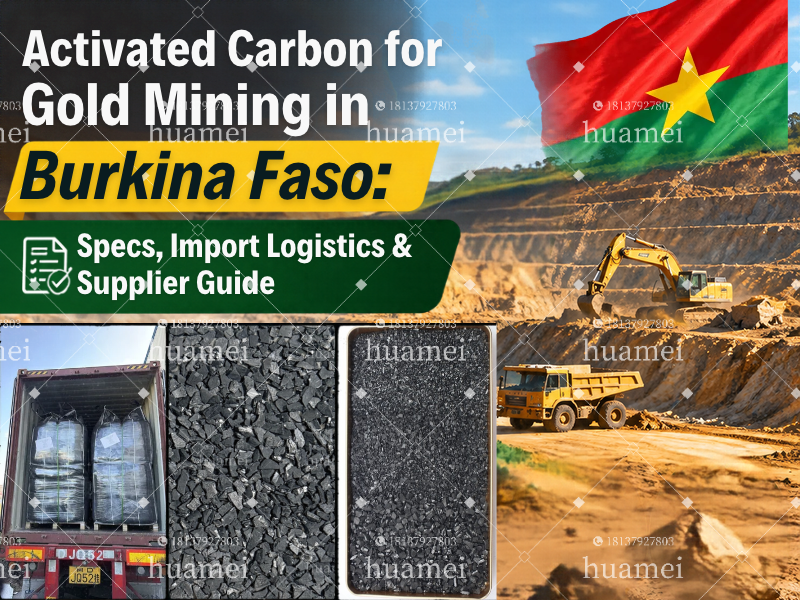
Burkina Faso is one of West Africa's fastest-growing gold producers. The Ministry of Energy, Mines and Quarries' 2025 statistical yearbook reports national gold production of approximately 90.8 tonnes in 2025, up from approximately 60.8 tonnes in 2024 — a 49% increase. As of 31 December 2025, the ministry recorded 15 industrial mines in production under 22 valid exploitation permits.
The same yearbook separates national output from industrial output: industrial production was 51.496 tonnes in 2025 versus 53.376 tonnes in 2024. The national increase therefore should not be interpreted as a 49% rise in industrial CIL demand or activated-carbon consumption.
Not all 15 mines use carbon-in-leach (CIL) or carbon-in-pulp (CIP) circuits — processing routes differ by operation. But the country's activated carbon imports tell the demand story clearly: Burkina Faso imported 4,173 tonnes of activated carbon worth US$7.28 million in 2025, up from 4,064 tonnes / US$4.13 million in 2024 (World Bank WITS, HS 380210).
Supplying carbon to Burkina Faso requires a different delivery plan from a coastal destination. The country is landlocked. Common options include transit through Lomé, Abidjan, Tema or Cotonou, followed by inland transport to the agreed delivery point. Transit clearance, road conditions and the mine’s location affect the final cost and schedule.
This guide covers the activated carbon specifications Burkina Faso's gold operations require, verified import data, the landlocked logistics landscape, and how to evaluate suppliers for a market where delivery reliability matters as much as product quality.
| Item | Detail |
|---|---|
| País | Burkina Faso (landlocked, West Africa) |
| 2025 gold production | ~90.8 tonnes (Ministry of Energy, Mines and Quarries, 2025 yearbook) |
| Industrial mines in production (Dec 2025) | 15 (not all use activated carbon circuits) |
| 2025 activated carbon imports (HS 380210) | 4,173 tonnes / US$7.28 million |
| 2024 activated carbon imports (HS 380210) | 4,064 tonnes / US$4.13 million |
| Top import sources (2025) | India, Sri Lanka, China (867t / $1.05M), Philippines, Vietnam |
| Transit ports | Lomé (Togo), Abidjan (Côte d'Ivoire), Tema (Ghana), Cotonou (Benin) |
| Processing methods | CIL, CIP and CIC circuits (varies by operation) |
| Preferred carbon type | Coconut shell GAC, commonly 6×12 mesh, iodine ≥1,050 mg/g |
Burkina Faso imported over 4,000 tonnes of activated carbon in both 2024 and 2025. This makes the country a relevant market for gold recovery activated carbon, while the customs totals also include carbon supplied to other applications.
An important distinction: HS 380210 covers all activated carbon forms — coconut shell gold-recovery grades, coal-based water-treatment carbon, powdered activated carbon and other types. The national import total is a useful market indicator, but it should not be read as the exact amount consumed by gold mines. A mine's actual annual requirement depends on its circuit design, carbon inventory, make-up rate, regeneration losses and operating hours.
Several major gold mines in Burkina Faso operate CIL circuits based on information from their parent companies' public filings. The table below lists operations where the processing method has been confirmed in operator annual reports or production disclosures:
| Mine | Owner | Confirmed Process | 2024 Production (oz) | 2025 Production (oz) | Notes |
|---|---|---|---|---|---|
| Essakane | IAMGOLD (85%) | CIL | 454,200 | 427,200 | Largest mine; open pit; 12.56 Mt milled in 2025 |
| Houndé | Endeavour Mining (85%) | CIL | 287,726 | 256,862 | 5.13 Mt processed in 2025; 86.2% recovery |
| Sanbrado | West African Resources (85%) | CIL | 206,622 | 205,228 | Open pit + underground; Toega expansion scheduled |
| Mana | Endeavour Mining (85%) | CIL | 147,806 | 172,877 | Fully underground since 2024; Siou and Wona deposits |
| Bomboré | Orezone Gold | CIL | 118,746 | 110,014 | Stage 2 expansion targets 220,000–250,000 oz/yr |
| Kiaka | West African Resources | CIL | — | 95,155 | Commissioned in 2025; 300,383 oz combined with Sanbrado in the 7 January 2026 production update |
Sources: operator FY-2025 disclosures and technical descriptions. Production is shown on a 100% mine basis, not the owner’s attributable share. The Sanbrado and Kiaka figures follow WAF’s 7 January 2026 production update. Ownership percentages are reported interests, which can change. These operators are market examples, not a list of Huamei customers.
Gold production establishes the scale of these operations, but it does not establish their activated-carbon consumption. Estimate procurement from the plant’s standing carbon inventory, measured make-up rate, screening and regeneration losses, and operating hours.
World Bank WITS data (UN Comtrade, HS 380210) provides a breakdown of Burkina Faso's activated carbon imports by source country. The 2024 data includes quantity detail by partner:
| Source Country | Value (US$ K) | Quantity (kg) | Share by Volume | Avg. Price ($/kg) |
|---|---|---|---|---|
| India | 2,602.68 | 2,468,080 | 60.7% | 1.05 |
| China | 860.65 | 1,173,240 | 28.9% | 0.73 |
| Philippines | 250.08 | 88,160 | 2.2% | 2.84 |
| Vietnam | 186.22 | 67,056 | 1.6% | 2.78 |
| Sri Lanka | 160.54 | 48,400 | 1.2% | 3.32 |
| Ghana (re-export) | 23.50 | 133,347 | 3.3% | 0.18 |
| Singapore | 38.95 | 84,348 | 2.1% | 0.46 |
| Others | 8.10 | 1,562 | <0.1% | — |
| Total (2024) | 4,130.70 | 4,064,190 | 100% | 1.02 |
For 2025, WITS reports total imports of 4,173.48 tonnes valued at US$7.28 million. China supplied 867 tonnes (US$1.05M) in 2025. The near-doubling of import value with similar tonnage suggests a shift toward higher-value grades or price increases across suppliers.
Source: WITS 2024 and WITS 2025. HS 380210 covers all activated carbon forms — not exclusively gold recovery grades.
Several patterns stand out:
→ India’s 60.7% volume share describes the reported partner-country trade flow in 2024. It does not identify individual manufacturers, final mine customers, raw materials, or re-export routes.
→ China’s $0.73/kg average versus India’s $1.05/kg (2024) is a customs unit value across all activated-carbon imports from each partner. It is not a quotation for gold-recovery carbon or evidence of a particular raw-material mix.
→ Ghana’s $0.18/kg unit value should be interpreted cautiously. These aggregate records do not establish whether the goods were virgin, reactivated or re-exported carbon; shipment-level information would be needed.
→ These are customs-trade statistics for all activated carbon under HS 380210, not a ranking of gold-mine suppliers. The data is useful for understanding trade flows and supplier origins, but each mine's actual consumption should be estimated from its own circuit parameters.
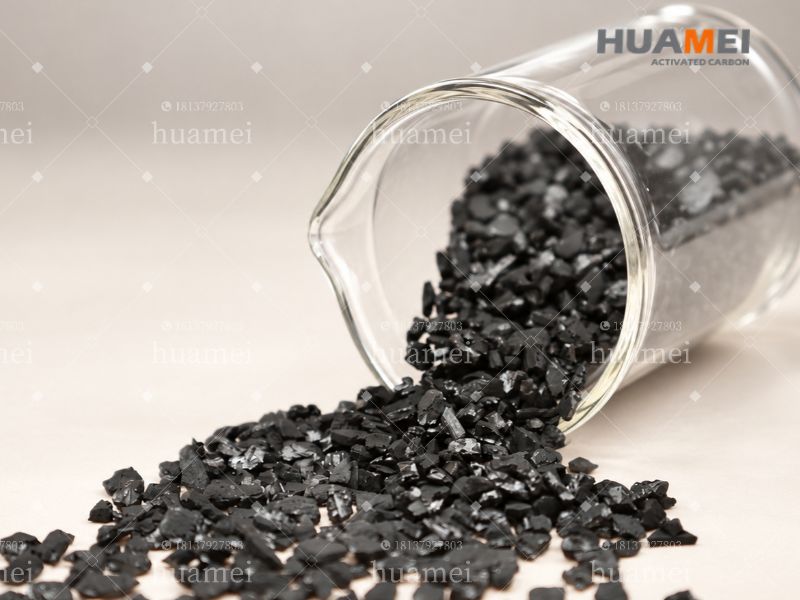
Granular activated carbon (GAC) is used in CIL, CIP, and CIC gold-recovery circuits to adsorb dissolved gold-cyanide complexes from process solution or slurry. Coconut-shell-based GAC is widely used because of its hard granular structure and microporous pore system — but the right product for a specific plant must be selected against that plant's metallurgical and operating requirements.
There is no single specification that fits every circuit. The end user's technical specification and site test results should take priority. The following parameters are useful when comparing products and reviewing a batch certificate of analysis (COA):
| Parámetro | Typical CIL Specification | Test Method | What It Tells the Buyer |
|---|---|---|---|
| Raw material | Coconut shell | — | Coconut-shell carbon is widely used for its durable granular structure; verify gold uptake and attrition under the plant’s conditions. |
| Número de yodo | ≥1,050 mg/g | ASTM D4607 | General indicator of micropore development — not a direct gold-loading test. Two carbons with similar iodine numbers may perform differently in a specific cyanide solution |
| Tamaño de la malla | 6×12 (1.70–3.35 mm) | ASTM D2862 | Common CIL size; balances adsorption rate against screen retention. Confirm against plant's screen openings and carbon transfer system |
| Ball-pan hardness | ≥97% | ASTM D3802 | Comparative lab measure of granular hardness; does not directly measure in-service carbon loss (per ASTM). Review alongside attrition data and plant operating results |
| Apparent density | 0.48–0.54 g/cm³ | ASTM D2854 | Affects bed mass-volume calculations and handling. Confirm the method, moisture basis and packing procedure; terminology varies between suppliers. |
| Contenido en cenizas | ≤3% | ASTM D2866 | Review mineral residue, purity and cleaning requirements alongside the plant’s acceptance limits; ash alone does not predict operating problems. |
| Humedad | ≤5% | ASTM D2867 | Affects net dry-carbon quantity. Moisture above 5% means paying to ship water through two customs borders |
| CTC activity | If required by the buyer | ASTM D3467 | A vapour-phase activity test; it is not a direct measurement of mesopore volume or gold-cyanide adsorption performance. |
| Gold adsorption kinetics | Per plant specification | Kinetic bottle roll test | More directly relevant than iodine number. Ask for test solution, Au concentration, pH, cyanide conditions, contact time and calculation method |
Iodine number and hardness tell you about the carbon's starting condition. They do not tell you how well it performs under actual CIL operating conditions. Three additional parameters separate adequate carbon from high-performance carbon:
→ K-value (equilibrium gold adsorption capacity) — describes gold loading capacity under the stated test conditions. Confirm the test solution, equilibrium gold concentration, units and calculation method before comparing supplier results.
→ R-value (gold adsorption rate) — describes how quickly carbon adsorbs gold under a specified procedure. Compare results using the same solution chemistry, carbon size, dosage, mixing and contact time. A rate-test value is not a universal guarantee of plant recovery.
→ Attrition rate — measures carbon breakdown under a defined test. Wet abrasion, handling and thermal regeneration can cause different losses; a laboratory result should not be presented as the loss per regeneration cycle unless that is what the method tests. Commercial impact depends on actual inventory, make-up rate, screening efficiency and gold carried with lost fines.
For a meaningful comparison between suppliers, ask for gold adsorption test data where available. The test report should identify the test solution, gold concentration, pH, cyanide conditions, carbon dosage, contact time, and calculation method. Compare results only when the test conditions are sufficiently similar.
Send your current specification and required gold-adsorption or attrition procedure. Ask Huamei which test reports and sample evaluation arrangements are available for your project.
Review HMGOLD™ grades and request samples · WhatsApp +86 181-3792-7803
Every kilogram of activated carbon entering Burkina Faso passes through a neighboring country's port and crosses at least one international border by road. This is the single biggest operational difference between sourcing carbon for Burkina Faso versus coastal gold producers like Ghana or Tanzania.
Four transit corridors serve Burkina Faso. Each has different tradeoffs in cost, speed, and reliability:
| Corridor | Puerto | Distance to Ouagadougou | Ventajas | Considerations |
|---|---|---|---|---|
| Togo corridor | Lomé | ~1,000 km | Primary transit gateway for BF freight; dedicated handling; rail link under development | Road condition variable on Togo-BF segment; single border crossing |
| Côte d'Ivoire corridor | Abidjan | ~1,100 km | Largest port capacity in West Africa; Abidjan-Ouagadougou railway connection | Longer distance; two clearance points if rail/road mix; rail reliability varies |
| Ghana corridor | Tema | ~1,050 km | Well-maintained road network; established freight forwarding infrastructure | Ghana-BF border congestion at peak periods; subject to ECOWAS transit regulations |
| Benin corridor | Cotonú | ~1,100 km | Alternative when primary corridors congested; serves eastern BF mines | Longest transit time; less established for BF freight; passes through Togo |
No port is universally the fastest or cheapest option. The best route must be evaluated against the consignee's exact mine-site location, current freight-forwarder quotations, and corridor conditions at the time of shipment.
Inland delivery adds port handling, transit formalities and transport to the mine on top of ocean freight. Compare the complete route and delivery responsibility rather than assuming that the lowest ocean-freight quotation produces the lowest landed cost.
This creates three procurement imperatives that coastal mines do not face:
→ Longer lead time planning — obtain a dated schedule covering production, vessel departure, port clearance and inland delivery. Any indicative 60–90-day planning allowance must be checked against the actual order and current route; it is not a Huamei delivery guarantee.
→ Packaging matters more — carbon travels further by road, over rougher terrain, with more handling points. Bags that survive a 20-day ocean voyage may not survive an additional 1,000 km on West African roads. Jumbo bags (1-tonne FIBCs) reduce handling damage; 25 kg bags offer easier manual loading at remote mine sites but increase handling touchpoints. Packaging should be agreed before quotation and confirmed in packing documents.
→ Supplier reliability over price — a price saving means nothing if a shipment is delayed 30 days at a transit port. Mines in Burkina Faso prioritize suppliers with proven West Africa logistics track records, pre-arranged transit documentation, and the ability to manage port-to-mine delivery — not just FOB or CIF pricing.
When comparing quotations from different suppliers, build a full landed-cost model rather than comparing product price alone:
Ask the freight forwarder to quote the full route to the named destination. Transit time and cost can change with shipping schedules, port congestion, border formalities, security conditions, season, and the final destination.
Before shipment, the importer should obtain written confirmation from its licensed customs broker or the competent authority for the specific product, importer and route. Do not assume that a mining permit automatically creates a customs exemption.
This is a procurement checklist. The importer’s broker should confirm the applicable requirements in writing before dispatch.
The combination of landlocked logistics, high consumption volumes, and multiple operating CIL plants creates a supplier evaluation framework that differs from coastal markets:
| Evaluation Criteria | What to Look For | Red Flags |
|---|---|---|
| West Africa logistics track record | Completed deliveries to landlocked destinations (BF, Mali, Niger); named freight forwarding partners; familiarity with TRIE carnet process | Supplier quotes FOB/CIF only and cannot discuss inland logistics; no prior landlocked country deliveries |
| Batch consistency | COA per batch (not per product line); iodine, hardness, ash, moisture tested per ASTM standards; K-value and R-value data available on request | Single "typical" spec sheet for all shipments; no batch-specific testing; reluctant to share COA before order |
| Technical documentation | Current TDS, batch-specific COA with test methods, SDS, and gold adsorption test data where available | No TDS; COA without stated test methods; cannot provide gold adsorption kinetics data |
| Production capacity | Confirmed available capacity, committed production slots and an agreed delivery schedule for your requirement | Cannot confirm the production slot or delivery basis for the quotation |
| Packaging for road transport | Reinforced jumbo bags with UV protection; pallet-ready configurations; moisture barrier for rainy season | Standard export packaging only; no consideration for 1,000+ km road transport |
| Technical support | Can discuss your specific circuit parameters; offers comparative testing against current carbon; provides reactivation guidance | Sales-only contact; cannot answer technical questions about K-value, attrition, or circuit optimization |
| References | Named mine sites in West Africa using the product; willingness to arrange reference calls; published case studies | Vague claims of "supplying Africa" without specific site references |
Review Huamei’s gold-recovery application guidance for CIP, CIL and CIC alongside your plant’s specification.
Huamei Carbon manufactures the HMGOLD™ range of coconut-shell activated carbon for gold recovery applications, including CIL, CIP, and CIC circuits. The product line covers four grades by iodine number:
| HMGOLD™ Grade | Número de yodo | Mesh Size | Ball-Pan Hardness | Contenido de ceniza | Humedad |
|---|---|---|---|---|---|
| HMGOLD™ 6000 | ≥1,050 mg/g | 6×12 | ≥99% | ≤3% | ≤5% |
| HMGOLD™ 7000 | ≥1,100 mg/g | 6×12 | ≥99% | ≤3% | ≤5% |
| HMGOLD™ 7500 | ≥1,150 mg/g | 6×12 | ≥98.5% | ≤3% | ≤5% |
| HMGOLD™ PLUS | ≥1,200 mg/g | 6×12 | ≥98% | ≤3% | ≤5% |
Confirm the test methods and acceptance limits in the agreed specification and batch COA. The cited SGS report (MSRCZ2500346-01A) concerns an HMGOLD™PLUS sample, including an iodine result of 1,208 mg/g; it is not certification of every grade or shipment, and its strength result should not be relabelled as an ASTM ball-pan result without method confirmation.
African supply records: Published Huamei examples include 56 tonnes to a Ghana CIP operation and 112 tonnes to a Tanzania CIL mine. Tanzania is in East Africa. These records do not establish deliveries to Burkina Faso or a guaranteed monthly capacity for this order.
What Huamei provides:
For a Burkina Faso project, Huamei can review the end user's specification and process information before recommending a grade. The final selection should be based on the mine's required particle size, adsorption performance, carbon handling system, and acceptance criteria — not iodine number alone.
Share your specification, quantity, destination and nominated forwarder. Confirm the quoted delivery point, freight responsibilities, transit documents and schedule before placing the order.
Granular activated carbon is used in CIL, CIP, and CIC gold-recovery circuits. Coconut-shell-based carbon is widely used because of its granular strength and microporous pore structure. The correct grade must be selected against the plant's process design and technical specification — not chosen by iodine number alone.
6×12 mesh (1.70–3.35 mm) is the most commonly used size for CIL circuits. However, mesh size depends on the adsorption circuit, inter-stage screen openings, carbon transfer system, and the mine's operating requirements. Confirm the required particle-size distribution with the plant before ordering.
Delivery depends on the production slot, vessel schedule, entry port, transit clearance and mine-site location. Request a current factory-to-delivery-point schedule. An indicative planning allowance is not a guaranteed lead time.
Lomé (Togo) is the primary transit port for Burkina Faso freight, with established customs procedures and the shortest border crossing route. Abidjan (Côte d'Ivoire) offers the largest port capacity and an existing rail connection. The best choice depends on the mine's location within Burkina Faso, current corridor conditions, and total landed cost. Get route-specific quotations before deciding.
Huamei’s minimum order quantity is 3 tonnes. Agree the packing, container-loading plan, delivery point and freight basis for the actual quantity; there is no universal order size for every mine.
The applicable duty, VAT and any mining-project exemption must be confirmed by the importer’s customs broker under current rules for the product, importer and permit. Do not assume an exemption applies automatically.
At minimum: current technical data sheet (TDS), a recent batch-specific certificate of analysis (COA) with stated test methods, safety data sheet (SDS), quotation, and proposed packing details. For a technically critical application, also request gold adsorption test data and third-party test reports where available.
