A gold mine in La Libertad, Peru — processing 3,000 tons of ore per day through a CIP circuit — was losing 8–10% of its carbon inventory every elution cycle. The old carbon had a ball-pan hardness of just 94%. Recovery had dropped from 96% to 93.5%, and the operation was bleeding gold into tailings. After switching to HMGOLD™7000 (iodine ≥1,100 mg/g, hardness ≥99%, 6×12 mesh), carbon loss dropped to 2.5–3% per cycle, recovery climbed to 97.3%, and the mine recovered an extra ~320 grams of gold per day — approximately $24,000 in additional daily revenue at the time of reporting. This is how that project came together.
The Problem: 94% Hardness Carbon Was Destroying Recovery
The mine's CIP circuit ran six adsorption tanks in series. The carbon they were using — a generic coconut shell product from a Southeast Asian supplier — was specified at 94% ball-pan hardness. On paper, 94% sounds fine. In a 3,000 tpd CIP circuit, it's not.
Here's what was happening:
| Metric |
Before (Old Carbon) |
Target |
| Ball-pan hardness |
94% |
≥98% |
| Carbon loss per elution |
8–10% |
<3% |
| Gold recovery rate |
93.5% (declining) |
≥96% |
| Fine carbon in tailings |
Visible on screens |
Minimal |
| Elution cycles before replacement |
30–40 cycles |
50+ cycles |
The mechanism is straightforward: every time carbon goes through the elution kiln and gets pumped back into the adsorption circuit, the granules collide with each other, the ore slurry, and the inter-stage screens. Low-hardness carbon breaks down into fines. Those fines are too small to be retained by the screens — they pass through and end up in tailings, carrying adsorbed gold with them.
At 8–10% loss per cycle, the mine was replacing its entire carbon inventory roughly every 10–12 cycles. That's not just a carbon cost problem — it's a gold loss problem. Every kilogram of carbon fines leaving the circuit carries gold that will never be recovered.

Why Hardness Matters More Than Iodine Number in High-Throughput CIP
Most buyers ask about iodine number first. It makes sense — iodine number indicates adsorption capacity, and higher numbers mean faster gold loading. But in a high-tonnage CIP circuit like this one, hardness is the controlling parameter.
Here's the math that convinced this buyer:
| Scenario |
94% Hardness |
99% Hardness |
| Starting carbon inventory |
52 т |
52 т |
| Loss per elution cycle |
9% (midpoint) |
2.75% (midpoint) |
| Carbon lost per cycle |
4.68 tons |
1.43 tons |
| Cycles to lose 50% inventory |
~7 cycles |
~24 cycles |
*Based on 26 elution cycles/year (biweekly), FOB carbon price ~$1,800/ton for gold-grade coconut shell GAC.
The carbon replacement cost difference alone is ~$145,000/year. Add the gold recovery improvement (from 93.5% to 97.3% on 3,000 tpd of ore), and the economics become overwhelming.
Huamei's Recommendation: HMGOLD™7000
After reviewing the mine's circuit design, ore characteristics, and operating conditions, we recommended HMGOLD™7000 — not the higher-grade HMGOLD™7500 or PLUS. Here's why:
| Parameter |
HMGOLD™7000 |
Old Carbon |
Why It Matters |
| Йодное число |
≥1,100 mg/g |
~1,000 mg/g |
Faster gold loading in the first 2–3 tanks |
| Ball-Pan Hardness |
≥99% |
94% |
Dramatically reduces carbon fines and gold loss |
| Содержание золы |
≤3% |
~5% |
Less inert material, more active carbon surface |
| Влага |
≤5% |
~6% |
Less water weight per bag |
| Mesh Size |
6×12 |
6×12 |
Standard CIP sizing — no screen modifications needed |
Why not HMGOLD™7500 or PLUS? The mine's ore grade and circuit throughput didn't justify the premium. HMGOLD™7000's ≥1,100 mg/g iodine number was more than sufficient for this operation, and the ≥99% hardness — actually higher than both HMGOLD™7500 (≥98.5%) and PLUS (≥98%) — was the priority for solving their carbon loss problem. We recommended the grade that solved the specific problem, not the most expensive option.
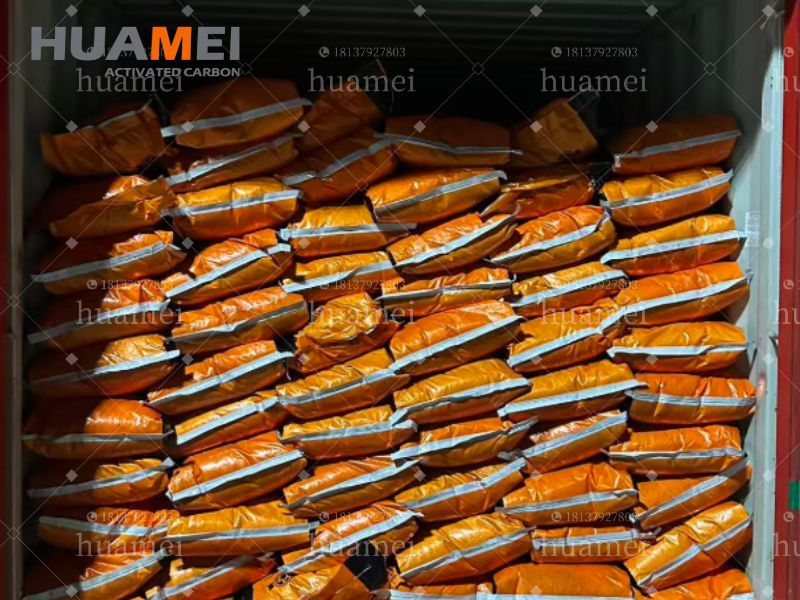
Shipment: 52 Tons in 4 × 20ft Containers to Callao
| Item |
Details |
| Продукт |
HMGOLD™7000 Coconut Shell Activated Carbon |
| Количество |
52 tons (4 × 13 tons per 20ft container) |
| Упаковка |
25 kg woven bags on pallets |
| Destination Port |
Callao, Peru |
| Origin Port |
Xiamen, China |
| Transit Time |
~15 days (sea freight) |
| Documentation |
COA per container, MSDS, phytosanitary certificate |
Each 20ft container was loaded with 13 tons — the standard loading capacity for 25 kg bags on pallets in a 20ft dry container. The mine requested COA testing for each container lot, including iodine number, hardness, ash, moisture, and particle size distribution. All four lots tested above spec.
Results After 6 Months
The mine ran HMGOLD™7000 through their full CIP circuit for six months before reporting back. The numbers:
| Metric |
Before (Old Carbon) |
After 6 Months (HMGOLD™7000) |
Change |
| Gold recovery rate |
93.5% |
97.3% |
+3.8 percentage
points |
| Carbon loss per elution |
8–10% |
2.5–3% |
Reduced by ~70% |
| Additional gold
recovered/day |
Baseline |
+~320 grams |
~$24,000/day
additional revenue |
| Carbon inventory stability |
Full replacement
every 10–12 cycles |
Stable with top-up only |
Replacement cost
down ~70% |
| Fine carbon in tailings |
Visible on inter-
stage screens |
Minimal |
Significant reduction |
The 3.8-point recovery improvement came from two sources: (1) less gold leaving the circuit on carbon fines, and (2) higher iodine number providing better adsorption kinetics in the lead tanks. The mine estimated the combined impact at roughly 320 grams of additional gold recovered per day across their 3,000 tpd throughput — approximately $24,000 per day in additional revenue based on the gold price at the time of reporting. That's from a carbon change that cost under $100,000.

Reorder: 56 Tons in 2 × 40ft Containers
Based on the six-month results, the mine placed a reorder for 56 tons — this time in two 40ft high-cube containers (28 tons each) instead of four 20ft containers. The switch to 40ft containers reduced per-ton shipping cost by approximately 15%.
The reorder also included a request to pre-screen the carbon to tighten the 6×12 mesh distribution — minimizing the fraction of particles near the upper and lower size limits. This is a detail that experienced gold mine operators pay attention to: tighter particle size distribution means more uniform flow through the carbon bed and more consistent gold loading across all tanks.
What This Case Tells You About Choosing CIP Carbon
If you're running a CIP or CIL gold circuit and evaluating carbon suppliers, this project highlights three things:
- Hardness is not optional. In circuits processing more than 1,000 tpd, anything below 97% ball-pan hardness will cost you in carbon loss and gold recovery. The 5-point difference between 94% and 99% hardness translated to a 70% reduction in carbon loss per cycle.
- The cheapest carbon is rarely the cheapest option. The old carbon was priced lower per ton, but the mine was replacing inventory 3× faster and losing gold to tailings. Total cost of ownership — including carbon replacement and gold loss — favored the higher-spec product by a wide margin.
- Match the grade to the circuit, not the brochure. We recommended HMGOLD™7000, not the top-tier PLUS, because this mine's specific problem was hardness, not adsorption capacity. Over-specifying wastes money; under-specifying loses gold.
Часто задаваемые вопросы
What causes high carbon loss in CIP gold circuits?
The primary cause is low ball-pan hardness — carbon with hardness below 97% breaks down rapidly during elution, screening, and inter-stage pumping in CIP circuits. Secondary causes include oversized or undersized particles (poor mesh distribution), excessive pumping velocity, and thermal shock during kiln regeneration. In this Peru case, upgrading from 94% to 99% hardness reduced carbon loss from 8–10% to 2.5–3% per elution cycle.
How much activated carbon does a CIP gold mine need?
A typical CIP circuit carries 10–20 kg of carbon per ton of ore processed per day. For a 3,000 tpd operation, that's 30–60 tons of carbon in the circuit at any time. Initial loading for this Peru mine was 52 tons. The exact quantity depends on the number of adsorption stages, tank volume, carbon concentration, and residence time.
What is the difference between HMGOLD™7000 and HMGOLD™7500?
HMGOLD™7000 has an iodine number ≥1,100 mg/g with ≥99% ball-pan hardness. HMGOLD™7500 has a higher iodine number (≥1,150 mg/g) but slightly lower hardness specification (≥98.5%). For circuits where carbon durability is the priority (high-throughput CIP), HMGOLD™7000 is often the better choice. For CIL circuits where faster adsorption kinetics matter more, HMGOLD™7500 may be preferred. See the full HMGOLD™ product comparison.
Can I test HMGOLD™ carbon before ordering a full container?
Yes. We provide sample quantities (25–50 kg) for lab-scale gold adsorption testing (R-value and K-value tests). Many buyers run a 1–2 ton trial lot in a single adsorption tank before committing to a full circuit change. Minimum production order is 10 tons (one 20ft container).
How long does it take to ship activated carbon from China to Peru?
Sea freight from Xiamen or Ningde port to Callao typically takes 30–40 days. Production lead time is 15–25 days for standard grades, so total door-to-door is approximately 45–65 days from order confirmation. We can also arrange CIF Callao pricing if needed.
Evaluating carbon options for your CIP or CIL circuit? Send us your current carbon specs and circuit conditions — we'll recommend the right HMGOLD™ grade and provide a quote:
In gold recovery, activated carbon is not a commodity you buy on price alone.
For mines running CIL (carbon-in-leach) and CIP (carbon-in-pulp) circuits, the carbon's particle size, adsorption capacity, mechanical strength, and attrition behavior all affect daily production and operating costs. A single batch with inconsistent specs can clog screens, reduce gold loading, or shorten reactivation cycles — problems that cost far more than whatever you saved on the purchase price.
That's why long-term carbon buyers care about two things above all else: specification consistency between shipments, and a supplier who can reliably meet their procurement schedule.
This Tanzania gold mine just placed their second order with Huamei Carbon — 56 tons of HMGOLD™ coconut shell activated carbon for their CIL circuit. Here's how this partnership developed from first contact to repeat purchase.
From First Order to Repeat Purchase
The relationship started when the mine was looking for a more consistent carbon supply. Their previous supplier's product had issues — uneven particle size and high ash content that made the carbon difficult to reactivate in the kiln.
That first order was 112 tons shipped in four 40-foot containers — a significant commitment for a new supplier relationship. The mine ran the carbon through their CIL circuit, confirmed the particle size uniformity, tested the reactivation performance, and tracked gold loading across multiple cycles.
The results held up. And when it was time to restock, they came back.
Why 56 Tons This Time?
The first order (112 tons) was an initial inventory fill — replacing the old carbon stock entirely. This 56-ton repeat order reflects the mine's ongoing consumption rate. For a CIL plant, annual fresh carbon consumption typically runs 50–200 tons depending on ore throughput, carbon attrition, and reactivation efficiency. A 56-ton order covers roughly 6–12 months of makeup carbon for a mid-size operation.
The shift from a large trial order to a regular resupply order is a normal pattern — and a good sign. It means the carbon is performing as expected in the circuit, and the mine has incorporated Huamei into their ongoing procurement plan rather than treating us as a one-time alternative.
Order Specifications
| Item |
Details |
| Продукт |
HMGOLD™ Coconut Shell Activated Carbon |
| Приложение |
Gold recovery — CIL circuit |
| Место назначения |
Танзания |
| Total volume |
56 tons (2 × 40ft containers) |
| Размер ячейки |
6×12 |
| Йодное число |
≥1100 mg/g |
| Ball-pan hardness |
≥98% |
| Зольность |
<3% |
| Влага |
≤5% |
Same specs as the first order — no changes. In gold carbon procurement, that's exactly what you want. When a mine finds a carbon grade that works in their circuit, they lock in the specification and expect every future shipment to match. Changing specs means re-tuning elution parameters, adjusting screen apertures, and potentially re-qualifying the carbon through plant trials.
What Consistency Actually Means in Practice
When we say "specification consistency," we're not talking about matching a datasheet. We mean batch-to-batch uniformity across the parameters that directly affect gold recovery operations:
| Parameter |
Why Consistency Matters |
What Happens When It Varies |
| Particle size
distribution (6×12 mesh) |
Screens are calibrated for
a specific size range |
Undersized particles pass through screens
→ carbon loss. Oversized particles reduce
surface area → lower gold loading |
| Йодное число
(≥1,100 mg/g) |
Directly correlates with
gold adsorption capacity |
Low iodine → lower gold loading
per kg of carbon
→ more carbon
needed per ounce
of gold recovered |
| Ball-pan hardness
(≥98%) |
Determines carbon
survival rate in the circuit |
Soft carbon breaks down faster
→ higher attrition losses
→ more frequent carbon replacement |
| Ash content (<3%) |
Affects reactivation
quality and carbon longevity |
High ash carbon → poor kiln reactivation
→ reduced cycle life
→ more fresh carbon purchases |
| Moisture (≤5%) |
Affects weight accuracy
and handling |
Excess moisture →
you're paying for water, not carbon.
Also causes clumping
during storage in tropical climates |
For this 56-ton order, we pulled test samples from the production batch and compared results against the first 112-ton shipment's Certificate of Analysis. The numbers matched within normal production variance — not because we got lucky, but because the raw coconut shell source, activation process, and screening protocols haven't changed.
Supply Chain: From Order to Port
For repeat orders, the process is faster because specifications and logistics are already established:
- Order confirmation — Client confirms quantity (56 tons), same spec as previous PO. No re-negotiation needed.
- Production scheduling — Batch allocated from our monthly output (700+ tons/month capacity across Fujian and Ningxia facilities). Repeat orders get priority scheduling.
- Quality testing — Full in-house COA on the production batch: iodine, hardness, ash, moisture, particle size distribution. Results sent to client for approval before loading.
- Container loading — 56 tons loaded into 2 × 40ft containers. Loading photos and seal numbers sent to client.
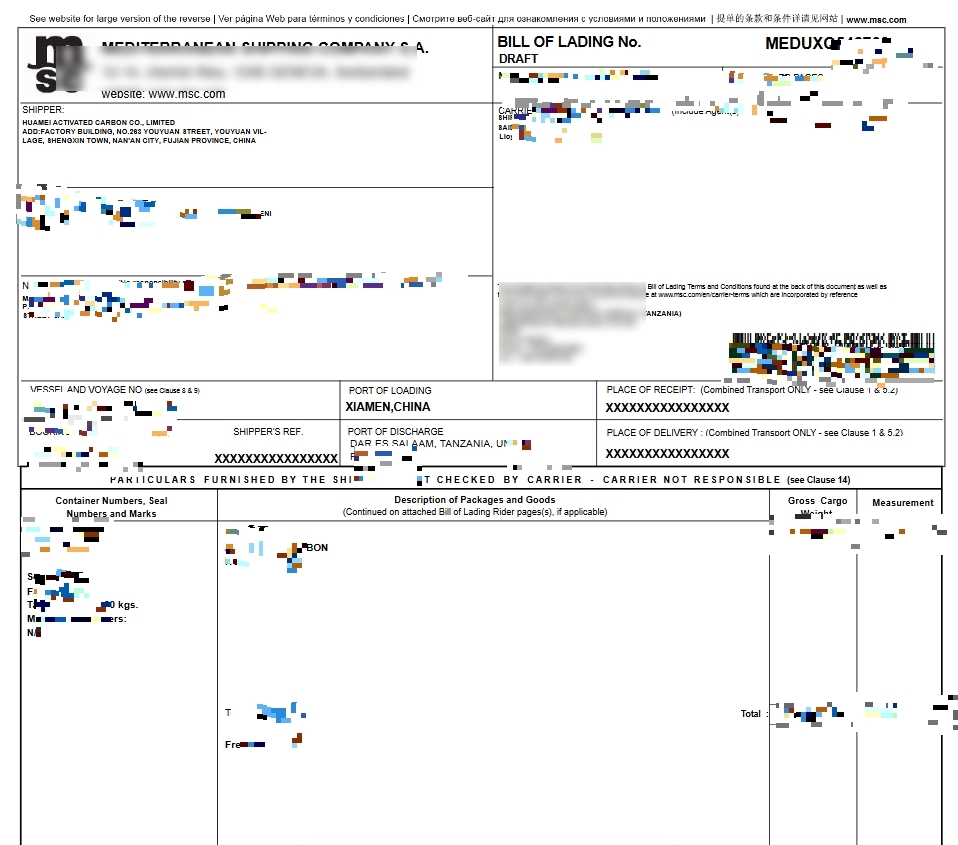
- Shipping — Export documentation (commercial invoice, packing list, COA, MSDS, certificate of origin) prepared. Typical transit to Dar es Salaam: 25–35 days.
From order confirmation to cargo departure, the turnaround for a repeat order is typically 15–20 days — shorter than a first order because there's no sample stage, no spec negotiation, and no new logistics setup.
The Economics of Carbon Supplier Switching vs. Staying
Mining operations sometimes consider switching carbon suppliers to chase a lower price quote. Here's what that decision actually costs:
| Factor |
Staying with Proven Supplier |
Switching to New Supplier |
| Sample testing |
Not needed |
4–8 weeks for sample
+ lab testing |
| Plant trial |
Not needed |
1–3 months of circuit
monitoring with new carbon |
| Risk of quality variance |
Low (track record established) |
Unknown until proven
in your circuit |
| Procurement lead time |
15–20 days (repeat order) |
8–16 weeks (sample
→ trial → first bulk order) |
| Operational disruption |
None |
Possible — if new carbon
behaves differently in
elution or reactivation |
| Price difference |
Known and stable |
May be 5–10% lower initially,
but hidden costs from above
factors can exceed savings |
This is why experienced procurement managers at gold mines tend to maintain their carbon supplier — unless there's a genuine quality or supply failure. The cost of switching is real, even if it doesn't show up on the purchase order.
Tanzania: A Growing Gold Mining Market
Tanzania is Africa's fourth-largest gold producer, with major mining operations in the Lake Victoria Goldfields, Lupa Goldfield, and Mpanda Mineral Field. The country's gold mining sector has grown steadily, driven by both large-scale international operations and expanding medium-scale mines.
For activated carbon suppliers, Tanzania represents a consistent demand market:
- Multiple CIL/CIP plants operating year-round
- Annual fresh carbon demand estimated at 1,000–3,000+ tons across all operations
- Dar es Salaam port provides direct shipping access from Chinese manufacturing hubs
- Growing preference for direct factory sourcing as mines optimize procurement costs
Huamei Carbon currently supplies multiple clients in Tanzania. This 56-ton repeat order is one of several ongoing partnerships we maintain in the country.
What This Order Means to Us
For us, the real measure of success is not completing a shipment — it's whether the customer comes back for the next one.
From order confirmation to cargo departure, we focus on three things: that the product specifications match what was agreed, that communication is clear and timely, and that the supply arrangement runs smoothly enough that the buyer doesn't need to think about it.
This 56-ton repeat order from Tanzania confirms that those three things are working. And it's a partnership we intend to maintain.
Working with Huamei Carbon
We produce Кокосовая скорлупа, угольный, и wood-based activated carbon at our facilities in Fujian and Ningxia provinces, China. Monthly production capacity exceeds 700 tons.
For gold recovery, our HMGOLD™ series covers four grades — HMGOLD™6000, 7000, 7500, and PLUS — with iodine values from 1,050 to 1,200 mg/g, designed for CIP, CIL, and CIC circuits.
Whether you're sourcing gold recovery carbon for the first time or looking for a more consistent supply, the process starts the same way: tell us your specs and volume, and we'll send a quote with full technical data within 24 hours.
📱 WhatsApp: +86 181-3792-7803
📧 Email: sale@huameicarbon.com
🌐 Website: www.huameicarbon.com
Часто задаваемые вопросы
Why do gold mines place repeat orders with the same activated carbon supplier?
Specification consistency. Gold recovery circuits are calibrated for a specific carbon grade — particle size, iodine number, hardness, and ash content. Switching suppliers introduces risk: the new carbon may behave differently during elution, reactivation, or screening. The cost of testing, trialing, and potentially disrupting production usually outweighs any savings from a lower per-ton price.
How often do CIL gold plants reorder activated carbon?
Most CIL plants place fresh carbon orders every 3–12 months, depending on plant size and carbon attrition rate. A mid-size CIL operation processing 2,000–5,000 tons of ore per day typically consumes 50–200 tons of fresh carbon per year. Regular reorders — like this 56-ton shipment — indicate the mine's normal consumption cycle.
What is the minimum order quantity for gold recovery activated carbon from China?
10 tons (one 20-foot container). For better freight economics, most buyers order in 26–28 ton increments (one 40-foot container). This 56-ton order shipped in two 40-foot containers — a common configuration for repeat orders.
How do you ensure activated carbon quality stays consistent between shipments?
Three controls: standardized raw material sourcing (same coconut shell grade from the same supply chain), consistent activation process parameters (temperature, steam ratio, residence time), and multi-stage quality testing on every production batch. We compare each batch's COA against previous shipments to the same client, flagging any drift before the carbon ships.
Can I get a sample before placing a bulk order?
Yes. We send 1–5 kg samples from the production line — not hand-picked samples. The sample comes from the same process that produces the bulk order, so test results are representative of what you'll receive. Sample testing typically takes 2–4 weeks including shipping and lab analysis.
56 tons of wood-based powdered activated carbon, shipped in two 40-foot containers to a South African edible oil processor. The carbon was used for decolorization and impurity removal during oil refining — one of the most demanding PAC applications in the food industry.
This case study covers the client's requirements, why wood-based PAC outperforms alternatives for edible oil, and how Huamei Carbon delivered from first inquiry to final shipment in under 8 weeks.
Client Background: Edible Oil Refining in South Africa
| Item |
Details |
| Industry |
Edible oil processing |
| Приложение |
Decolorization & impurity removal in oil refining |
| Key concern |
Color removal efficiency + product purity after filtration |
| Order quantity |
56 tons (2 × 40ft containers, 28 tons each) |
| Продукт |
Wood-based powdered activated carbon |
| Место назначения |
South Africa |
The client produces refined edible oil and needed a reliable PAC supplier that could deliver consistent decolorization performance across large production batches. Their previous carbon supplier had inconsistent quality — batch-to-batch variation in color removal meant frequent production adjustments and higher product loss.
Why Wood-Based PAC for Edible Oil Decolorization
Edible oil refining is one of the most PAC-intensive food processing applications. During the bleaching stage, powdered activated carbon is mixed directly into the oil to adsorb pigments (carotenoids, chlorophyll), free fatty acids, and trace contaminants like PAHs (polycyclic aromatic hydrocarbons).
Wood-based PAC is the industry standard for edible oil because of its pore structure. Produced through phosphoric acid activation of wood chips, it develops a high proportion of mesopores (2–50 nm) — the exact pore range that captures large organic color molecules in oil.
| Property |
Wood-Based PAC |
Coal-Based PAC |
Why it matters for edible oil |
| Dominant pore type |
Mesopores |
Micropores |
Mesopores capture
large pigment molecules |
| Метиленовый синий |
150–300 mg/g |
80–150 mg/g |
Higher MB = stronger
decolorization |
| Зольность |
≤6% |
≤15% |
Lower ash = less
contamination in oil |
| pH |
Neutral to slightly acidic |
Alkaline |
Acidic pH is compatible
with oil refining |
| Iron content |
Very low |
Higher |
Iron catalyzes oil oxidation
— must be minimal |
For this client, we recommended Huamei's wood-based powdered activated carbon with the following specifications:
| Parameter |
Технические характеристики |
| Raw material |
Wood (sawdust) |
| Activation method |
Phosphoric acid |
| Particle size |
200 mesh (95% pass) |
| Метиленовый синий |
≥17 ml/0.1g |
| Влага |
≤10% |
| Зольность |
≤6% |
From Inquiry to Order: 5 Days
The entire sales cycle — from first contact to confirmed purchase order — took just two days. Here's the timeline:
August 15: The client sent their initial inquiry, describing their edible oil decolorization requirements. Our technical team reviewed the application details and recommended wood-based PAC with high methylene blue value. We shipped samples the same day via express courier and invited the client to visit our factory.
August 20: The client arrived for a factory visit. We walked them through the full production process — raw material storage, carbonization furnace, activation line, grinding and classification, quality control laboratory, and packaging line. The client inspected our production equipment, testing instruments, and finished product warehouse.
After seeing the production scale and quality control procedures firsthand, the client placed the order on the spot — 56 tons of wood-based PAC, packed in two 40-foot containers.
Loading day: The client personally returned to our factory to supervise the container loading process, verifying product labels, packaging integrity, and container conditions before sealing.
Shipment Details
| Item |
Details |
| Total quantity |
56 тонн |
| Container |
2 × 40ft |
| Loading per container |
28 тонн |
| Упаковка |
Jumbo bags (FIBC) on pallets |
| Documentation |
COA (Certificate of Analysis) per batch, packing list, commercial invoice |
Client Feedback: Less Loss, Better Finished Product
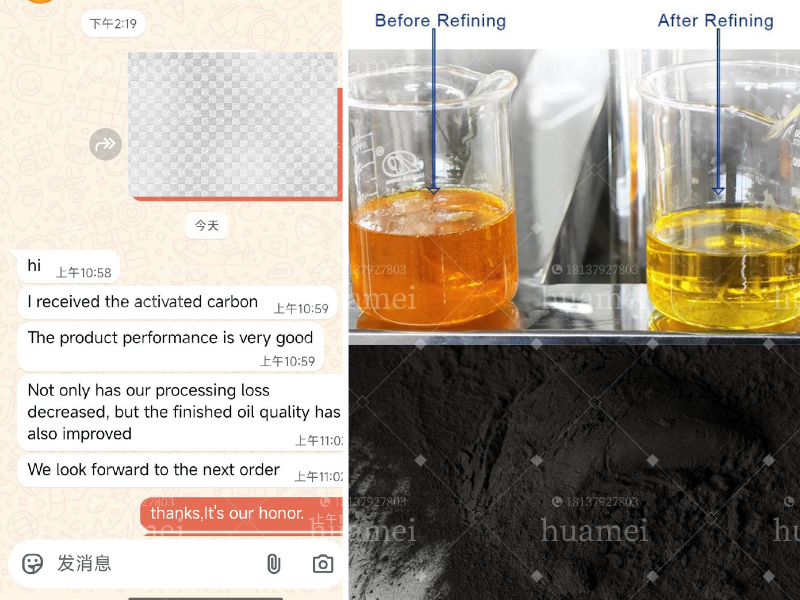
On October 12, the client sent their feedback after running our PAC through full-scale production:
"The product performance is very good. Not only has our processing loss decreased, but the finished oil quality has also improved. We look forward to the next order."
Two specific results the client reported:
- Lower processing loss — the carbon achieved target color removal at a lower dosing rate than their previous supplier's product, which means less oil absorbed by the carbon during filtration
- Better finished product quality — the refined oil had more consistent color and purity across production batches
In edible oil refining, lower carbon dosage directly translates to less oil loss. Even a small reduction — say from 1.5% to 1.2% of oil volume — saves thousands of dollars per month at industrial production scale.
Why Factory Visits Build Trust in Activated Carbon Trade
This case is a good example of how factory visits accelerate procurement decisions. Activated carbon is a product where quality is difficult to verify from a datasheet alone — the same spec sheet can come from a trader reselling unknown product or from a manufacturer with real quality control.
When buyers visit our factory in person, they can verify:
- Raw material sourcing and storage conditions
- Production line capacity and equipment condition
- In-house laboratory with testing equipment for iodine value, methylene blue, ash content, moisture, and particle size
- Packaging and loading procedures
- Finished product warehouse inventory levels
Huamei Carbon welcomes factory visits from all prospective buyers. Our production facilities are located in Fujian and Ningxia, China, approximately 50 km from the nearest export port.
Huamei Wood-Based PAC for Food Processing
Huamei Carbon manufactures wood-based and coal-based powdered activated carbon for edible oil refining, sugar decolorization, beverage purification, glycerin processing, pharmaceutical applications, and water treatment. Our wood-based PAC is produced using phosphoric acid activation of premium wood raw materials, delivering high methylene blue value and low ash content for food-grade applications.
If you need powdered activated carbon for edible oil or other food processing applications, contact us for free samples and a technical consultation:
📱 WhatsApp: +86 181-3792-7803
📧 Email: sale@huameicarbon.com
🌐 Website: www.huameicarbon.com
Часто задаваемые вопросы
What type of activated carbon is best for edible oil refining?
Wood-based powdered activated carbon (PAC) is the industry standard for edible oil decolorization. Its mesoporous structure efficiently adsorbs large pigment molecules like carotenoids and chlorophyll, while its low ash and low iron content prevent contamination of the refined oil.
How much PAC is needed per ton of edible oil?
Typical dosing rates for edible oil decolorization range from 0.5% to 2.0% by weight of oil, depending on the crude oil quality and target color specifications. A bench-scale bleaching test with your actual crude oil is the most reliable way to determine the optimal dose.
What is the minimum order quantity for wood-based PAC?
Huamei Carbon's standard MOQ for wood-based powdered activated carbon is 3 tons. For edible oil processors running continuous production, we typically supply in 20-foot or 40-foot container loads (20–56 tons per container) to ensure uninterrupted supply.
Can I visit the factory before placing an order?
Yes. Huamei Carbon welcomes factory visits from prospective buyers. Our production facilities in Fujian and Ningxia are open for inspection, including the production line, quality control laboratory, and warehouse. We can assist with travel arrangements if needed.
How do you ensure batch-to-batch quality consistency?
Every batch is tested in our in-house laboratory before shipment. A Certificate of Analysis (COA) is provided with every delivery, covering methylene blue value, moisture, ash content, particle size distribution, pH, and iron content. We also support third-party inspection by SGS, Bureau Veritas, or Intertek.
Turkey's water filtration market is one of the largest in the Middle East region — and water filter cartridge manufacturers there need activated carbon that fits tightly packed cartridge beds without excessive pressure drop. Pellet (extruded) activated carbon is the go-to choice for this application.
Huamei Carbon shipped 4 containers (20ft each) of pellet activated carbon to a Turkish water filter cartridge manufacturer. Here's how the project came together.
The Customer: A Turkish Water Filter Cartridge Manufacturer
The customer produces CTO (Chlorine, Taste, Odor) and other inline water filter cartridges for both the domestic Turkish market and export. They were sourcing pellet carbon from multiple suppliers but running into inconsistency — different batches had different diameters, different hardness levels, and different dust content. That meant their cartridge production line needed constant adjustment, and some batches produced cartridges with unacceptable pressure drop.
They needed a single reliable supplier who could deliver consistent pellet carbon, batch after batch, at the volumes their production required.
Why Pellet Carbon for Water Filter Cartridges?
Water filter cartridges — especially CTO-type cartridges — use pellet (extruded) activated carbon rather than granular for several reasons:
- Uniform diameter — pellets are extruded to a precise diameter, so they pack evenly inside the cartridge. No gaps, no channeling, consistent flow distribution
- Low dust — the extrusion process produces fewer fines than crushed granular carbon. Less dust means cleaner water from the first flush and fewer rejected cartridges on the production line
- Predictable pressure drop — uniform pellet size means the pressure drop through the cartridge is consistent and calculable. This is critical for cartridge manufacturers who need to meet flow rate specifications
- Good chlorine reduction — pellet carbon (especially coal-based) provides excellent free chlorine removal capacity, which is the primary function of CTO cartridges
What We Shipped
| Item |
Details |
| Продукт |
Pellet (extruded) activated carbon |
| Приложение |
Water filter cartridge manufacturing (CTO cartridges) |
| Место назначения |
Турция |
| Shipment size |
4 × 20ft containers |
| Упаковка |
Мешки по 25 кг на поддонах |
How We Solved the Consistency Problem
The customer's core complaint about previous suppliers was batch-to-batch variation. Here's what we did differently:
Production Control
Every batch of pellet carbon goes through the same extrusion line with locked-in process parameters — extrusion pressure, die diameter, carbonization temperature, and activation time. Changing suppliers or raw materials mid-run doesn't happen. The result is pellets that look and perform the same whether it's the first container or the fourth.
Pre-Shipment Screening
After activation, the pellets are screened to remove any broken pieces and dust. The customer receives clean, uniform pellets that go straight into their cartridge filling line without additional processing.
Quality Documentation
Each container ships with a Certificate of Analysis showing the key parameters the customer cares about. No surprises at the receiving end — they know exactly what's in the container before it arrives.
The Result
The customer reported that the cartridge production line ran smoothly without the constant adjustments they'd been making with previous suppliers. Pressure drop across their finished cartridges was consistent, and the first-pass rejection rate dropped because there were fewer cartridges with excessive fines or flow problems.
They've since placed repeat orders — consistency at scale is what keeps cartridge manufacturers coming back.
Turkey's Water Filtration Market
Turkey is both a major consumer and exporter of water filtration products. Turkish manufacturers produce millions of water filter cartridges annually for domestic use (point-of-use and point-of-entry systems) and for export to Europe, the Middle East, and Africa.
The demand for activated carbon in Turkey's filtration industry is driven by:
- Growing domestic water purifier adoption — Turkish consumers increasingly install under-sink and countertop filtration systems
- Export manufacturing — Turkey is a cost-competitive production base for water filtration products sold into EU and MENA markets
- Municipal water quality concerns — chlorine disinfection is standard in Turkish municipal water, creating demand for chlorine-removing CTO cartridges
For cartridge manufacturers operating at these volumes, having a stable activated carbon supply chain is not optional — it's a production requirement.
Choosing Pellet Carbon for Your Filtration Products
If you manufacture water filter cartridges or filtration systems and you're evaluating pellet activated carbon suppliers, here's what matters:
- Diameter consistency — request the diameter tolerance range. Tight tolerance means predictable cartridge packing and pressure drop
- Dust content — lower is better for cartridge production. High dust means more fines in the first flush and potential customer complaints
- твердость — pellets need to survive the cartridge filling process and shipping without breaking. Higher hardness = fewer fines generated during handling
- Chlorine reduction capacity — for CTO cartridges, this is the key performance metric. Request test data per ASTM or NSF/ANSI 42 protocol
- Sample testing — run a trial batch through your production line before committing to a container order. Check packing density, pressure drop, and cartridge performance
Huamei Carbon manufactures гранулированный активированный уголь in multiple diameters for water filtration, air purification, and gas treatment applications. We supply filter cartridge manufacturers in Turkey, Southeast Asia, South America, and other regions.
📱 WhatsApp: +86 181-3792-7803
📧 Email: sale@huameicarbon.com
🌐 Website: www.huameicarbon.com
Часто задаваемые вопросы
What type of activated carbon is used in water filter cartridges?
Pellet (extruded) activated carbon is the standard for CTO and inline water filter cartridges. The uniform cylindrical shape provides consistent packing, predictable pressure drop, and low dust — all critical for cartridge manufacturing. Granular activated carbon is used in some larger-format filters, but pellet carbon dominates the cartridge market.
Why do water filter manufacturers prefer pellet carbon over granular?
Pellet carbon has a uniform diameter that packs consistently in cartridges, producing predictable flow rates and pressure drops. Granular carbon has irregular shapes that can create channeling (uneven flow) and generate more dust. For automated cartridge filling lines, pellet carbon's uniformity means fewer production line adjustments and lower rejection rates.
Can Huamei supply pellet activated carbon to Turkey?
Yes. We regularly ship to Turkish ports (Mersin, Istanbul, Izmir) in 20ft containers. Transit time from China is typically 20–30 days. We've supplied multiple Turkish water filter cartridge manufacturers and can provide samples for production trials before bulk orders.
What is CTO activated carbon?
CTO stands for Chlorine, Taste, and Odor — the three main things the carbon removes in a drinking water filter cartridge. CTO cartridges use activated carbon (usually pellet form) to adsorb free chlorine, organic compounds that cause bad taste, and volatile compounds that cause odors. They're the most common type of activated carbon water filter cartridge worldwide.
How much pellet activated carbon does a water filter cartridge manufacturer need?
It depends on production volume and cartridge size. A standard 10-inch CTO cartridge uses approximately 300–500 grams of pellet carbon. A manufacturer producing 10,000 cartridges per day would consume roughly 3–5 tons of carbon per day, or 80–130 tons per month. Most medium to large cartridge manufacturers order in container quantities (18–20 tons per 20ft container).