Activated Carbon for Gas Mask Filters: Types, Specs & Selection
Every gas mask and respirator cartridge relies on activated carbon to capture airborne contaminants. But not all activated carbon works the same way in respiratory protection — standard granular carbon handles organic vapors through physical adsorption, while impregnated carbon uses chemical reactions to neutralize toxic gases that standard carbon cannot touch.
This guide breaks down the two main types of activated carbon used in gas mask filters, the specifications that matter for each protection class, and what OEM filter manufacturers and industrial buyers need to know when sourcing carbon for respiratory protection applications.
How Activated Carbon Works in Gas Mask Filters
A gas mask filter cartridge is essentially a miniature fixed-bed adsorption column. Air passes through a packed layer of activated carbon granules, and contaminant molecules are captured either by physical adsorption (van der Waals forces pulling molecules into the carbon's pore network) or by chemical reaction with impregnants on the carbon surface.
The carbon bed in a typical industrial respirator cartridge contains 30–80 g of activated carbon. Military CBRN canisters contain 150–250 g. The carbon must do its job at very short contact times — air passes through the bed in fractions of a second at breathing flow rates of 30–95 L/min — which means the carbon needs to be extremely efficient at capturing target gases on first contact.
| Filter Component | Function | Material |
|---|---|---|
| Pre-filter (P-class
particulate layer) |
Removes dust, aerosols, mist | HEPA or electrostatic fiber media |
| Activated carbon bed | Adsorbs gases and vapors | GAC or impregnated GAC
(coconut shell or coal-based) |
| Post-filter | Prevents carbon dust migration | Nonwoven fabric |
| Housing/cartridge | Contains media, directs airflow | Polypropylene or ABS plastic |
Key Point: The activated carbon bed is where the chemistry happens. Everything else in the cartridge is mechanical filtration or structural. The type, quality, and quantity of activated carbon directly determines what gases the mask can protect against, how long the protection lasts, and at what concentrations it remains effective.
Two Types of Activated Carbon for Respiratory Protection
All gas mask carbons fall into two categories based on how they capture contaminants:
1. Standard (Non-Impregnated) Activated Carbon
Standard activated carbon removes contaminants through physical adsorption — organic vapor molecules are trapped in the carbon's micropore network by van der Waals forces. No chemical reaction occurs. The carbon simply provides an enormous internal surface area (800–1,200 m²/g) for molecules to stick to.
→ What it removes: Organic vapors and gases with boiling points above 65 °C — solvents (toluene, xylene, acetone), paint fumes, fuel vapors, pesticide sprays. These are the contaminants classified as Type A (Europe, EN 14387) or OV (North America, NIOSH 42 CFR 84).
→ What it does NOT remove: Low-boiling-point gases, acid gases (HCl, SO₂, HF), ammonia, carbon monoxide, formaldehyde, mercury vapor, hydrogen cyanide, or cyanogen chloride. These molecules are too small, too volatile, or too reactive to be captured by physical adsorption alone.
→ Preferred raw material: Coconut shell activated carbon is the industry standard for respirator-grade GAC. Its predominantly microporous structure (pores <2 nm) provides higher adsorption capacity per gram for small organic molecules compared to coal-based carbon. Coconut shell carbon also has superior hardness (≥97%), which minimizes dust generation inside the cartridge — critical for a device that delivers air directly to the user's lungs.

2. Impregnated Activated Carbon
Impregnated carbon starts with a standard activated carbon base (usually coconut shell) and adds chemical agents — metals, metal oxides, or organic compounds — to the surface. These impregnants react with specific toxic gases that standard carbon cannot adsorb, converting them into less harmful compounds that remain bound to the carbon.
→ What it removes: Acid gases (HCl, HF, SO₂, H₂S), ammonia, formaldehyde, mercury vapor, hydrogen cyanide, cyanogen chloride, phosgene, and radioactive iodine (¹³¹I). The specific gases removed depend entirely on which impregnants are used.
| Impregnant | Chemical Symbol | Target Gases | Mechanism |
|---|---|---|---|
| Copper | Cu | HCN, CNCl, H₂S, phosgene | Catalytic oxidation and
chemisorption |
| Silver | Ag | Toxic organics, antimicrobial | Catalytic oxidation |
| Zinc | Zn | HCN, CNCl
(synergistic with Cu) |
Complex formation |
| Molybdenum | Mo | HCN, CNCl (enhances Cu/Zn) | Catalytic enhancement |
| TEDA (triethylenediamine) | C₆H₁₂N₂ | CNCl, phosgene | Nucleophilic substitution |
| Sulfuric acid /
Phosphoric acid |
H₂SO₄ / H₃PO₄ | Ammonia, amines | Acid-base neutralization |
| Potassium iodide | KI | Radioactive iodine (¹³¹I) | Isotope exchange |
| Potassium hydroxide | KOH | SO₂, HCl, HF, Cl₂, H₂S | Acid-base neutralization |
The ASZM-TEDA Standard: The most widely used military-grade impregnated carbon is designated ASZM-TEDA, where A = silver, S = copper (sulfur-reactive), Z = zinc, M = molybdenum, and TEDA = triethylenediamine. This formulation is the current NATO standard for CBRN (Chemical, Biological, Radiological, Nuclear) gas mask canisters, replacing the older ASC (chromium-containing) formulation which posed hexavalent chromium exposure risks during production and disposal.
Protection Classes and the Carbon They Require
Gas mask filters are classified by the type of gas they protect against. In Europe, the EN 14387 standard uses letter codes (A, B, E, K, etc.). In North America, NIOSH uses descriptive codes (OV, AG, AM, etc.). Each class requires different activated carbon specifications.
| EN 14387 Class | NIOSH Equivalent | Protection Against | Carbon Type Required | Color Code |
|---|---|---|---|---|
| A (A1, A2, A3) | OV | Organic vapors
(BP >65 °C) |
Standard coconut shell GAC | Brown |
| B (B1, B2, B3) | AG | Inorganic/acid gases
(Cl₂, H₂S, HCN) |
Impregnated
(Cu, Zn, TEDA or KOH) |
Gray |
| E (E1, E2, E3) | AG | Sulfur dioxide
and acid gases |
Impregnated
(KOH or amine-based) |
Yellow |
| K (K1, K2, K3) | AM | Ammonia and
organic amines |
Impregnated
(H₂SO₄ or H₃PO₄) |
Green |
| AX | OV (low BP) | Low-BP organics
(BP <65 °C) |
High-activity coconut
shell GAC |
Brown |
| Hg-P3 | — | Mercury vapor | Sulfur-impregnated
carbon |
Red |
| NO-P3 | — | Nitrous gases
(NO, NO₂) |
KMnO₄ or specialized
impregnation |
Blue |
| Reactor / CBRN | CBRN | Military/CBRN
threats |
ASZM-TEDA
impregnated carbon |
Varies |
→ ABEK combination filters: The most common multi-gas industrial filter is the ABEK cartridge, which protects against organic vapors (A), inorganic gases (B), acid gases (E), and ammonia (K) simultaneously. Manufacturing an ABEK filter requires either multiple carbon layers with different impregnations or a single carbon with combined impregnants — the latter is more complex but reduces pressure drop.
→ Capacity classes (1, 2, 3): Within each type, EN 14387 defines three capacity levels. Class 1 filters handle up to 1,000 ppm. Class 2 handles up to 5,000 ppm. Class 3 handles up to 10,000 ppm. Higher capacity requires more carbon per cartridge and/or carbon with higher adsorption capacity.
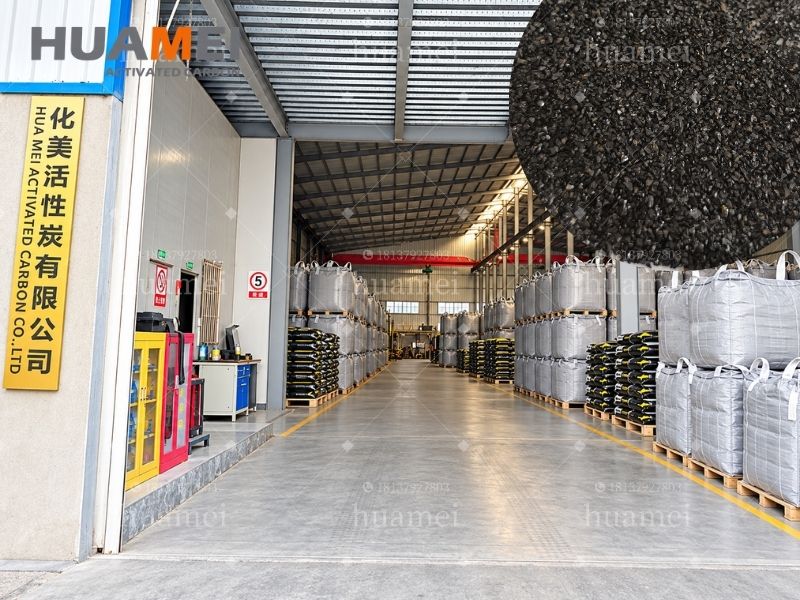
Huamei manufactures coconut shell GAC in 12×20 and 20×50 mesh grades for OEM respiratory protection applications. 700+ tons/month production capacity. MOQ 10 tons. Samples available for cartridge testing.
Activated Carbon Specifications for Respirator Filters
Respirator-grade activated carbon has tighter spec requirements than most water treatment applications. The carbon must perform at very short contact times, generate minimal dust, and meet strict safety standards because the treated air goes directly into human lungs.
| Parameter | Standard GAC (Type A/OV) | Impregnated (ABEK/CBRN) | Why It Matters |
|---|---|---|---|
| Raw
Material |
Coconut shell
(preferred) |
Coconut shell
(required for military) |
Microporous structure +
high hardness = best for short-contact gas capture |
| Mesh
Size |
12×20 or 14×25 | 12×20 or 20×50 | Balances pressure
drop vs contact time at 30–95 L/min airflow |
| Iodine
Number |
≥1,000 mg/g | ≥900 mg/g
(pre-impregnation) |
Higher iodine =
more micropore volume for organic vapor capture |
| CTC | ≥60% | ≥50%
(pre-impregnation) |
Better correlates
to organic vapor capacity than iodine for gas-phase use |
| Hardness
(ASTM D3802) |
≥98% | ≥95% | Prevents dust
migration into inhaled air; critical safety parameter |
| Ash
Content |
≤3% | ≤5% (impregnant
adds weight) |
Low ash = fewer
leachable minerals, cleaner airstream |
| Moisture | ≤5% | ≤5% | Excess moisture
reduces adsorption capacity and adds dead weight |
| Bulk
Density |
0.48–0.55 g/cm³ | 0.55–0.70 g/cm³ | Determines mass
of carbon per cartridge volume |
| Dust
Content |
≤0.5% | ≤0.5% | User breathes through
this carbon — minimal dust is non-negotiable |
→ Why coconut shell dominates respiratory protection: Three reasons. First, micropore volume — coconut shell carbon has 85–90% of its pore volume in micropores (<2 nm), which is exactly the pore size needed to trap small gas molecules at the millisecond contact times in a respirator. Coal-based carbon has more mesopores, which are less efficient for gas-phase capture. Second, hardness — coconut shell carbon at ≥97% ball-pan hardness generates far less dust than coal-based alternatives, which matters enormously when the air goes into someone's lungs. Third, low ash — coconut shell typically has ≤3% ash versus 8–15% for coal-based carbon, meaning less risk of mineral particulate contamination.
→ Mesh size selection: The standard mesh sizes for respirator carbon are 12×20 (0.85–1.70 mm) and 20×50 (0.30–0.85 mm). Finer mesh provides more surface contact and better capture efficiency at high flow rates, but increases breathing resistance (pressure drop). The OEM filter designer must balance protection performance against user comfort. For a deeper look at how mesh size affects performance, see our mesh size selection guide.
Testing Standards for Gas Mask Carbon
Activated carbon for respiratory protection must meet both material standards (carbon quality) and performance standards (breakthrough testing with specific challenge gases).
→ Material testing (carbon quality):
- Iodine Number: ASTM D4607
- CTC Activity: ASTM D3467
- Ball-Pan Hardness: ASTM D3802
- Ash Content: ASTM D2866
- Moisture: ASTM D2867
- Particle Size Distribution: ASTM D2862
→ Filter performance testing (cartridge level):
- EN 14387 (Europe): Tests breakthrough time against specific challenge gases (cyclohexane for Type A, chlorine for Type B, SO₂ for Type E, ammonia for Type K) at defined concentrations and flow rates
- NIOSH 42 CFR 84 (North America): Certifies respirator cartridges for specific contaminant classes at 64 L/min test flow
- EN 403 (Fire escape hoods): Tests CO, HCN, and smoke protection for emergency escape devices
- MIL-PRF-51560 (US Military): Specifies ASZM-TEDA performance for CBRN canisters
Important for OEMs: The activated carbon you purchase is a raw material. The finished filter cartridge must pass regulatory certification testing (EN 14387 type approval or NIOSH approval) before it can be sold. Carbon suppliers provide material certificates (COA) with iodine, CTC, hardness, and ash data. But the breakthrough time — how long the filter actually protects — depends on your cartridge design (bed depth, cross-section area, airflow path) combined with the carbon quality.
Sourcing Activated Carbon for Filter Manufacturing
If you manufacture respirator cartridges, gas mask canisters, or portable air purifiers, here's what to evaluate when choosing an activated carbon supplier:
→ Consistent particle size distribution: Respirator cartridges are precision products. If the carbon PSD varies batch to batch, your pressure drop and breakthrough time will vary — leading to failed certification tests. Request PSD analysis (ASTM D2862) for every production batch.
→ Dust-free processing: Insist on <0.5% dust content. Some suppliers skip the dedusting step to save cost. For water treatment GAC, a little dust is washed out during backwash. For respirator carbon, there is no backwash — any dust goes directly into the user's airway.
→ Batch-to-batch reproducibility: Request a minimum of 5 recent COAs to verify consistency. Key parameters to compare across batches: iodine number (should vary ≤5%), hardness (should be consistently ≥97%), and mesh size distribution (sieve analysis should be repeatable within ±2%).
→ Custom mesh sizing: Standard water treatment mesh sizes (8×30, 12×40) may not match your cartridge design. Respirator applications often need non-standard cuts like 12×20, 14×25, or 20×50. Confirm the supplier can produce and hold these custom sizes reliably.
→ Third-party certification: Request SGS, BV, or equivalent third-party test reports — not just in-house COAs. For food/pharma-adjacent applications (clean room air systems, medical respirators), NSF/ANSI 61 or equivalent certification may be required.
→ Packaging for sensitivity: Respirator-grade carbon should ship in moisture-proof packaging (sealed PE-lined bags or vacuum-sealed) to prevent moisture uptake during transit. Carbon that absorbs 5% moisture during a 30-day ocean shipment loses measurable adsorption capacity. Standard woven PP bags used for water treatment GAC are not adequate for respirator applications.
What Huamei Can Supply for Respiratory Protection
Huamei manufactures coconut shell granular act
htmlivated carbon suitable for OEM respirator and gas mask filter applications:
→ Standard (non-impregnated) GAC: Available in 12×20 and 20×50 mesh with iodine ≥1,000 mg/g, CTC ≥60%, hardness ≥98% (ball-pan, ASTM D3802), and ash ≤3%. This covers Type A (organic vapor) and AX (low-boiling-point organic) filter applications. The same HMGOLD™ coconut shell carbon used in gold recovery — with its ≥99% hardness and 1,050–1,200 mg/g iodine number — provides an excellent base material for high-performance respirator cartridges.
→ Production capacity: 700+ tons/month across manufacturing facilities in Fujian and Ningxia provinces. Minimum order: 10 tons (one 20-foot container).
→ Quality documentation: Every shipment includes COA with iodine number, CTC, hardness, ash, moisture, pH, bulk density, and full sieve analysis. Third-party testing (SGS) available on request.
→ Packaging options: 25 kg PE-lined bags, 500 kg or 1-ton jumbo bags. Moisture-proof vacuum sealing available for respirator-grade shipments.
Note: Huamei supplies the activated carbon base material for filter manufacturing. We do not supply finished impregnated carbon (ASZM-TEDA, acid-impregnated, etc.) or assembled respirator cartridges. OEM filter manufacturers typically perform impregnation in-house using our coconut shell GAC as the substrate, or source impregnated carbon from specialized chemical processors.
Frequently Asked Questions
What type of activated carbon is used in gas masks?
Gas masks use two types of activated carbon. Standard (non-impregnated) coconut shell GAC in 12×20 or 20×50 mesh removes organic vapors through physical adsorption. Impregnated carbon — with metals like copper, silver, zinc, and organic compounds like TEDA — removes toxic industrial chemicals, acid gases, ammonia, and CBRN agents through chemical reactions on the carbon surface. Most multi-gas industrial filters (ABEK type) use impregnated carbon to cover a broad range of hazards.
Why is coconut shell carbon preferred for respirator filters?
Three reasons: (1) its microporous structure captures small gas molecules efficiently at the very short contact times inside a respirator cartridge, (2) its high hardness (≥97%) minimizes dust generation — critical because inhaled dust from the carbon itself would be a health hazard, and (3) its low ash content (≤3%) means fewer mineral particles that could contaminate the airstream.
What is ASZM-TEDA carbon?
ASZM-TEDA is the current NATO/military standard for CBRN gas mask carbon. The acronym stands for the impregnants: Silver (A), Copper/sulfur-reactive (S), Zinc (Z), Molybdenum (M), and triethylenediamine (TEDA). It replaced the older ASC formulation, which contained hexavalent chromium — a known carcinogen. ASZM-TEDA provides broad-spectrum protection against chemical warfare agents, toxic industrial chemicals, and radioactive iodine.
How long does activated carbon last in a gas mask filter?
It depends on the contaminant type, concentration, breathing rate, temperature, and humidity. A Type A1 (EN 14387) filter tested against 1,000 ppm cyclohexane at 30 L/min must last at least 70 minutes before breakthrough. In real-world use at much lower ambient concentrations, a cartridge may last
html 8–40 hours of actual use. All gas mask manufacturers specify a maximum service life and replacement schedule — follow those guidelines, because once the carbon is saturated, contaminants pass straight through.
What is the minimum order for respirator-grade activated carbon?
From Huamei, the minimum order for coconut shell GAC in respirator mesh sizes (12×20 or 20×50) is 10 tons — one 20-foot container. Free samples (1–5 kg) are available for laboratory cartridge testing before committing to bulk orders. Lead time from order confirmation to port is typically 15–25 days.
The Bottom Line
Activated carbon is the core functional material in every gas mask and respirator filter. Standard coconut shell GAC handles organic vapors. Impregnated carbon handles the rest — acid gases, ammonia, CBRN threats, mercury, and formaldehyde. The quality of the carbon directly determines the protection performance and service life of the finished filter.
For OEM filter manufacturers: the specs that matter most are hardness (≥97% for minimal dust), mesh size consistency (repeatable PSD for predictable pressure drop), and adsorption capacity (iodine ≥1,000 mg/g, CTC ≥60% for gas-phase performance). Get these right, and your cartridge design has a strong foundation. Get them wrong, and no amount of clever engineering in the housing will compensate.
Huamei supplies 12×20 and 20×50 mesh coconut shell activated carbon with iodine ≥1,000 mg/g and hardness ≥98% — suitable as base material for OEM respirator cartridges. Send us your spec sheet and we'll provide a matching COA + free samples for testing.