
56 tons of wood-based powdered activated carbon, shipped in two 40-foot containers to a South African edible oil processor. The carbon was used for decolorization and impurity removal during oil refining — one of the most demanding PAC applications in the food industry.
This case study covers the client's requirements, why wood-based PAC outperforms alternatives for edible oil, and how Huamei Carbon delivered from first inquiry to final shipment in under 8 weeks.
| Item | Details |
|---|---|
| Industry | Edible oil processing |
| تطبيق | Decolorization & impurity removal in oil refining |
| Key concern | Color removal efficiency + product purity after filtration |
| Order quantity | 56 tons (2 × 40ft containers, 28 tons each) |
| منتج | Wood-based powdered activated carbon |
| Destination | South Africa |
The client produces refined edible oil and needed a reliable PAC supplier that could deliver consistent decolorization performance across large production batches. Their previous carbon supplier had inconsistent quality — batch-to-batch variation in color removal meant frequent production adjustments and higher product loss.
Edible oil refining is one of the most PAC-intensive food processing applications. During the bleaching stage, powdered activated carbon is mixed directly into the oil to adsorb pigments (carotenoids, chlorophyll), free fatty acids, and trace contaminants like PAHs (polycyclic aromatic hydrocarbons).
Wood-based PAC is the industry standard for edible oil because of its pore structure. Produced through phosphoric acid activation of wood chips, it develops a high proportion of mesopores (2–50 nm) — the exact pore range that captures large organic color molecules in oil.
| Property | Wood-Based PAC | Coal-Based PAC | Why it matters for edible oil |
|---|---|---|---|
| Dominant pore type | Mesopores | Micropores | Mesopores capture
large pigment molecules |
| Methylene blue | 150–300 mg/g | 80–150 mg/g | Higher MB = stronger
decolorization |
| Ash content | ≤6% | ≤15% | Lower ash = less
contamination in oil |
| pH | Neutral to slightly acidic | Alkaline | Acidic pH is compatible
with oil refining |
| Iron content | Very low | Higher | Iron catalyzes oil oxidation
— must be minimal |
For this client, we recommended Huamei's wood-based powdered activated carbon with the following specifications:
| Parameter | Specification |
|---|---|
| Raw material | Wood (sawdust) |
| Activation method | Phosphoric acid |
| Particle size | 200 mesh (95% pass) |
| Methylene blue | ≥17 ml/0.1g |
| رُطُوبَة | ≤10% |
| Ash content | ≤6% |
The entire sales cycle — from first contact to confirmed purchase order — took just two days. Here's the timeline:
August 15: The client sent their initial inquiry, describing their edible oil decolorization requirements. Our technical team reviewed the application details and recommended wood-based PAC with high methylene blue value. We shipped samples the same day via express courier and invited the client to visit our factory.
August 20: The client arrived for a factory visit. We walked them through the full production process — raw material storage, carbonization furnace, activation line, grinding and classification, quality control laboratory, and packaging line. The client inspected our production equipment, testing instruments, and finished product warehouse.
After seeing the production scale and quality control procedures firsthand, the client placed the order on the spot — 56 tons of wood-based PAC, packed in two 40-foot containers.
Loading day: The client personally returned to our factory to supervise the container loading process, verifying product labels, packaging integrity, and container conditions before sealing.

| Item | Details |
|---|---|
| Total quantity | 56tons |
| Container | 2 × 40ft |
| Loading per container | 28 tons |
| التعبئة والتغليف | Jumbo bags (FIBC) on pallets |
| Documentation | COA (Certificate of Analysis) per batch, packing list, commercial invoice |
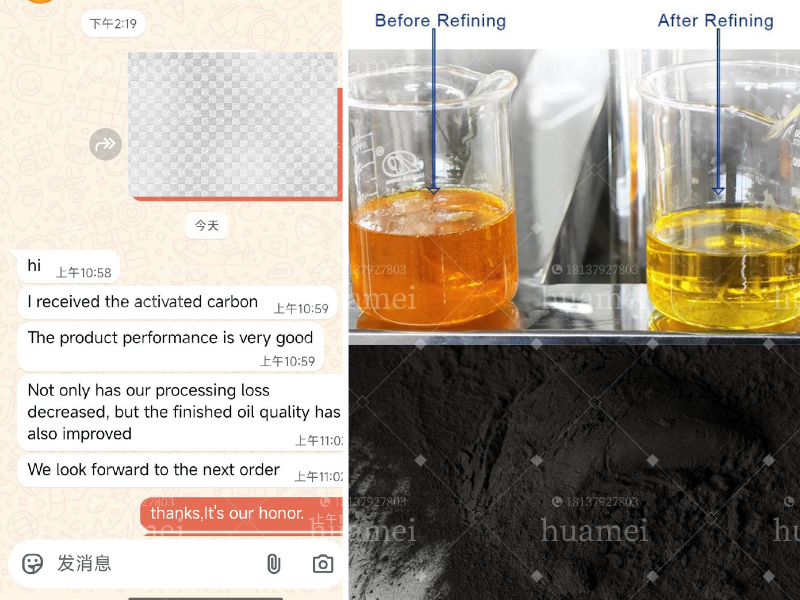
On October 12, the client sent their feedback after running our PAC through full-scale production:
"The product performance is very good. Not only has our processing loss decreased, but the finished oil quality has also improved. We look forward to the next order."
Two specific results the client reported:
In edible oil refining, lower carbon dosage directly translates to less oil loss. Even a small reduction — say from 1.5% to 1.2% of oil volume — saves thousands of dollars per month at industrial production scale.
This case is a good example of how factory visits accelerate procurement decisions. Activated carbon is a product where quality is difficult to verify from a datasheet alone — the same spec sheet can come from a trader reselling unknown product or from a manufacturer with real quality control.
When buyers visit our factory in person, they can verify:
Huamei Carbon welcomes factory visits from all prospective buyers. Our production facilities are located in Fujian and Ningxia, China, approximately 50 km from the nearest export port.
Huamei Carbon manufactures wood-based and coal-based powdered activated carbon for edible oil refining, sugar decolorization, beverage purification, glycerin processing, pharmaceutical applications, and water treatment. Our wood-based PAC is produced using phosphoric acid activation of premium wood raw materials, delivering high methylene blue value and low ash content for food-grade applications.
If you need powdered activated carbon for edible oil or other food processing applications, contact us for free samples and a technical consultation:
📱 WhatsApp: +86 181-3792-7803
📧 Email: sale@huameicarbon.com
🌐 Website: www.huameicarbon.com
Wood-based powdered activated carbon (PAC) is the industry standard for edible oil decolorization. Its mesoporous structure efficiently adsorbs large pigment molecules like carotenoids and chlorophyll, while its low ash and low iron content prevent contamination of the refined oil.
Typical dosing rates for edible oil decolorization range from 0.5% to 2.0% by weight of oil, depending on the crude oil quality and target color specifications. A bench-scale bleaching test with your actual crude oil is the most reliable way to determine the optimal dose.
Huamei Carbon's standard MOQ for wood-based powdered activated carbon is 3 tons. For edible oil processors running continuous production, we typically supply in 20-foot or 40-foot container loads (20–56 tons per container) to ensure uninterrupted supply.
Yes. Huamei Carbon welcomes factory visits from prospective buyers. Our production facilities in Fujian and Ningxia are open for inspection, including the production line, quality control laboratory, and warehouse. We can assist with travel arrangements if needed.
Every batch is tested in our in-house laboratory before shipment. A Certificate of Analysis (COA) is provided with every delivery, covering methylene blue value, moisture, ash content, particle size distribution, pH, and iron content. We also support third-party inspection by SGS, Bureau Veritas, or Intertek.
