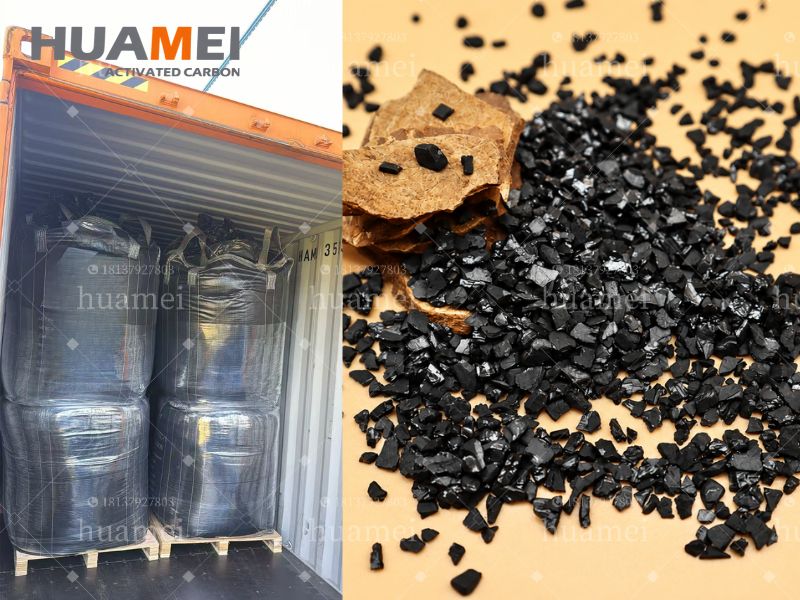
A gold mine in La Libertad, Peru — processing 3,000 tons of ore per day through a CIP circuit — was losing 8–10% of its carbon inventory every elution cycle. The old carbon had a ball-pan hardness of just 94%. Recovery had dropped from 96% to 93.5%, and the operation was bleeding gold into tailings. After switching to HMGOLD™7000 (iodine ≥1,100 mg/g, hardness ≥99%, 6×12 mesh), carbon loss dropped to 2.5–3% per cycle, recovery climbed to 97.3%, and the mine recovered an extra ~320 grams of gold per day — approximately $24,000 in additional daily revenue at the time of reporting. This is how that project came together.
The mine's CIP circuit ran six adsorption tanks in series. The carbon they were using — a generic coconut shell product from a Southeast Asian supplier — was specified at 94% ball-pan hardness. On paper, 94% sounds fine. In a 3,000 tpd CIP circuit, it's not.
Here's what was happening:
| Metric | Before (Old Carbon) | Target |
|---|---|---|
| Ball-pan hardness | 94% | ≥98% |
| Carbon loss per elution | 8–10% | <3% |
| Gold recovery rate | 93.5% (declining) | ≥96% |
| Fine carbon in tailings | Visible on screens | Minimal |
| Elution cycles before replacement | 30–40 cycles | 50+ cycles |
The mechanism is straightforward: every time carbon goes through the elution kiln and gets pumped back into the adsorption circuit, the granules collide with each other, the ore slurry, and the inter-stage screens. Low-hardness carbon breaks down into fines. Those fines are too small to be retained by the screens — they pass through and end up in tailings, carrying adsorbed gold with them.
At 8–10% loss per cycle, the mine was replacing its entire carbon inventory roughly every 10–12 cycles. That's not just a carbon cost problem — it's a gold loss problem. Every kilogram of carbon fines leaving the circuit carries gold that will never be recovered.

Most buyers ask about iodine number first. It makes sense — iodine number indicates adsorption capacity, and higher numbers mean faster gold loading. But in a high-tonnage CIP circuit like this one, hardness is the controlling parameter.
Here's the math that convinced this buyer:
| Scenario | 94% Hardness | 99% Hardness |
|---|---|---|
| Starting carbon inventory | 52 toneladas | 52 toneladas |
| Loss per elution cycle | 9% (midpoint) | 2.75% (midpoint) |
| Carbon lost per cycle | 4.68 tons | 1.43 tons |
| Cycles to lose 50% inventory | ~7 cycles | ~24 cycles |
*Based on 26 elution cycles/year (biweekly), FOB carbon price ~$1,800/ton for gold-grade coconut shell GAC.
The carbon replacement cost difference alone is ~$145,000/year. Add the gold recovery improvement (from 93.5% to 97.3% on 3,000 tpd of ore), and the economics become overwhelming.
After reviewing the mine's circuit design, ore characteristics, and operating conditions, we recommended HMGOLD™7000 — not the higher-grade HMGOLD™7500 or PLUS. Here's why:
| Parámetro | HMGOLD™7000 | Old Carbon | Why It Matters |
|---|---|---|---|
| Número de yodo | ≥1,100 mg/g | ~1,000 mg/g | Faster gold loading in the first 2–3 tanks |
| Ball-Pan Hardness | ≥99% | 94% | Dramatically reduces carbon fines and gold loss |
| Contenido de ceniza | ≤3% | ~5% | Less inert material, more active carbon surface |
| Humedad | ≤5% | ~6% | Less water weight per bag |
| Mesh Size | 6×12 | 6×12 | Standard CIP sizing — no screen modifications needed |
Why not HMGOLD™7500 or PLUS? The mine's ore grade and circuit throughput didn't justify the premium. HMGOLD™7000's ≥1,100 mg/g iodine number was more than sufficient for this operation, and the ≥99% hardness — actually higher than both HMGOLD™7500 (≥98.5%) and PLUS (≥98%) — was the priority for solving their carbon loss problem. We recommended the grade that solved the specific problem, not the most expensive option.
| Item | Details |
|---|---|
| Producto | HMGOLD™7000 Coconut Shell Activated Carbon |
| Cantidad | 52 tons (4 × 13 tons per 20ft container) |
| Embalaje | 25 kg woven bags on pallets |
| Destination Port | Callao, Peru |
| Origin Port | Xiamen, China |
| Transit Time | ~15 days (sea freight) |
| Documentation | COA per container, MSDS, phytosanitary certificate |
Each 20ft container was loaded with 13 tons — the standard loading capacity for 25 kg bags on pallets in a 20ft dry container. The mine requested COA testing for each container lot, including iodine number, hardness, ash, moisture, and particle size distribution. All four lots tested above spec.
The mine ran HMGOLD™7000 through their full CIP circuit for six months before reporting back. The numbers:
| Metric | Before (Old Carbon) | After 6 Months (HMGOLD™7000) | Change |
|---|---|---|---|
| Gold recovery rate | 93.5% | 97.3% | +3.8 percentage
points |
| Carbon loss per elution | 8–10% | 2.5–3% | Reduced by ~70% |
| Additional gold
recovered/day |
Baseline | +~320 grams | ~$24,000/day
additional revenue |
| Carbon inventory stability | Full replacement
every 10–12 cycles |
Stable with top-up only | Replacement cost
down ~70% |
| Fine carbon in tailings | Visible on inter-
stage screens |
Minimal | Significant reduction |
The 3.8-point recovery improvement came from two sources: (1) less gold leaving the circuit on carbon fines, and (2) higher iodine number providing better adsorption kinetics in the lead tanks. The mine estimated the combined impact at roughly 320 grams of additional gold recovered per day across their 3,000 tpd throughput — approximately $24,000 per day in additional revenue based on the gold price at the time of reporting. That's from a carbon change that cost under $100,000.
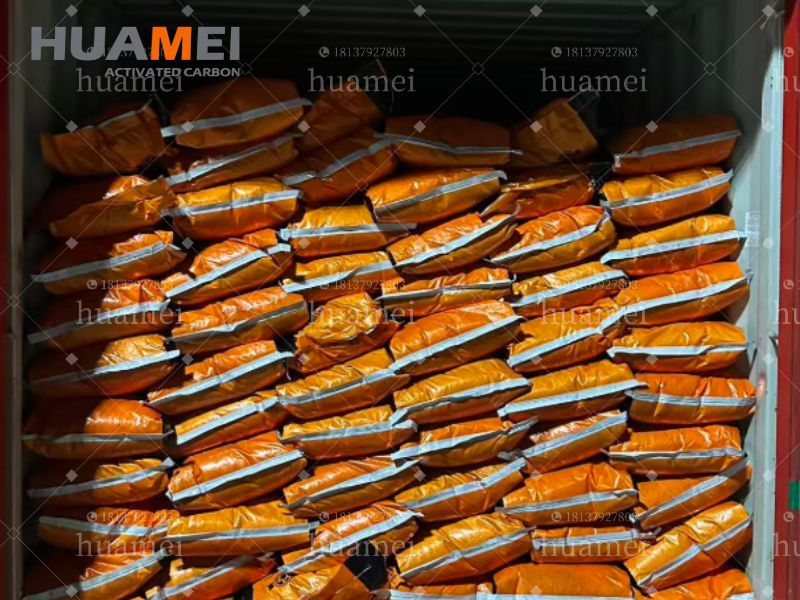
Based on the six-month results, the mine placed a reorder for 56 tons — this time in two 40ft high-cube containers (28 tons each) instead of four 20ft containers. The switch to 40ft containers reduced per-ton shipping cost by approximately 15%.
The reorder also included a request to pre-screen the carbon to tighten the 6×12 mesh distribution — minimizing the fraction of particles near the upper and lower size limits. This is a detail that experienced gold mine operators pay attention to: tighter particle size distribution means more uniform flow through the carbon bed and more consistent gold loading across all tanks.
If you're running a CIP or CIL gold circuit and evaluating carbon suppliers, this project highlights three things:
The primary cause is low ball-pan hardness — carbon with hardness below 97% breaks down rapidly during elution, screening, and inter-stage pumping in CIP circuits. Secondary causes include oversized or undersized particles (poor mesh distribution), excessive pumping velocity, and thermal shock during kiln regeneration. In this Peru case, upgrading from 94% to 99% hardness reduced carbon loss from 8–10% to 2.5–3% per elution cycle.
A typical CIP circuit carries 10–20 kg of carbon per ton of ore processed per day. For a 3,000 tpd operation, that's 30–60 tons of carbon in the circuit at any time. Initial loading for this Peru mine was 52 tons. The exact quantity depends on the number of adsorption stages, tank volume, carbon concentration, and residence time.
HMGOLD™7000 has an iodine number ≥1,100 mg/g with ≥99% ball-pan hardness. HMGOLD™7500 has a higher iodine number (≥1,150 mg/g) but slightly lower hardness specification (≥98.5%). For circuits where carbon durability is the priority (high-throughput CIP), HMGOLD™7000 is often the better choice. For CIL circuits where faster adsorption kinetics matter more, HMGOLD™7500 may be preferred. See the full HMGOLD™ product comparison.
Yes. We provide sample quantities (25–50 kg) for lab-scale gold adsorption testing (R-value and K-value tests). Many buyers run a 1–2 ton trial lot in a single adsorption tank before committing to a full circuit change. Minimum production order is 10 tons (one 20ft container).
Sea freight from Xiamen or Ningde port to Callao typically takes 30–40 days. Production lead time is 15–25 days for standard grades, so total door-to-door is approximately 45–65 days from order confirmation. We can also arrange CIF Callao pricing if needed.
Evaluating carbon options for your CIP or CIL circuit? Send us your current carbon specs and circuit conditions — we'll recommend the right HMGOLD™ grade and provide a quote:
