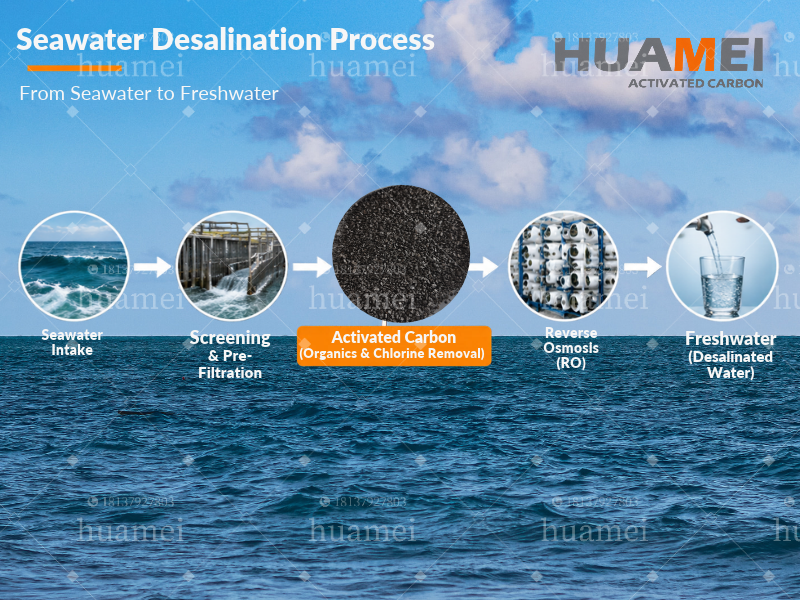
Activated carbon can support desalination pretreatment by reducing specified residual disinfectants and adsorbing suitable organic contaminants before water reaches RO membranes. Whether your plant needs a dedicated GAC filter depends on source water quality, existing treatment steps and membrane protection requirements.
The first question is not "Which carbon has the highest iodine number?" It is: what must this carbon remove, under what conditions, and how will you verify performance?
No. A GAC filter is one pretreatment option, not a mandatory stage in every desalination plant.
Chlorine-sensitive polyamide RO membranes require oxidant control — but that can be achieved through GAC filtration or chemical dosing (sodium metabisulfite). DuPont's FilmTec Technical Manual discusses both approaches without establishing either as universally preferred. [Source: DuPont FilmTec Manual]
A GAC stage deserves evaluation when:
| Situation | What to Establish First |
|---|---|
| Residual disinfectant reaching RO feed | Disinfectant type, concentration range, membrane supplier's limit |
| Organics contributing to membrane fouling | Water analysis, TOC/DOC levels, contaminants of concern |
| Existing carbon filter underperforming | Current media spec, bed dimensions, flow, breakthrough data |
| Seasonal water-quality swings | Representative data covering worst-case conditions |
If none of these apply and your existing pretreatment handles oxidant control adequately, a carbon filter may not be necessary.
The following is one illustrative route for a plant using a GAC stage, not a standard configuration for all SWRO or BWRO systems:
| Stage | Function | Position |
|---|---|---|
| Intake Screen | Remove debris, marine life | 1st |
| Coagulation / Flocculation | Aggregate suspended solids | 2nd |
| Multimedia Filter | Remove suspended matter using a project-specific media arrangement | 3rd |
| GAC Filter | Dechlorination + organic adsorption | 4th |
| Cartridge Filter | Downstream particle protection selected for the equipment requirements | 5th |
| High-Pressure Pump → RO | Desalination | 6th |
| Post-Treatment | Remineralization, pH adjustment, disinfection | 7th |
For the upstream filtration medium, see Huamei’s media filtrante antracite. For background on the separate roles of filter media and activated carbon, see Huamei’s anthracite vs bituminous coal water-filtration guide. Anthracite filtration and activated-carbon adsorption should not be treated as interchangeable duties.
Actual process trains vary. Some plants use dissolved air flotation (DAF) or ultrafiltration (UF) instead of multimedia filters. The process designer should confirm where oxidants are introduced and removed, how carbon fines are controlled, and how downstream equipment is protected during startup and backwash.
These duties require separate performance evaluations; the same carbon grade and operating conditions should not be assumed suitable for both.
GAC removes free chlorine through a catalytic surface reaction, reducing it to chloride. Confirm the permitted oxidant exposure and monitoring requirements with the supplier of the exact membrane. Do not apply a universal residual-chlorine limit from a general purchasing guide. The key is specifying which disinfectant needs removal: free chlorine and chloramine behave differently and require different design conditions.
NORIT's dechlorination guidance explains that disinfectant chemistry directly affects adsorber design — a carbon selected for one duty should not be assumed suitable for another. [Source: NORIT Dechlorination White Paper]
"Organic matter" is a mixture of substances, not one contaminant. Seawater carries dissolved organic carbon (DOC) from algal decay, humic substances and industrial runoff. Some organic constituents can contribute to RO fouling. Their relevance and removal should be evaluated using representative water and operating data.
Define what you're targeting: specific compounds, color, taste/odor, DOC reduction, or another parameter. Where performance is uncertain, pilot testing with representative water and candidate media is the responsible path. Calgon Carbon's technical guidance specifically cautions against installing carbon systems based on assumptions without adequate analysis. [Source: Calgon Carbon — Optimizing Water Cleanup]
| Factor | GAC filtration | SMBS dosing |
|---|---|---|
| Dechlorination | Evaluate the grade, disinfectant, contact conditions and outlet performance. | Evaluate chemical quality, dose control, mixing and outlet performance. |
| Organic removal | Can adsorb suitable compounds; assess the target mixture and breakthrough. | Does not provide an equivalent adsorption stage. |
| Equipment | Contactors, media retention and required backwash/handling arrangements. | Chemical storage/preparation, dosing equipment and mixing arrangements. |
| Operating costs | Include media, pumping, maintenance, backwashing where applicable and spent-media management. | Include chemicals, equipment, monitoring and maintenance. |
| Failure conditions | Breakthrough, uneven flow, fines release or inadequate biological management. | Dosing interruption, unsuitable dose or inadequate mixing. |
| Protection | Define monitoring, alarms and protective responses for the exact treatment duty and membrane system. | |
Neither approach is automatically fail-safe or universally less expensive. Compare them against a defined treatment objective. Variable organic loading can justify evaluating GAC, but it does not by itself prove that GAC will prevent membrane fouling or outperform another pretreatment arrangement.

Raw material is a starting point, not a performance guarantee. Compare coal-based activated carbon and coconut-shell activated carbon at the grade level against the actual water and treatment duty.
| Selection question | Evidence to request for either material |
|---|---|
| Will it remove the target disinfectant? | Relevant dechlorination evidence and operating conditions. |
| Will it adsorb the organics of concern? | Representative-water testing and a defined breakthrough criterion. |
| Will it suit the filter equipment? | Particle-size distribution, density, mechanical data and hydraulic guidance. |
| What is the operating cost? | Compare scoped quotations and expected operating requirements, not raw-material labels alone. |
For the available granular product form, review Huamei’s granular activated carbon product page. Product listings help identify candidates; they do not establish suitability for a particular seawater or brackish-water installation.
Set acceptance criteria for the selected grade and treatment duty. Distinguish contractual limits from typical values; do not apply one universal desalination-carbon specification.
| Item | What to agree or request |
|---|---|
| Product identity | Manufacturer, grade, raw material and traceable batch identification. |
| Numero di iodio | Agreed value, reporting basis and actual test method, such as ASTM D4607 where specified. It is not a substitute for target-contaminant testing. |
| Particle size | Sieve standard, full distribution and oversize/undersize limits compatible with the equipment. |
| Mechanical properties | Named method, such as ASTM D3802 where applicable, and a method-specific limit. |
| Ash and extractables | Relevant methods and limits. Total ash, for example measured by ASTM D2866, does not alone establish leaching behaviour. |
| Moisture and density | Delivery and reporting basis; actual density method, such as ASTM D2854 where specified, for media-mass calculations. |
| Treatment evidence | Test conditions and results relevant to dechlorination, specified organic removal or both. |
| Compliance and acceptance | Project-specific approvals, sampling, documents, retained samples and retesting procedure. |
ASTM references identify potential test methods, not universal pass values or certification. Check the method and result on the actual report. For potable-water applications, Huamei’s drinking-water treatment application page provides related application context; confirm approvals for the exact proposed grade rather than assuming a general application listing proves compliance.
Start with the flow through the carbon bed, not the plant's advertised production capacity.
Carbon-bed volume (m³) = Flow through GAC (m³/h) × EBCT (hours)
| Input | How to establish it |
|---|---|
| EBCT | Select for the actual disinfectant or adsorption duty using relevant evidence. |
| Superficial velocity and bed depth | Evaluate with flow, vessel area, contact requirements and pressure loss. EBCT = bed depth ÷ superficial velocity, with consistent units. |
| Backwash flow and bed expansion | Specify separately using media-specific guidance and water temperature; expansion percentage is not a flow-rate unit. |
| Service life | Establish monitoring and replacement criteria for the actual duty rather than a universal calendar life. |
A critical sizing distinction is the meaning of the stated capacity. The example below assumes 15-minute EBCT and 500 kg/m³ apparent density solely to explain the arithmetic; neither is a universal design recommendation. It also assumes 24-hour operation and that the entire corresponding RO feed passes through GAC, without additional process-water allowances.
| What "10,000 m³/day" Means | Flow to GAC | Bed Volume (15-min EBCT) | Media Mass (at 500 kg/m³) |
|---|---|---|---|
| Actual flow through GAC stage | ~417 m³/h | ~104 m³ | ~52 tons |
| RO product water (assuming 45% recovery) | ~926 m³/h | ~231 m³ | ~116 tons |
In the illustrated 45% recovery scenario, confusing RO permeate output with feed flow understates the calculated pretreatment flow by about 2.22 times. The factor changes with recovery. Clarify this in your RFQ. [Source: DuPont — RO Definitions and Terms]
Two parallel vessels do not automatically mean full-flow redundancy. If one is offline for backwash, the remaining vessel must still meet hydraulic and treatment conditions.
For coastal and island projects, request seasonal source-water analyses, temperature ranges and records of any algal or contamination events. For brackish groundwater, evaluate relevant dissolved constituents, suspended matter and oxidant treatment. Country or region alone does not determine the carbon grade, iodine number, replacement interval or container loading.
Use observed site conditions to define testing. Media quantity and shipping arrangements should follow the selected product, packaging, container limits and destination requirements.
Carbon filters can develop biofilm. Biofilm sloughing from biologically active GAC can affect downstream water quality — GAC filtration alone should not be assumed to prevent RO biofouling. A biological-management plan appropriate to your process conditions is essential. [Source: Ontario Drinking-Water System Design Guidelines]
Agree on handling, initial rinsing, startup checks and downstream protection with equipment and media suppliers. A mesh designation alone does not describe fines quantity or prove commissioning is complete.
Establish measurable criteria for each duty: chlorine breakthrough, TOC threshold, hydraulic degradation, or media property decline. A fixed calendar replacement schedule is not a substitute for operating evidence.

Huamei’s published product information identifies HMG-BC as its granular liquid-phase carbon series. Request the current grade-specific TDS, quotation and relevant batch documents for evaluation. Confirm the product identity and required tests before approving a substitution.
Huamei’s coal-based activated carbon page and published supply record includes a 600-tonne order for municipal drinking-water treatment in Saudi Arabia, specifying 8×30 mesh, iodine value 950 mg/g and 500 kg jumbo-bag packaging. This is a published water-treatment supply reference, not evidence of desalination operating performance or longer RO membrane life.
The product page currently states a 3-tonne MOQ. Confirm the current order terms for the exact grade; do not equate MOQ with a fixed container payload.
For another media-supply example, see the 40-tonne anthracite filter-media shipment to Saudi Arabia. Anthracite is a separate filtration medium, and this shipment should not be presented as proof of activated-carbon adsorption or desalination performance.
Before comparing quotations, agree on the specification, quantity, packaging, delivery basis and document requirements. Keep procurement cost separate from an unverified promise of membrane-life savings.
Send your project specs on WhatsApp or submit an inquiry to discuss grade selection and documentation for your desalination project.
Not in every plant. Determine whether the existing process meets oxidant-control and fouling-management requirements. GAC is one option to evaluate for an identified treatment duty; it is not a mandatory stage in every SWRO plant.
There is no universal best raw material or grade. Compare the proposed products against actual water quality, treatment duty, hydraulic conditions and acceptance requirements.
Agree on a grade-specific value and test method. Iodine number is a characterization parameter and does not independently predict dechlorination rate or organic removal from the actual water.
Multiply the actual flow through the carbon bed by the selected EBCT using consistent units, then use the proposed density to estimate mass. The example in this guide uses 15 minutes and 500 kg/m³ only as calculation assumptions, not design recommendations.
Service life depends on the treatment duty, inlet loading, operating conditions and media condition. Set measurable replacement criteria and monitor the relevant outlet quality and hydraulic performance rather than relying on a universal number of months.
Ethiopia sits on one of Africa's most underexplored gold belts. With large-scale operations expanding in Oromia, Tigray, Benishangul-Gumuz, and the western lowlands, demand for quality activated carbon is growing faster than local supply chains can handle.
If you're running a CIP or CIL gold recovery plant in Ethiopia — or planning one — this guide covers what carbon specs you need, what to watch out for when importing, and how to avoid the quality problems that plague the East African supply chain.
Ethiopia's gold production has grown steadily as the government opens the sector to foreign investment. Key facts:
The challenge for Ethiopian gold miners: getting reliable activated carbon at competitive prices, with consistent quality batch to batch, delivered to a landlocked country.
Gold recovery circuits in Ethiopia face the same technical demands as anywhere — but with additional logistics challenges:
| Requirement | Why it matters in Ethiopia |
|---|---|
| High hardness (≥98%) | Aggressive circuits + long transport = carbon must survive mechanical stress |
| Consistent iodine (≥1050 mg/g) | Batch inconsistency directly reduces gold recovery |
| Low ash (≤3%) | High ash means gold adsorption capacity drops |
| Reliable supply | Landlocked logistics mean you can't afford stock-outs |
| Competitive pricing | Tight margins on most Ethiopian operations |
The spec that matters most for Ethiopian gold mines:
| Parametro | Minimum | Recommended |
|---|---|---|
| Raw material | 100% coconut shell | 100% coconut shell |
| Dimensione della maglia | 6×12 | 6×12 |
| Numero di iodio | ≥1050 mg/g | ≥1100 mg/g |
| Hardness (ball-pan) | ≥97% | ≥98% |
| Contenuto di ceneri | ≤5% | ≤3% |
| Umidità | ≤5% | ≤5% |
| Apparent density | 0.48–0.55 g/mL | 0.50–0.54 g/mL |
Many suppliers pass the first test order, then gradually drop quality on repeat orders. We've heard this from Ethiopian clients who switched to us after dealing with:
Ethiopia is landlocked. Goods arrive via Djibouti port, then overland. Total transit from factory to mine site can be 45–60 days. If your supplier takes 4–6 weeks to produce, you're looking at 3+ months from order to delivery.
Some suppliers mix cheaper materials (apricot shell, palm shell) into coconut shell carbon. The visual difference is minimal. The performance difference in a CIL circuit is not. Ethiopian buyers who've been burned by this are now testing every batch independently — which is the right approach.
Going through South African or Middle Eastern distributors adds 20–40% to the price. Direct factory purchasing eliminates these layers but requires finding a trustworthy Chinese manufacturer.
Over 60% of activated carbon used in African gold mining originates from Chinese factories. Reasons:
The question isn't whether to buy from China — it's which factory to trust.
We've been supplying activated carbon to Ethiopian gold recovery operations for several years. What our Ethiopian clients consistently tell us:
One of our Ethiopian partners put it directly: they tested carbon from five different Chinese suppliers over two years. Most passed the sample stage but failed on consistency at production volumes. They've been reordering from us since because every container matches the first.
We don't claim to be the only good supplier in China. But we do promise that batch #20 will be identical to batch #1 — and we back that with third-party inspection on every order if requested.
| Stage | Timeline | Notes |
|---|---|---|
| Production | 7–15 days | After order confirmation and deposit |
| Inland transport to port | 1–2 days | Ningxia → Tianjin/Qingdao port |
| Ocean freight to Djibouti | 20–25 days | Standard container shipping |
| Djibouti → Addis Ababa (rail/road) | 3–7 days | Djibouti-Ethiopia railway operational |
| Customs clearance | 3–7 days | Varies; experienced agents help |
Tips for Ethiopian buyers:

| Spec | Detail |
|---|---|
| Prodotto | Coconut Shell Activated Carbon for Gold CIL/CIP |
| Dimensione della maglia | 6×12 |
| Numero di iodio | 1100–1300 mg/g |
| Durezza | 98–99% |
| Contenuto di ceneri | ≤3% |
| Umidità | ≤5% |
| Raw material | Indonesia/Philippines/Sri Lanka coconut shell |
| MOQ | 10 tons |
| Production capacity | 700+ tons/month |
| Export experience | 30+ countries, including Ethiopia, Sudan, Ghana, Tanzania, Mali |
Yes — if you verify. Over 60% of activated carbon used in African gold mining comes from China. The risk isn't the country of origin; it's the specific factory. Protect yourself with independent testing, pre-shipment inspection, and trial orders before committing to large volumes. Reputable factories welcome this scrutiny.
Depends on circuit size and carbon losses. A medium-scale CIL plant processing 2,000–5,000 tons of ore per day typically holds 100–200 tons of carbon in the circuit, with annual top-up requirements of 20–50 tons to replace losses from attrition, fine carbon, and elution degradation.
FOB China price for quality coconut shell 6×12, 1100+ iodine: $3,400–4,100/ton. Add ocean freight ($800–1,200 to Djibouti), inland transport, and customs — total delivered cost is typically $4,500–6,000/ton depending on volume and logistics arrangements.
Yes. We host buyers from Africa regularly. We can arrange factory tours showing raw material storage, production lines, quality control labs, and packing facilities. Most Ethiopian clients visited after their first or second successful order to build longer-term supply relationships.
Three quick checks: (1) Ball-pan hardness test — pure coconut shell gives 97%+, blended material drops to 90–93%. (2) Apparent density — genuine coconut shell is 0.48–0.55 g/mL; lighter material suggests contamination. (3) Send samples to an independent lab for raw material identification if hardness or density are off.
Tell us your carbon specs, annual consumption volume, and delivery location. We'll provide FOB pricing and can recommend freight forwarders experienced with the China-Djibouti-Ethiopia route.
Huamei Activated Carbon Co., Ltd.
Website: www.huameicarbon.com
In the grand narrative of gold mining and refining, a humble black material plays the indispensable role of the "adsorbent," silently capturing precious gold molecules from vast quantities of ore pulp. This is activated carbon. As a highly efficient and environmentally sound adsorbent, activated carbon has become an irreplaceable component in modern cyanidation gold extraction processes. Its performance directly dictates gold recovery rates and the overall economic viability of a mining operation.

The high efficiency of activated carbon for gold recovery stems from its dual adsorption mechanism.
First, physical adsorption: activated carbon possesses a highly developed pore structure and an enormous specific surface area, providing countless attachment sites for gold-cyanide complexes like Au(CN)₂⁻.
Second, chemical adsorption: functional groups on the carbon's surface can engage in chemical reactions with gold ions, forming stable bonds that securely lock the gold in place.
This process follows the cyanidation stage, where gold in the ore is dissolved into a soluble state in an alkaline cyanide solution.
Two primary industrial application processes are utilized: Heap Leaching and the Carbon-in-Pulp (CIP) or Carbon-in-Leach (CIL) processes. Heap leaching is suitable for low-grade ores, where crushed ore is stacked and irrigated with cyanide solution.
The resulting pregnant solution is then passed through columns packed with activated carbon for gold adsorption. The more common CIP/CIL processes involve directly mixing finely ground ore slurry with cyanide and activated carbon in agitated tanks, allowing leaching and adsorption to occur simultaneously or in series.
The gold-loaded carbon is then processed through elution (typically using a hot solution of sodium cyanide and sodium hydroxide) and electrowinning to recover pure gold. Used carbon can often be thermally regenerated to restore much of its activity, enabling cost-effective recycling within the circuit.
Not all activated carbon is suitable for gold extraction. To withstand the abrasive conditions of slurry agitation and meet demanding adsorption/elution requirements, the following primary types are used:
Coconut Shell Activated Carbon for Gold Mining: Often the premier choice for CIP/CIL gold recovery processes. Produced from high-quality coconut shells via physical activation, its greatest advantage is exceptional hardness and abrasion resistance (typically ≥98%). This minimizes gold losses from carbon attrition and fines generation. Its predominantly microporous structure facilitates excellent gold loading capacity and elution kinetics. Common mesh sizes like 6x12 or 8x16 are standard for CIP/CIL circuits.
Coal-Based Granular Activated Carbon for Gold Extraction: Manufactured from select bituminous coal, this type is characterized by high adsorption capacity, good mechanical strength, and cost-effectiveness. It is a reliable choice for gold recovery in heap leaching applications or for processing certain ore types. Its pore structure, containing both micropores and mesopores, offers good adaptability to various gold complex species.
Specialty Impregnated or Tailored Activated Carbons: For operations facing specific challenges like preg-robbing ores (where organic carbon steals the gold) or high concentrations of fouling ions, specially formulated or impregnated activated carbons can be developed to optimize performance and protect recovery rates.
Selecting the right gold recovery carbon requires close attention to key performance indicators: Iodine Number (indicative of microporosity, often required ≥1000 mg/g), CTC Activity (a measure of adsorptive capacity), Hardness/Abrasion Resistance (critical for service life in agitated tanks), and Apparent Density.
A crucial industry benchmark is the "K-value" – the laboratory-measured equilibrium gold loading capacity under standard conditions, with high-quality carbons achieving values of 24-30 grams Au per kilogram of carbon. While actual plant loadings are lower due to competing ions and kinetics, the K-value remains a core grading parameter.

Gold extraction is an industry intensely sensitive to efficiency and cost. Activated carbon, though a consumable, is a "key player" in determining profitability. From the CIP adsorption process to loaded carbon stripping and regeneration, each stage places stringent demands on the carbon's adsorption kinetics, loading capacity, and mechanical integrity.
Huamei Activated Carbon understands this critical role. We specialize in providing high-performance adsorption solutions for the global gold mining industry. Our product range includes high-strength coconut shell carbon for gold recovery, abrasion-resistant coal-based carbon for gold extraction, and tailored products designed for specific ore types and processes like CIL or heap leaching.
We maintain strict control over every stage, from raw material selection to activation, ensuring our products deliver high adsorption capacity, superior selectivity, and exceptional durability. Our goal is to maximize your gold recovery while minimizing losses from carbon wear and inefficient adsorption.
We recognize that reliable activated carbon is fundamental to stable production and profitability. Huamei Activated Carbon invites mining companies, refiners, and supplier partners worldwide to connect and explore collaboration. Let us support you in building a more efficient and cost-effective gold recovery value chain with our premium products and expert technical support.
