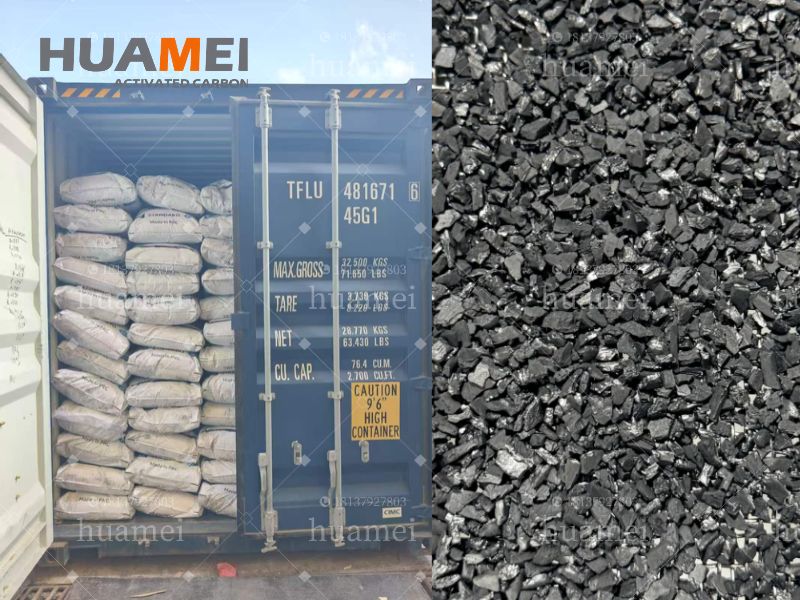
Huamei just completed a two-container shipment of coconut shell activated carbon for recuperação de ouro to Sudan — roughly 56 tonnes of HMGOLD™ carbon, produced, tested, packed, and loaded in 18 days from order confirmation to vessel departure.
This article walks through the entire fulfillment process step by step: what the client needed, how we produced and tested the carbon, how it was packaged for Sudan's inland logistics reality, and how two 40ft high-cube containers were loaded and dispatched. Every detail here reflects an actual shipment — not a capabilities brochure.
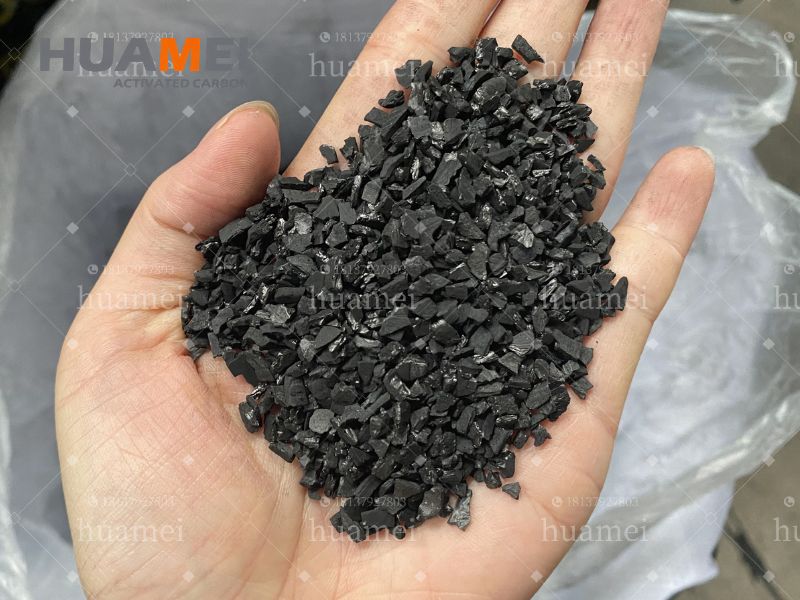
A gold recovery activated carbon order profile defines the product specification, packaging format, shipping terms, and delivery timeline agreed between supplier and buyer before production begins — it is the single document that drives every downstream decision from raw material selection to container loading.
| Order Detail | Especificação |
|---|---|
| Produto | HMGOLD™ coconut shell carvão ativado
for gold recovery |
| Aplicação | CIL/CIP gold processing circuit |
| Quantity | ~56 tonnes (two 40ft high-cube containers) |
| Tamanho da malha | 6×12 (1.70–3.35 mm) |
| Número de iodo | ≥1,100 mg/g (ASTM D4607) |
| Ball-pan hardness | ≥97% (ASTM D3802) |
| Teor de cinzas | ≤3% (ASTM D2866) |
| Umidade | ≤5% (ASTM D2867) |
| Embalagem | 25 kg PP woven bags on pallets |
| Shipping terms | FOB Xiamen |
| Destination port | Port Sudan |
The client operates a gold processing plant in Sudan's River Nile State, running a CIL circuit with a daily ore throughput that requires regular activated carbon replenishment. This was not a first order — the operation had previously tested Huamei samples and confirmed gold loading performance before committing to a full two-container shipment.
→ Why two 40ft containers instead of 20ft? A 40ft high-cube container holds approximately 26–28 tonnes of activated carbon in 25 kg bags on pallets. Two containers deliver ~56 tonnes — enough carbon inventory for several months of continuous CIL operation at a medium-scale plant. Shipping two 40ft containers in one booking also reduces per-tonne ocean freight cost by 8–12% compared to four separate 20ft containers carrying the same volume.
Gold recovery activated carbon starts with raw material — and not all coconut shell charcoal is equal. For this Sudan order, we selected coconut shell charcoal sourced from Southeast Asia with fixed carbon content ≥75% and ash ≤2%, which are the baseline requirements for producing carbon that meets the iodine and hardness specs demanded by CIL circuits.
| Raw Material Parameter | Requirement | Why It Matters for Gold Recovery |
|---|---|---|
| Fixed carbon | ≥75% | Higher fixed carbon → more micropores
after activation → better gold-cyanide complex adsorption |
| Teor de cinzas | ≤2% | Low-ash charcoal produces cleaner
carbon with fewer mineral impurities that block pores |
| Particle size (pre-crush) | 5–30 mm | Uniform feed size ensures consistent
activation and mesh distribution after crushing |
| Umidade | ≤8% | Excess moisture reduces kiln
efficiency and activation uniformity |
Before production begins, our QC team tests every incoming batch of coconut shell charcoal against these parameters. Batches that don't meet the threshold are rejected or diverted to lower-grade product lines. Based on our production records, roughly 10–15% of incoming charcoal batches are rejected at this stage.
Rule of Thumb: The quality ceiling of your finished activated carbon is set by the raw material. No amount of activation time or temperature can turn low-grade charcoal into high-performance gold recovery carbon.
The crushed coconut shell charcoal enters our rotary activation kilns at 850–950°C under a controlled steam atmosphere. This is the step that transforms dense charcoal into the highly porous structure that adsorbs gold-cyanide complexes.
For this shipment, the activation parameters were tuned specifically for gold recovery grade:
→ Why activation matters for gold recovery specifically: Gold-cyanide complexes (Au(CN)₂⁻) are relatively small molecules that adsorb preferentially in micropores (pore diameter <2 nm). The activation step develops these micropores. Under-activated carbon has too few micropores — the gold loading capacity drops. Over-activated carbon develops mesopores (2–50 nm) at the expense of micropores, which actually reduces gold adsorption efficiency. The sweet spot for gold recovery carbon is an iodine number of 1,050–1,300 mg/g.
After activation, the carbon is cooled and passed through multi-deck vibrating screens to separate it into the target mesh size — in this case, 6×12 mesh (1.70–3.35 mm), the industry standard for CIL and CIP gold circuits.
| Mesh Fraction | Tamanho da partícula | Disposition |
|---|---|---|
| Oversize (>6 mesh) | >3.35 mm | Returned for re-crushing |
| On-spec (6×12 mesh) | 1.70–3.35 mm | Proceeds to QC testing → packaging |
| Undersize (<12 mesh) | <1.70 mm | Diverted to water treatment or other applications |
→ Why mesh size precision matters in CIL/CIP: Oversized particles reduce the total surface area available for gold adsorption per kilogram of carbon. Undersized particles — fines — pass through inter-stage screens in the CIL circuit and carry adsorbed gold into the tailings stream. Either way, you lose gold. For this shipment, we targeted <5% material outside the 6×12 specification, verified by sieve analysis on every production batch.
This is where we prove the carbon meets spec — not with a generic data sheet, but with batch-specific testing on every production run that goes into the shipment.
For the Sudan two-container order, testing covered:
| Parâmetro | Test Method | Target | Actual Result (Batch Average) |
|---|---|---|---|
| Número de iodo | ASTM D4607 | ≥1,100 mg/g | 1,165 mg/g |
| Ball-pan hardness | ASTM D3802 | ≥97% | 98.5% |
| Teor de cinzas | ASTM D2866 | ≤3% | 2.3% |
| Umidade | ASTM D2867 | ≤5% | 3.8% |
| Apparent density | ASTM D2854 | 0.45–0.55 g/cm³ | 0.49 g/cm³ |
| Mesh distribution (6×12) | Sieve analysis | ≥95% on-spec | 96.7% |
Each production batch gets its own Certificate of Analysis (COA) before being cleared for packaging. If any parameter falls outside the agreed specification, that batch is held and re-tested or diverted — it does not go into the shipment.
Key Distinction: A COA from the manufacturer tells you what the carbon tested at in our lab. For critical gold recovery applications, some clients also request third-party verification through SGS, Intertek, or Bureau Veritas. We facilitate this on request — the client in this case had already validated our carbon through sample testing and accepted our in-house COA for the production order.
→ What the numbers mean in practice: Iodine 1,165 mg/g means this carbon has approximately 15% more adsorption capacity than the minimum 1,000 mg/g often sold as "gold grade" by competitors. Hardness 98.5% means less than 1.5% of the carbon will break down into fines per reactivation cycle — critical for a CIL circuit where fines equal gold loss. Ash 2.3% is well below the 3% ceiling, indicating clean raw material and minimal mineral contamination.
Need Gold Recovery Carbon with Batch-Specific COA?
Every Huamei shipment comes with ASTM-method test reports for iodine, hardness, ash, moisture, and mesh distribution. Third-party SGS testing available on request. MOQ 10 tonnes. Free samples for plant trials.
Packaging is not an afterthought — it's a logistics decision that affects product integrity, handling efficiency, and cost all the way to the mine site.
For this shipment, the client specified 25 kg polypropylene (PP) woven bags, palletized and stretch-wrapped. Here's why:
| Packaging Option | Weight | Bags per 40ft HC | Best For |
|---|---|---|---|
| 25 kg PP woven
bags (palletized) |
25 kg each | ~1,080–1,120 bags | Sites with manual handling,
remote mine access, redistribution to smaller operations |
| Jumbo bags (FIBC) | 500–1,000 kg each | 24–28 bags | Industrial sites with forklift/
crane access, bulk storage |
| 500 kg bags | 500 kg each | ~52–56 bags | Compromise — manageable
without heavy equipment |
→ Why 25 kg bags for Sudan: Most gold mining operations in Sudan — particularly in River Nile State and Red Sea Hills — are reached by roads that range from paved highways to unpaved tracks. The last 50–200 km from the main road to the mine site often requires smaller trucks or even donkey carts. 25 kg bags can be manually loaded and unloaded by two workers, don't require a forklift at the mine site, and are easy to store in simple warehouses without specialized racking.
The trade-off is more labor at the port for container destuffing, but the client's logistics team confirmed this was the right format for their operation.
Each bag is double-stitched, with an inner moisture barrier liner to protect the carbon during the 30–45 day ocean transit and potential delays at Port Sudan. Moisture pickup during shipping is one of the most common quality complaints in the activated carbon trade — our packaging is designed to keep moisture below the 5% specification even after extended storage.
Loading two 40ft high-cube containers with ~56 tonnes of 25 kg bags is a precision operation that takes approximately 6–8 hours per container.
The loading sequence:
| Loading Detail | Container 1 | Container 2 |
|---|---|---|
| Container type | 40ft high-cube | 40ft high-cube |
| Net weight (carbon) | ~28 tonnes | ~28 tonnes |
| Bags | ~1,120 × 25 kg | ~1,120 × 25 kg |
| Pallets | 28 | 28 |
| Loading time | ~7 hours | ~7 hours |
| Seal number | Recorded on B/L | Recorded on B/L |

Once loaded and sealed, the containers were trucked from our factory in Fujian Province to Xiamen Port for vessel loading. The shipping route:
| Stage | Timeline | Detail |
|---|---|---|
| Factory → Xiamen Port | 1–2 days | Inland trucking, ~60 km
from factory to port |
| Port processing | 2–3 days | Customs declaration,
inspection, vessel booking |
| Ocean transit | 30–40 days | Xiamen → (transshipment)
→ Port Sudan |
| Port Sudan arrival | — | Client arranges customs
clearance and inland transport |
Export documentation provided with this shipment:
→ Why documentation completeness matters for Sudan: Sudan customs has specific requirements for imported industrial chemicals, including activated carbon. Missing or incomplete documentation can cause clearance delays of 1–3 weeks at Port Sudan — a costly hold when your gold plant is waiting for carbon. We provide a complete document package before vessel departure so the client's customs broker can pre-clear as much as possible.
Here's how the entire production-to-shipment cycle looked for this two-container order:
| Day | Activity |
|---|---|
| Day 1 | Order confirmed, raw material allocated, production scheduled |
| Day 2–8 | Production: activation,
screening, and mesh grading for ~56 tonnes |
| Day 9–10 | Quality testing: full ASTM parameter suite on every batch |
| Day 11–13 | Packaging: 25 kg bags,
palletizing, stretch-wrapping |
| Day 14–15 | Container loading:
two 40ft HCs loaded and sealed |
| Day 16 | Inland transport:
factory → Xiamen Port |
| Day 17–18 | Port processing: customs
declaration, vessel loading |
Total: 18 days from order confirmation to vessel departure. This timeline reflects our current production capacity of 700+ tonnes/month across two factory sites in Fujian and Ningxia — enough capacity to handle multiple large orders simultaneously without queue delays.
→ What this means for buyers planning procurement: If you need carbon at your Sudan mine site in 60 days, work backward: 30–40 days ocean transit + 18 days production-to-vessel = order must be placed at least 48–58 days before needed. Add 5–14 days for Port Sudan clearance and inland transport, and the real planning horizon is 65–75 days minimum. This is why we always tell Sudan-based clients: order before you're running low, not after.
Approximately 26–28 tonnes, depending on packaging format. In 25 kg bags on pallets, a 40ft HC holds about 1,080–1,120 bags (27–28 pallets). In jumbo bags (1,000 kg each), it holds 24–26 bags. The high-cube variant offers ~13% more volume than a standard 40ft container, which matters for lightweight-but-bulky cargo like activated carbon.
Every shipment includes a batch-specific Certificate of Analysis (COA) covering iodine number (ASTM D4607), ball-pan hardness (ASTM D3802), ash content (ASTM D2866), moisture (ASTM D2867), apparent density (ASTM D2854), and mesh distribution. We also provide commercial invoice, packing list, bill of lading, certificate of origin, MSDS, and fumigation certificate. Third-party SGS/Intertek testing is available on request at the buyer's cost.
Yes. We ship from Xiamen Port to Port Sudan regularly, with transit time of 10–25 days depending on carrier and routing (direct or transshipment). We've completed multiple shipments to Sudan and are familiar with the documentation requirements for Sudanese customs clearance. FOB, CFR, and CIF terms are all available.
For a ~56-tonne order, production-to-vessel typically takes 15–20 days: 7–8 days production, 2 days testing, 3 days packaging, 2 days loading, and 2–3 days port processing. Larger orders (100+ tonnes) may require 25–30 days. We confirm exact timelines at order placement based on current production schedule.
Get Gold Recovery Carbon — Factory Direct, Full Documentation
Tell us your gold processing method, annual carbon consumption, and preferred packaging. We'll provide specs, pricing, and a production timeline. Free samples available for plant trials.
WhatsApp: +86 181-3792-7803
E-mail: sale@huameicarbon.com
Website: www.huameicarbon.com
