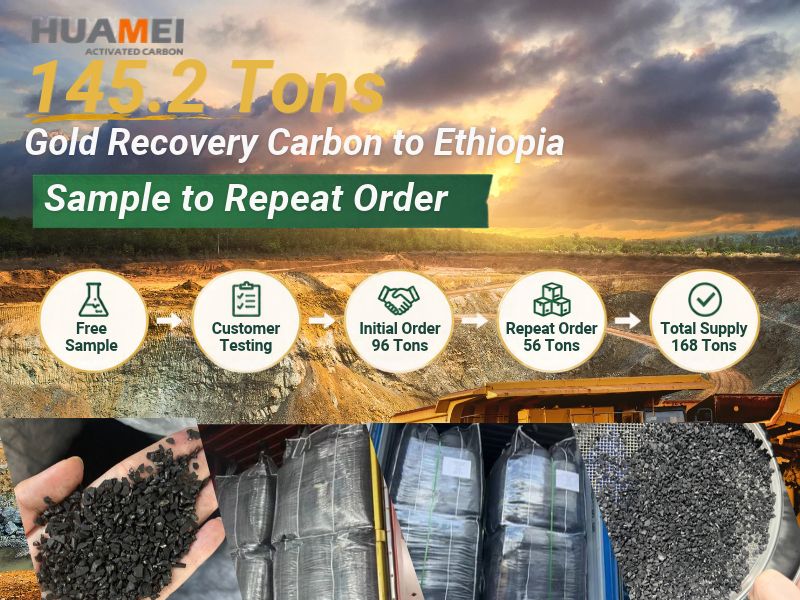
An Ethiopian CIL gold mine switched activated carbon suppliers after persistent problems with particle consistency and ash content. After free sample testing and a 96.8-tonne trial shipment, the operation validated Huamei's HMGOLD PLUS™ carbon through multiple reactivation cycles — then placed a 48.4-tonne repeat order. Total supply: 145.2 tonnes across six 40-foot containers.
This case study documents the full process: the quality problems that triggered the supplier search, how the technical evaluation was structured, what the CIL circuit performance data showed, and why the total cost of ownership — not just the per-ton price — drove the repeat order decision.
| Parameter | Details |
|---|---|
| Customer location | Ethiopia (gold mining region) |
| Processing method | CIL (Carbon-in-Leach) |
| Product supplied | HMGOLD PLUS™ coconut shell activated carbon |
| Mesh size | 6×12 (1.70–3.35 mm) |
| First order | 96.8 tonnes — 4 × 40ft containers, 550 kg bulk bag packaging |
| Repeat order | 48.4 tonnes — 2 × 40ft containers |
| Total supply | 145.2 tonnes |
| Packaging | 550 kg bulk bags (~44 bags per container) |
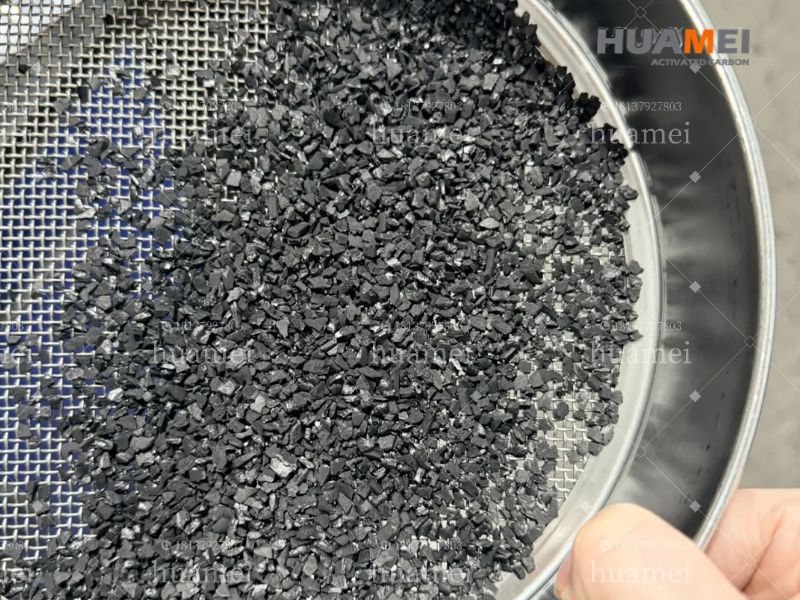
The customer's CIL plant had been running activated carbon from another supplier, but two recurring quality issues were affecting production efficiency:
→ Uneven particle size distribution: The carbon arriving on site showed significant variation in granule size within the same batch. In a CIL circuit, inconsistent particle size creates problems at every stage — undersized particles pass through inter-stage screens and report to tailings (direct gold loss), while oversized particles have slower adsorption kinetics due to reduced surface-area-to-volume ratio. The screening team was spending excessive time managing carbon fines and dealing with screen blinding from irregularly shaped fragments.
→ Elevated ash content: The previous supplier's carbon consistently tested above 4% ash, sometimes reaching 5–6%. High ash content in gold recovery carbon is not just a specification issue — it has direct operational consequences. Mineral ash deposits block micropores over successive reactivation cycles, progressively reducing gold loading capacity. At the kiln, high-ash carbon requires more aggressive reactivation temperatures to maintain activity, which accelerates structural degradation and increases carbon losses per cycle.
The combined effect: Higher carbon consumption rates (more tonnes of make-up carbon needed per year), lower gold recovery efficiency, and increased reactivation operating costs. The customer estimated they were losing meaningful production value through carbon-related inefficiencies before initiating the supplier search.
When the customer approached Huamei, they referenced Jacobi's GoldSorb® series as the performance standard they wanted to match or exceed. This is common in the gold mining industry — Jacobi GoldSorb® is widely specified in CIL/CIP operations across Africa, and procurement teams often use it as a benchmark when evaluating alternative suppliers.
Important clarification: The customer was not replacing Jacobi products. They were replacing a different supplier whose carbon was underperforming. Jacobi's published specifications served as the technical reference point for evaluating whether Huamei's HMGOLD PLUS™ could meet their CIL circuit requirements.
| Parameter | Jacobi GoldSorb® 5500
(Published TDS, 2012 rev.) |
HMGOLD PLUS™
(SGS Report MSRCZ2500346-01A) |
Test Method |
|---|---|---|---|
| Raw material | Coconut shell | Coconut shell | — |
| CTC activity | ≥55% | Contact factory for batch COA | ASTM D3467 |
| Total ash | ≤4% | 2.52% | ASTM D2866 / Huamei ASTM testing |
| Hardness | ≥99% (Jacobi proprietary
attrition method, ≤2% loss) |
98.2% (GB/T method) | Not directly comparable
— see note below |
| Platelets | ≤7% | Not tested on this batch | Visual / sieve |
| Moisture | ≤5% | ≤5% | ASTM D2867 |
| Apparent density | 450–550 kg/m³ | 450–550 kg/m³ | ASTM D2854 |
| Mesh size | 6×12 | 6×12 (1.70–3.35 mm) | ASTM D2862 |
| Iodine number | Not published in GoldSorb 5500 TDS | 1,208 mg/g | ASTM D4607 |
⚠️ Important note on test methods: Jacobi specifications are from the publicly available GoldSorb® 5500 TDS (2012 revision) and use Jacobi's proprietary test methods for hardness and attrition. HMGOLD PLUS™ results are SGS-tested using GB/T and ASTM standards. Different test methods apply different mechanical stress conditions — direct percentage comparison between columns is not valid. The meaningful comparison is field performance: how the carbon performs in your specific CIL circuit through multiple reactivation cycles. We provide free samples for exactly this purpose.
What the data does show: HMGOLD PLUS™ achieved 2.52% ash (SGS-verified) versus GoldSorb® 5500's ≤4% specification limit. Lower ash content translates directly to better micropore preservation through reactivation cycles — this was the parameter that mattered most to this customer.
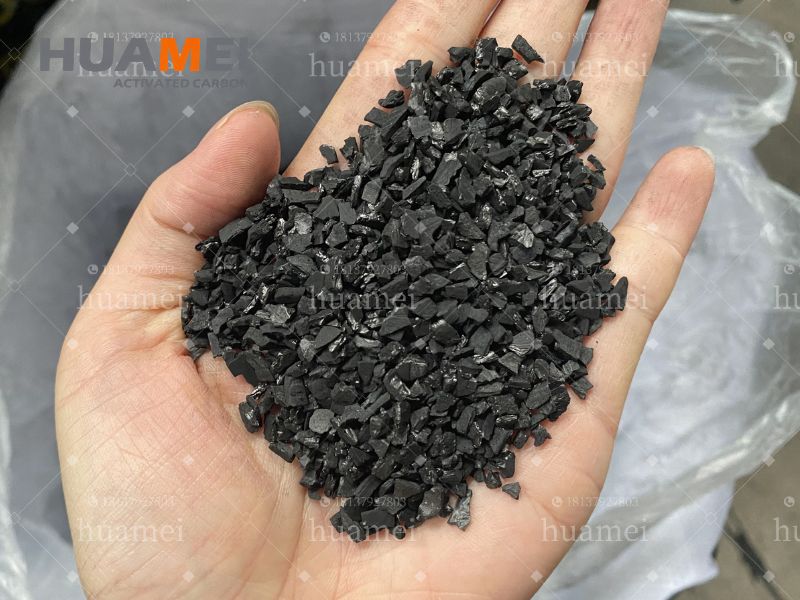
Before committing to a production order, the customer requested free samples — a standard step that Huamei supports for every gold mining inquiry. Here is how the evaluation process worked:
1. Sample shipment: Huamei shipped representative HMGOLD PLUS™ samples (6×12 mesh) with a batch-specific Certificate of Analysis (COA) showing all tested parameters: iodine number, hardness, ash content, moisture, mesh distribution, and apparent density.
2. Customer-side laboratory testing: The mine's metallurgical team ran their own verification tests, comparing the COA data against their independent results. This step confirms that the supplier's reported data matches reality — a critical trust-building step, especially when switching suppliers.
3. Circuit compatibility assessment: Beyond lab specs, the team evaluated whether the carbon's physical properties (density, mesh distribution, hardness) were compatible with their existing CIL circuit infrastructure — screen apertures, carbon transfer pumps, elution columns, and reactivation kiln settings.
4. Decision to proceed: The sample results confirmed that HMGOLD PLUS™ met the customer's acceptance criteria across all parameters. The particularly low ash content (2.52%) and tight particle size distribution were the deciding factors.
After sample approval, the customer placed a 96.8-tonne initial order — four 40-foot containers, all packed in 550 kg bulk bags.
| Item | Details |
|---|---|
| Order quantity | 96.8 tonnes |
| Containers | 4 × 40ft FCL |
| Packaging | 550 kg bulk bags |
| Loading per container | ~24.2 tonnes (~44 bags) |
| Product | HMGOLD PLUS™ coconut
shell activated carbon, 6×12 mesh |
| Documentation | Batch-specific COA per container,
commercial invoice, packing list, certificate of origin |
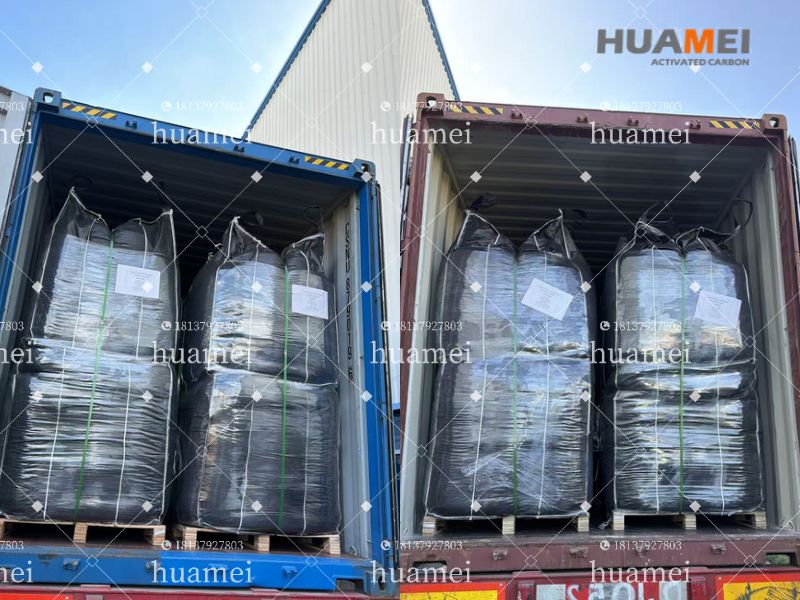
The customer specified 550 kg bulk bags rather than 25 kg bags for operational reasons:
The real test of any gold recovery carbon is not what the lab report says — it is what happens when the carbon goes into the leach tanks and runs through multiple adsorption-elution-reactivation cycles under actual operating conditions.
After loading HMGOLD PLUS™ into their CIL circuit, the customer's metallurgical team monitored performance across several key indicators over multiple operating cycles:
| Indicator | What Was Monitored | Why It Matters |
|---|---|---|
| Gold loading (K value) | Gold concentration on loaded
carbon (g Au/t carbon) at steady state |
Directly determines how much gold is
recovered per tonne of carbon in circuit — the core economic metric |
| Adsorption kinetics (R value) | Rate of gold uptake from leach
solution during the initial contact period |
In CIL, carbon must adsorb gold quickly
because it competes with ongoing leaching — slow kinetics means gold stays in solution longer and can be lost to tails |
| Screening efficiency | Carbon retention on
inter-stage screens, frequency of screen blinding events |
Uniform particle size means fewer fines
passing screens (less gold loss) and less screen maintenance downtime |
| Attrition per cycle | Carbon mass loss
through each adsorption-elution -reactivation cycle |
Lower attrition = less make-up carbon needed
per year = lower long-term operating cost |
| Reactivation response | Recovery of adsorption
activity after thermal reactivation in kiln |
Low-ash carbon reactivates more completely
because fewer mineral deposits block micropores — the carbon "bounces back" better each cycle |
| Platelet generation | Formation of flat, disc-shaped
carbon fragments during use |
Platelets blind screens, cause carbon carryover
to tails, and reduce effective carbon inventory |
The result that drove the repeat order: After running HMGOLD PLUS™ through multiple full cycles, the customer confirmed that the carbon maintained consistent performance — gold loading capacity held up through reactivation, attrition rates were within acceptable limits, and the particle size distribution remained uniform enough that screening operations normalized. The problems they had experienced with the previous supplier — excessive fines, declining activity after reactivation, high make-up carbon consumption — were resolved.
Gold recovery carbon purchasing decisions that focus exclusively on the per-ton price miss the majority of the actual cost. Carbon in a CIL circuit is not a consumable that gets used once — it cycles through adsorption, elution, and reactivation repeatedly. The total cost of ownership depends on how the carbon performs over its entire service life.
| Cost Factor | How It Connects to Carbon Quality |
|---|---|
| Initial purchase price | The only number most
procurement teams compare — but typically represents only 30– 40% of the total carbon-related operating cost |
| Make-up carbon (annual top-up) | CIL circuits typically need 20–50 tonnes
of new carbon per year to replace losses from attrition, screening, and elution. Higher attrition rate = more make-up carbon = higher annual spend |
| Gold lost to carbon fines | When carbon breaks into fines that pass through screens,
the gold adsorbed on those fines reports to tailings — permanently lost. At current gold prices, even small increases in carbon fines translate to significant revenue loss |
| Reactivation fuel and kiln wear | High-ash carbon may require
higher reactivation temperatures or longer kiln residence time, increasing fuel consumption and kiln refractory wear |
| Screen maintenance | Inconsistent particle size and platelet formation cause screen
blinding, requiring more frequent cleaning or replacement |
| Reactivation efficiency loss | Carbon that loses activity faster
through reactivation cycles needs to be replaced sooner — shortening the effective service life of each tonne purchased |
Rule of Thumb: A carbon that costs 10% more per tonne but lasts 20% more reactivation cycles with 30% lower attrition is significantly cheaper over a 12-month operating period. The customer in this case study understood this — the repeat order confirmed that HMGOLD PLUS™ delivered lower total cost of ownership despite whatever the per-ton price comparison showed.
After running the initial 96.8-tonne supply through their CIL circuit and verifying performance across multiple reactivation cycles, the customer placed a second order: 48.4 tonnes in two 40-foot containers.
| Order | Quantity | Containers | Packaging |
|---|---|---|---|
| First order | 96.8 tonnes | 4 × 40ft | 550 kg bulk bags |
| Repeat order | 48.4 tonnes | 2 × 40ft | 550 kg bulk bags |
| Total | 145.2 tonnes | 6 × 40ft | — |
A repeat order in gold mining carbon supply is the strongest form of product validation. It means the carbon passed every test that matters — lab verification, circuit performance, reactivation durability, screening behavior, and total cost analysis. No amount of marketing material achieves what a repeat purchase order confirms.
One risk when scaling from a trial order to ongoing supply is batch-to-batch variation. A supplier might deliver excellent carbon on the first shipment and inconsistent quality on subsequent orders — different raw material sources, varying activation conditions, or production line changes can all introduce variation.
Huamei addresses this through:
Ethiopia's Ministry of Mines reported total gold production of approximately 44.1 tonnes in the 2025/26 fiscal year (roughly 40.9 tonnes from artisanal miners and 3.2 tonnes from licensed mining companies). The country's industrial gold sector is centered on MIDROC Gold Mine PLC, which operates CIL/CIP processing at the Lega Dembi and Sakaro extraction sites in the Guji Zone, Oromia Region, southern Ethiopia.
Ethiopia's gold mining sector is expanding. New projects backed by $500+ million investment are in development, and the government is actively encouraging foreign investment in mineral extraction. For activated carbon suppliers, this means growing demand for high-quality gold recovery carbon — particularly coconut shell grades suitable for CIL and CIP circuits.
Key factors for supplying activated carbon to Ethiopian gold mines:
📱 WhatsApp: +86 181-3792-7803 · 📧 sale@huameicarbon.com · 🌐 huameicarbon.com
Ethiopian CIL operations typically require coconut shell activated carbon with 6×12 mesh size, iodine number ≥1,050 mg/g (ASTM D4607), ball-pan hardness ≥97% (ASTM D3802), ash content ≤3% (ASTM D2866), and moisture ≤5%. Beyond these baseline specs, evaluate K value (gold loading capacity), R value (adsorption kinetics), and attrition resistance using your specific ore and leach solution.
Ash content directly affects how well activated carbon maintains its adsorption performance through reactivation cycles. Mineral ash deposits accumulate in micropores during thermal reactivation, progressively blocking the sites where gold adsorption occurs. Carbon with 2.5% ash will maintain gold loading capacity through significantly more reactivation cycles than carbon with 5% ash — reducing make-up carbon consumption and lowering total operating costs.
Activated carbon is typically shipped in 20ft or 40ft containers from Chinese ports (Xiamen, Shanghai) to Djibouti, Ethiopia's primary import gateway. Ocean freight takes approximately 20–30 days (est.). From Djibouti, overland transport to Ethiopian mine sites follows established logistics corridors. Huamei provides full export documentation including batch-specific COA, commercial invoice, packing list, and certificate of origin.
MOQ is 10 tonnes (one 20ft container). For gold mining operations evaluating a new supplier, we recommend starting with one container alongside free samples for laboratory testing. The customer in this case study started with 96.8 tonnes (4 × 40ft containers) because their sample evaluation was thorough enough to justify a full initial inventory load.
Every HMGOLD PLUS™ shipment includes a batch-specific Certificate of Analysis with independently tested parameters. We maintain consistent coconut shell sourcing, controlled activation conditions, and production capacity of 700+ tonnes per month. Customers can also arrange SGS or other third-party witness testing at the factory before shipment.
